AQA · A-Level · Biology
Course version: 7402 · Version from Sept 2016
Species and taxonomy: Each group is called a taxon (plural taxa).
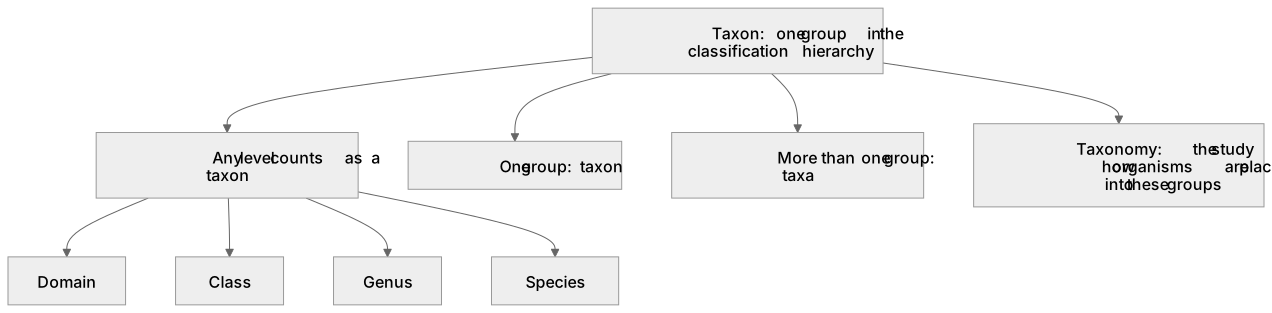
A taxon is any one group within the classification hierarchy, at any level.
Checked against the AQA 7402 specification (opens in a new tab) on .
- Point 6 of 9
- 3 key terms
Study notes
From the checked teaching notes for this specification point.
The idea
A taxon is any one group within the classification hierarchy, at any level. A domain is a taxon, a class is a taxon, and a species is a taxon; the word names the group, not the rank. The plural is taxa, used when more than one group is meant, as in 'six taxa of shade-tolerant plants'. Taxonomy is the study of how organisms are placed into these groups, and a taxonomist uses evidence about ancestry to decide which taxon an organism belongs to. In data questions, a value given for a taxon may be an aggregate or mean for the group, so it need not apply to every species it contains; comparisons should therefore be written between named taxa rather than between individual organisms, for example 'the ferns produce less than the asterids'. Read the plural carefully, since questions often refer to several taxa at once.
What earns the marks
- Define a taxon as a group of organisms at any level of the classification hierarchy.
- Use the correct plural, taxa, when referring to more than one group.
- Name a level of the hierarchy as an example of a taxon, such as domain, genus or species.
- In a data question, write a comparison between named taxa rather than between individual organisms.
- Recognise that a value given for a taxon may be an aggregate or mean for the group and need not apply to every species it contains.
Common mistakes and how to put them right
Believing a taxon is one particular level, usually species, rather than any group in the hierarchy.
Put it right: A taxon can be any rank, from domain down to species.
Writing 'taxa' for a single group, or inventing the plural 'taxons'.
Put it right: One group is a taxon; several groups are taxa.
Confusing taxon with taxonomy, which is the study of classification itself.
Put it right: Taxon is the group; taxonomy is the study of how organisms are classified.
Treating a value given for a taxon in a table as though it applied to a single organism.
Put it right: The value may be an aggregate or mean for the group.
Assuming all the taxa shown in one figure must be at the same level of the hierarchy.
Put it right: Taxa in a figure may sit at different levels.
Exam tips
- When a question says 'six taxa', check the levels shown before you compare them; they are often not all the same rank.
- Use taxon and taxa correctly in written answers, since the specification uses both and examiners expect the vocabulary.
- If a data question is about taxa, keep comparisons at group level: 'the ferns produce less than the asterids', not 'this plant produces less'.
Try the lesson
The start of the Species and taxonomy: Each group is called a taxon (plural taxa). lesson, made from checked teaching notes for this specification point.
Have a go first
In classification, what name is given to each group at any level of the hierarchy?
Listen
A taxon is any one group within the classification hierarchy, at any level. A domain is a taxon, a class is a taxon, and a species is a taxon; the word names the group, not the rank. The plural is taxa, used when more than one group is meant, as in 'six taxa of shade-tolerant plants'. Taxonomy is the study of how organisms are placed into these groups, and a taxonomist uses evidence about ancestry to decide which taxon an organism belongs to. In data questions, a value given for a taxon may be an aggregate or mean for the group, so it need not apply to every species it contains; comparisons should therefore be written between named taxa rather than between individual organisms, for example 'the ferns produce less than the asterids'. Read the plural carefully, since questions often refer to several taxa at once. A strong answer earns marks for these points. Define a taxon as a group of organisms at any level of the classification hierarchy. Use the correct plural, taxa, when referring to more than one group. Name a level of the hierarchy as an example of a taxon, such as domain, genus or species. In a data question, write a comparison between named taxa rather than between individual organisms. A common slip: Believing a taxon is one particular level, usually species, rather than any group in the hierarchy. Instead, a taxon can be any rank, from domain down to species. Exam tip: When a question says 'six taxa', check the levels shown before you compare them; they are often not all the same rank.
See it
Key words
Say what each word means before you turn the card.
taxon
Try answering aloud or in your head before turning the card.
taxa
Try answering aloud or in your head before turning the card.
taxonomy
Try answering aloud or in your head before turning the card.
See every definition
- taxon
- Each group within the classification hierarchy is called this, at any level, and the word names the group, not the rank.
- taxa
- The plural form, used when more than one group is meant, as in 'six taxa of shade-tolerant plants'.
- taxonomy
- The study of how organisms are placed into these groups, with a taxonomist using evidence about ancestry to decide which group an organism belongs to.
Label the diagram
Some boxes have lost their names. Pick the right name for each number.
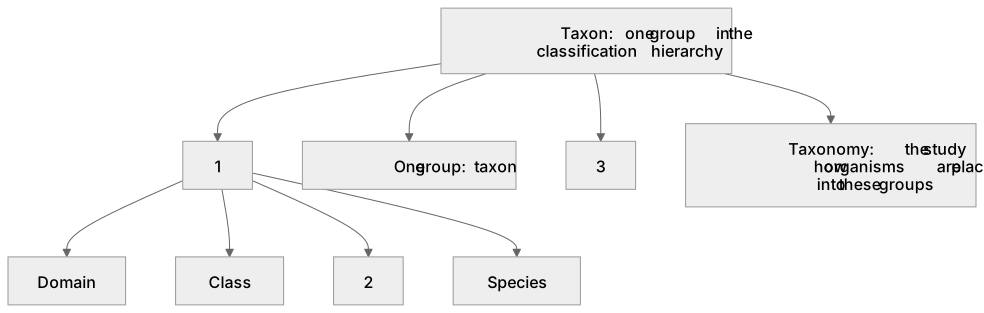
1Box 1
2Box 2
3Box 3
There is more to this lesson
The full lesson goes on to check your understanding and help you earn the marks. Create a free account to carry on, with your progress saved.
A week of Premium from your first lesson · Then the free plan continues · No card, no charge
Test your understanding of Species and taxonomy: Each group is called a taxon (plural taxa).
Active recall beats re-reading. Take an instant quiz now to test what you’ve learned and lock it into long-term memory.
A week of Premium from your first lesson · Then the free plan continues · No card, no charge