AQA · A-Level · Biology
Course version: 7402 · Version from Sept 2016
It uses a hierarchy in which smaller groups are placed within larger…
Full specification wording
Species and taxonomy: It uses a hierarchy in which smaller groups are placed within larger groups, with no overlap between groups.
A hierarchy is a set of groups nested inside larger groups, like boxes within boxes.
Checked against the AQA 7402 specification (opens in a new tab) on .
- Point 5 of 9
- 4 key terms
Study notes
From the checked teaching notes for this specification point.
The idea
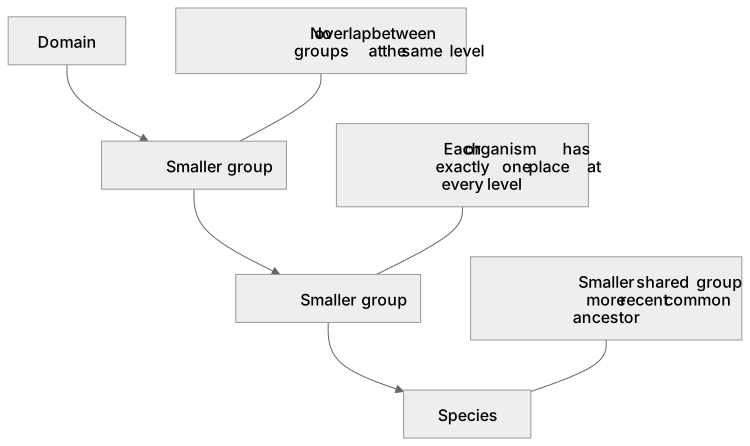
A hierarchy is a set of groups nested inside larger groups, like boxes within boxes. In classification the largest group is the domain, and each level below it divides its members into smaller, more closely related groups until the smallest group, the species, is reached. Two rules follow. First, every member of a small group is also a member of every larger group containing it, so one species belongs to one genus, one family, one order and so on all the way up. Second, there is no overlap: a species cannot sit in two genera, and a genus cannot be shared between two families, so at every level an organism has exactly one place. Because the system is phylogenetic, the nesting mirrors evolutionary branching, and organisms sharing a small group also share a recent common ancestor.
What earns the marks
- Describe a hierarchy as smaller groups contained within larger groups.
- State that there is no overlap between groups at the same level.
- Explain that each organism belongs to exactly one group at every level of the hierarchy.
- Link a smaller shared group to a more recent common ancestor and a closer relationship.
Common mistakes and how to put them right
Listing the levels without saying that each level is contained within the one above.
Forgetting the no-overlap rule and suggesting a species could be placed in two different genera.
Inverting the order, so that a domain is described as sitting inside a kingdom.
Saying two organisms in the same class are closely related without noting that sharing a genus would make them more closely related still.
Treating the hierarchy as a ranking of how advanced organisms are rather than as nested groups.
Exam tips
- If a question asks what a hierarchy means, you need both halves: nested groups and no overlap.
- Sketch the levels as nested rectangles in rough work; it stops you inverting the order under pressure.
- Compare relatedness by naming the smallest taxon two organisms share, because that is what fixes how closely related they are.
Try the lesson
The start of the Species and taxonomy: It uses a hierarchy in which smaller groups are placed within larger groups, with no overlap between groups. lesson, made from checked teaching notes for this specification point.
Have a go first
In the hierarchical classification system used by biologists, how are groups arranged?
Listen
A hierarchy is a set of groups nested inside larger groups, like boxes within boxes. In classification the largest group is the domain, and each level below it divides its members into smaller, more closely related groups until the smallest group, the species, is reached. Two rules follow. First, every member of a small group is also a member of every larger group containing it, so one species belongs to one genus, one family, one order and so on all the way up. Second, there is no overlap: a species cannot sit in two genera, and a genus cannot be shared between two families, so at every level an organism has exactly one place. Because the system is phylogenetic, the nesting mirrors evolutionary branching, and organisms sharing a small group also share a recent common ancestor. A strong answer earns marks for these points. Describe a hierarchy as smaller groups contained within larger groups. State that there is no overlap between groups at the same level. Explain that each organism belongs to exactly one group at every level of the hierarchy. Link a smaller shared group to a more recent common ancestor and a closer relationship. Exam tip: If a question asks what a hierarchy means, you need both halves: nested groups and no overlap.
See it
Key words
Say what each word means before you turn the card.
hierarchy
Try answering aloud or in your head before turning the card.
no overlap
Try answering aloud or in your head before turning the card.
levels of classification
Try answering aloud or in your head before turning the card.
relatedness
Try answering aloud or in your head before turning the card.
See every definition
- hierarchy
- A set of groups nested inside larger groups, like boxes within boxes, with no overlap between groups.
- no overlap
- A species cannot sit in two genera, and a genus cannot be shared between two families, so at every level an organism has exactly one place.
- levels of classification
- The largest group is the domain, and each level below it divides its members into smaller, more closely related groups until the smallest group, the species, is reached.
- relatedness
- Organisms sharing a small group also share a recent common ancestor, and sharing a genus would make them more closely related still.
There is more to this lesson
The full lesson goes on to check your understanding and help you earn the marks. Create a free account to carry on, with your progress saved.
A week of Premium from your first lesson · Then the free plan continues · No card, no charge
Test your understanding of Species and taxonomy: It uses a hierarchy in which smaller groups are placed within larger groups, with no overlap between groups.
Active recall beats re-reading. Take an instant quiz now to test what you’ve learned and lock it into long-term memory.
A week of Premium from your first lesson · Then the free plan continues · No card, no charge