AQA · A-Level · Biology
Course version: 7402 · Version from Sept 2016
Two organisms belong to the same species if they are able to produce…
Full specification wording
Species and taxonomy: Two organisms belong to the same species if they are able to produce fertile offspring.
The biological species concept defines a species by reproductive compatibility, not by appearance.
Checked against the AQA 7402 specification (opens in a new tab) on .
- Point 1 of 9
- 4 key terms
Study notes
From the checked teaching notes for this specification point.
The idea
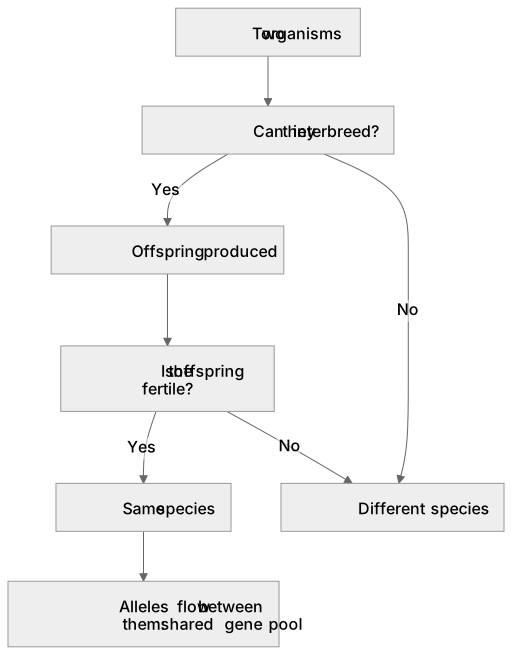
The biological species concept defines a species by reproductive compatibility, not by appearance. Two organisms belong to the same species only if they can interbreed and the offspring are themselves fertile, so that alleles keep flowing between them and they share a single gene pool. A horse and a donkey interbreed and produce a mule, but the mule is sterile because its odd chromosome number prevents homologous chromosomes pairing in meiosis; horse and donkey are therefore separate species. The word fertile is what carries the definition, because offspring that cannot themselves reproduce are an evolutionary dead end and the two parent populations continue to evolve apart.
What earns the marks
- Stating that members of the same species can interbreed to produce fertile offspring, with the word fertile present.
- Using the sterility of a hybrid such as a mule to place its two parents in different species.
- One mark, at the end of a speciation answer, for saying the two populations can no longer interbreed to produce fertile offspring.
- Linking interbreeding to gene flow between populations or to a shared gene pool.
Common mistakes and how to put them right
Writing that the two organisms can produce offspring and leaving out fertile, which is the word the mark scheme requires.
Writing 'no inbreeding' instead of 'no interbreeding', which examiners reject.
Defining a species by how similar the organisms look rather than by whether their offspring are fertile.
Merging reproductive isolation and the species definition into one point in a speciation answer, when isolation belongs at the start of the process and fertile offspring at the end.
Assuming any hybrid shows the parents are one species, when only a fertile hybrid does.
Exam tips
- Write the full phrase 'interbreed to produce fertile offspring' every time; the single word fertile is often the difference between the mark and no mark.
- In a five-mark speciation question, save this definition for your final sentence so it scores as the separate 'now two species' point.
- If a question gives you a hybrid, state whether it is fertile before you decide how many species are involved.
Try the lesson
The start of the Species and taxonomy: Two organisms belong to the same species if they are able to produce fertile offspring. lesson, made from checked teaching notes for this specification point.
Have a go first
According to the biological species concept, two organisms belong to the same species if they are able to produce which of the following?
Listen
The biological species concept defines a species by reproductive compatibility, not by appearance. Two organisms belong to the same species only if they can interbreed and the offspring are themselves fertile, so that alleles keep flowing between them and they share a single gene pool. A horse and a donkey interbreed and produce a mule, but the mule is sterile because its odd chromosome number prevents homologous chromosomes pairing in meiosis; horse and donkey are therefore separate species. The word fertile is what carries the definition, because offspring that cannot themselves reproduce are an evolutionary dead end and the two parent populations continue to evolve apart. A strong answer earns marks for these points. stating that members of the same species can interbreed to produce fertile offspring, with the word fertile present. using the sterility of a hybrid such as a mule to place its two parents in different species. one mark, at the end of a speciation answer, for saying the two populations can no longer interbreed to produce fertile offspring. linking interbreeding to gene flow between populations or to a shared gene pool. Exam tip: Write the full phrase 'interbreed to produce fertile offspring' every time; the single word fertile is often the difference between the mark and no mark.
See it
Key words
Say what each word means before you turn the card.
biological species concept
Try answering aloud or in your head before turning the card.
fertile offspring
Try answering aloud or in your head before turning the card.
interbreeding
Try answering aloud or in your head before turning the card.
gene pool
Try answering aloud or in your head before turning the card.
See every definition
- biological species concept
- Defines a species by reproductive compatibility, not by appearance, so that organisms belong together only if they can interbreed and the offspring are themselves fertile.
- fertile offspring
- Offspring that can themselves reproduce, so that alleles keep flowing between the parent populations and they share a single gene pool.
- interbreeding
- Members of the same species can do this to produce fertile offspring, keeping alleles flowing between them and giving them a shared gene pool.
- gene pool
- A single shared set of alleles, which organisms share when they can interbreed and their offspring are fertile.
Label the diagram
Some boxes have lost their names. Pick the right name for each number.
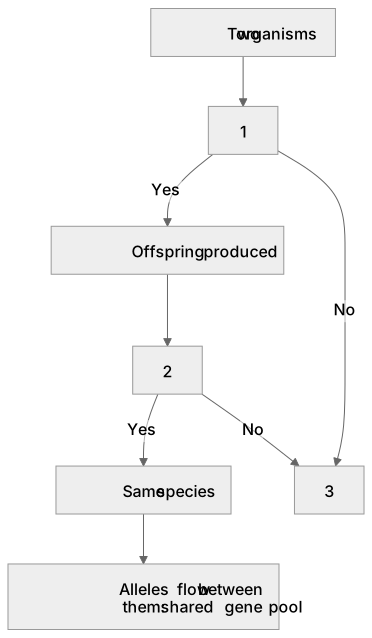
1Box 1
2Box 2
3Box 3
There is more to this lesson
The full lesson goes on to check your understanding and help you earn the marks. Create a free account to carry on, with your progress saved.
A week of Premium from your first lesson · Then the free plan continues · No card, no charge
Test your understanding of Species and taxonomy: Two organisms belong to the same species if they are able to produce fertile offspring.
Active recall beats re-reading. Take an instant quiz now to test what you’ve learned and lock it into long-term memory.
A week of Premium from your first lesson · Then the free plan continues · No card, no charge