AQA · A-Level · Biology
Course version: 7402 · Version from Sept 2016
Courtship behaviour as a necessary precursor to successful mating.
Full specification wording
Species and taxonomy: Courtship behaviour as a necessary precursor to successful mating.
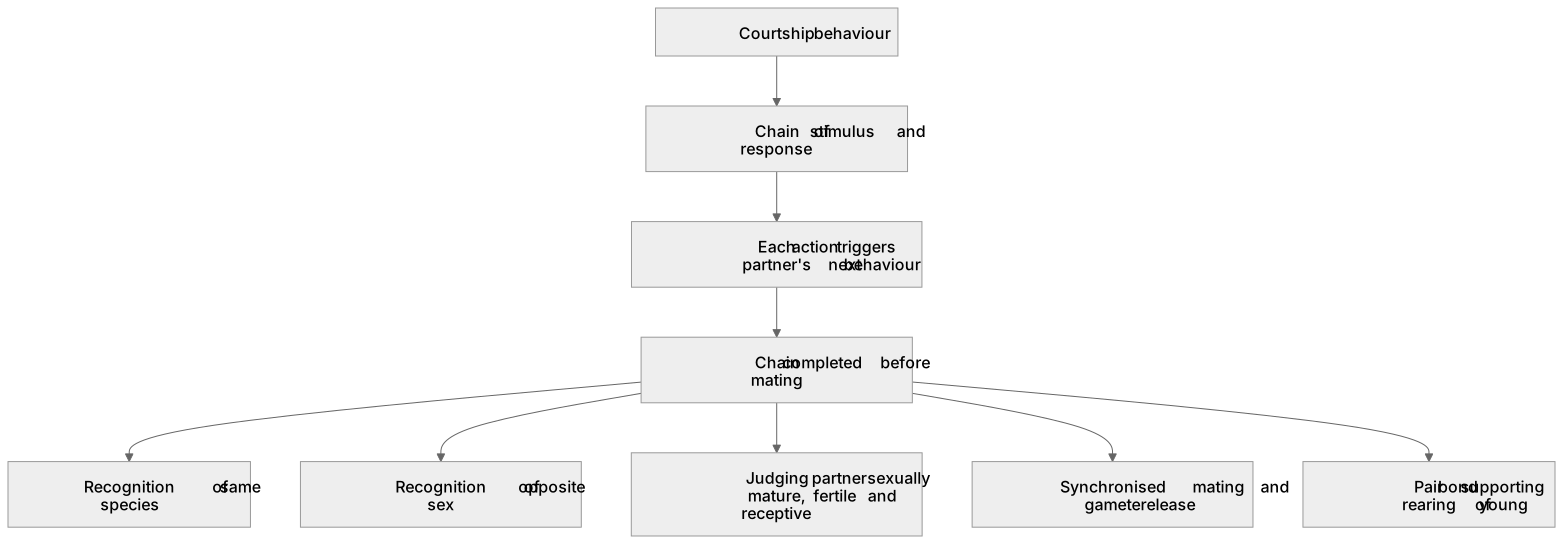
Courtship is a sequence of behaviours performed before mating, and each action by one animal is the stimulus for the next response by its partner, so the pair works through a chain of stimulus and…
Checked against the AQA 7402 specification (opens in a new tab) on .
- Point 2 of 9
- 4 key terms
Study notes
From the checked teaching notes for this specification point.
The idea
Courtship is a sequence of behaviours performed before mating, and each action by one animal is the stimulus for the next response by its partner, so the pair works through a chain of stimulus and response. The chain has to be completed before mating takes place, which is what makes it a necessary precursor. It does several jobs at once. It allows an animal to recognise a member of its own species, so that gametes are not wasted on a mating which could not produce fertile offspring. It allows an individual to recognise the opposite sex, and to judge whether a partner is sexually mature, fertile and receptive, because an animal that does not give the correct response is not ready to breed. It synchronises mating so that sperm and egg are released at the same time, raising the probability of fertilisation, and in many species the display itself triggers ovulation or sperm release.
What earns the marks
- Describing courtship as a chain of stimulus and response in which each action triggers the partner's next behaviour.
- Recognition of a member of the same species, so that mating can produce fertile offspring.
- Identifying a mate that is sexually mature, fertile or receptive.
- Synchronising mating or triggering the release of gametes so that fertilisation is more likely.
- Forming a pair bond that supports the rearing of the young.
Common mistakes and how to put them right
Describing what the animal does, such as dancing or singing, without saying what the behaviour achieves.
Writing that courtship 'attracts a mate' and stopping there, which does not name a benefit the mark scheme lists.
Claiming courtship guarantees fertilisation rather than raising its probability.
Giving the same benefit twice in different words, such as species recognition and avoiding the wrong species.
Writing about the survival of the individual when the marks are for reproduction and offspring.
Exam tips
- Turn every behaviour you describe into a consequence, using the words 'so that' to force the benefit out.
- Treat courtship as a self-contained paragraph you can deploy in any essay on reproduction or on interactions between organisms, rather than relying on a published topic list.
- Two- and three-mark courtship questions want separate benefits, not one benefit explained three ways; count distinct ideas before you write.
Try the lesson
The start of the Species and taxonomy: Courtship behaviour as a necessary precursor to successful mating. lesson, made from checked teaching notes for this specification point.
Have a go first
What is the main role of courtship behaviour before mating?
Listen
Courtship is a sequence of behaviours performed before mating, and each action by one animal is the stimulus for the next response by its partner, so the pair works through a chain of stimulus and response. The chain has to be completed before mating takes place, which is what makes it a necessary precursor. It does several jobs at once. It allows an animal to recognise a member of its own species, so that gametes are not wasted on a mating which could not produce fertile offspring. It allows an individual to recognise the opposite sex, and to judge whether a partner is sexually mature, fertile and receptive, because an animal that does not give the correct response is not ready to breed. It synchronises mating so that sperm and egg are released at the same time, raising the probability of fertilisation, and in many species the display itself triggers ovulation or sperm release. A strong answer earns marks for these points. describing courtship as a chain of stimulus and response in which each action triggers the partner's next behaviour. recognition of a member of the same species, so that mating can produce fertile offspring. identifying a mate that is sexually mature, fertile or receptive. synchronising mating or triggering the release of gametes so that fertilisation is more likely. Exam tip: Turn every behaviour you describe into a consequence, using the words 'so that' to force the benefit out.
See it
Key words
Say what each word means before you turn the card.
stimulus response chain
Try answering aloud or in your head before turning the card.
species recognition
Try answering aloud or in your head before turning the card.
synchronising mating
Try answering aloud or in your head before turning the card.
pair bond
Try answering aloud or in your head before turning the card.
See every definition
- stimulus response chain
- A sequence in which each action by one animal is the stimulus for the next response by its partner, worked through before mating takes place.
- species recognition
- Allows an animal to recognise a member of its own species, so that gametes are not wasted on a mating which could not produce fertile offspring.
- synchronising mating
- Sperm and egg are released at the same time, raising the probability of fertilisation, and the display itself may trigger ovulation or sperm release.
- pair bond
- Formed by courtship and supports the rearing of the young.
Label the diagram
Some boxes have lost their names. Pick the right name for each number.
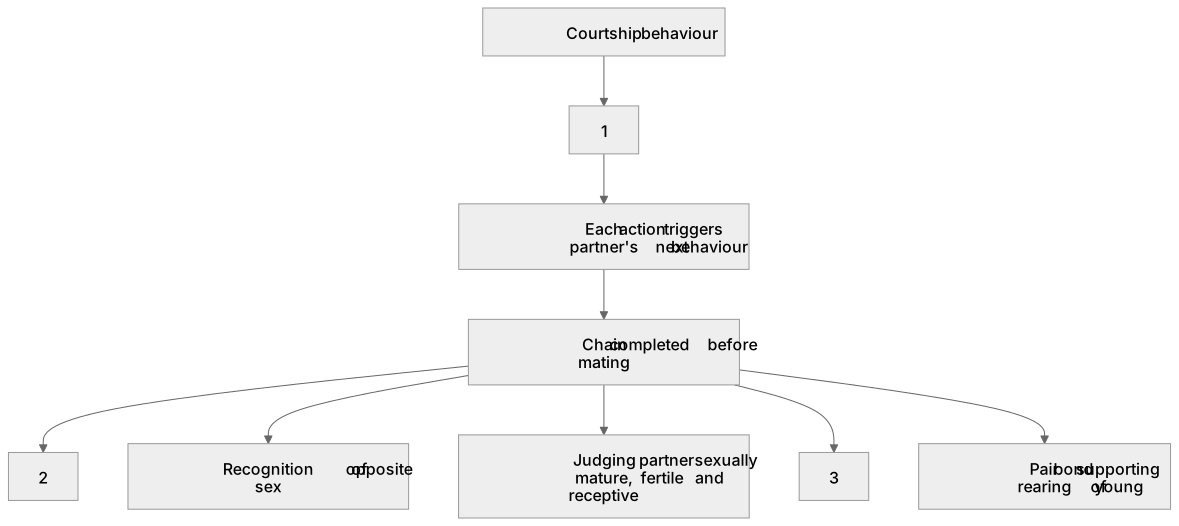
1Box 1
2Box 2
3Box 3
There is more to this lesson
The full lesson goes on to check your understanding and help you earn the marks. Create a free account to carry on, with your progress saved.
A week of Premium from your first lesson · Then the free plan continues · No card, no charge
Test your understanding of Species and taxonomy: Courtship behaviour as a necessary precursor to successful mating.
Active recall beats re-reading. Take an instant quiz now to test what you’ve learned and lock it into long-term memory.
A week of Premium from your first lesson · Then the free plan continues · No card, no charge