AQA · A-Level · Biology
Course version: 7402 · Version from Sept 2016
Structure of DNA and RNA: Ribosomes are formed from RNA and proteins.
A ribosome is a non-membrane-bound structure built from ribosomal RNA (rRNA) and protein, assembled into a large and a small subunit. rRNA is transcribed at the nucleolus and combined with…
Checked against the AQA 7402 specification (opens in a new tab) on .
- Point 3 of 7
- 4 key terms
Study notes
From the checked teaching notes for this specification point.
The idea
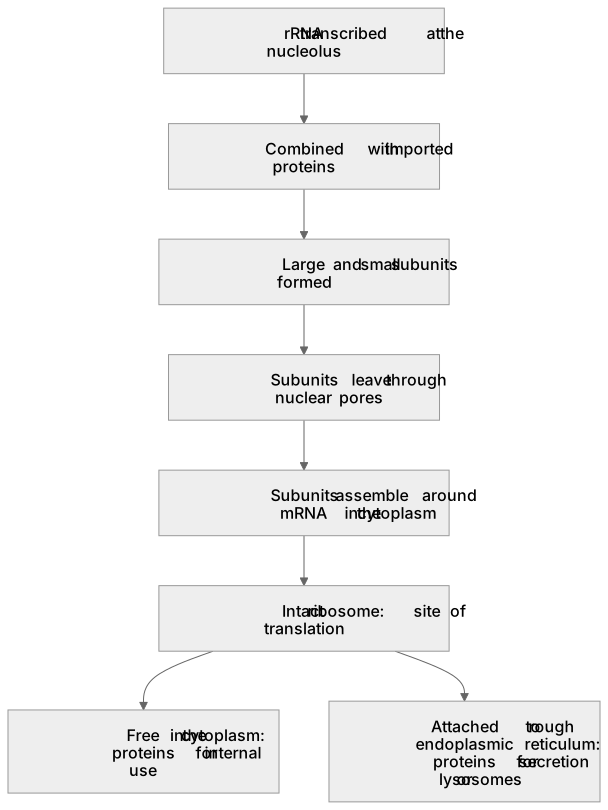
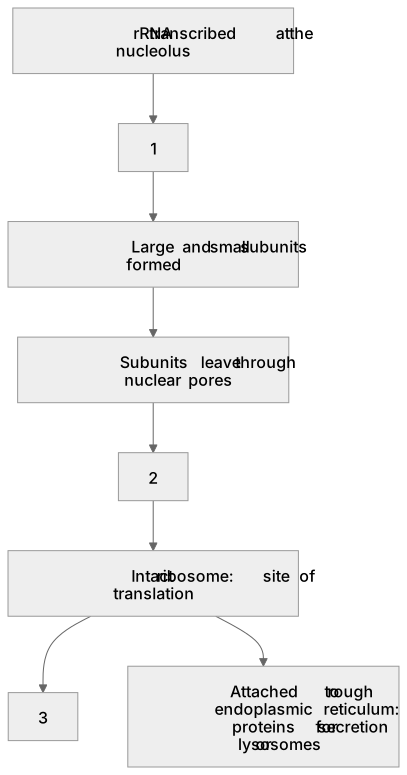
A ribosome is a non-membrane-bound structure built from ribosomal RNA (rRNA) and protein, assembled into a large and a small subunit. rRNA is transcribed at the nucleolus and combined with imported proteins to form subunits; these subunits then leave through nuclear pores and assemble around mRNA in the cytoplasm during translation. Eukaryotic ribosomes are 80S, larger than the 70S ribosomes of prokaryotes and chloroplasts. Mammalian mitochondria contain ~55S ribosomes. Many antibiotics target bacterial 70S ribosomes, which is selectively toxic because human cytosolic ribosomes are 80S. Ribosomes occur free in the cytoplasm, making proteins for internal use, and attached to rough endoplasmic reticulum, making proteins for secretion or lysosomes.
What earns the marks
- A ribosome consists of ribosomal RNA and protein, arranged in a large and a small subunit.
- Ribosomal subunits are assembled at the nucleolus, then combine around mRNA in the cytoplasm to form the intact ribosome.
- Ribosomes have no membrane, unlike most other organelles.
- Eukaryotic cells contain 80S ribosomes, which are larger than the 70S ribosomes found in prokaryotes and chloroplasts.
- The ribosome is the site of translation, located either free in the cytoplasm or attached to the rough endoplasmic reticulum.
- Antibiotics targeting 70S ribosomes are selectively toxic because human cytosolic ribosomes are 80S.
Common mistakes and how to put them right
Drawing or describing a ribosome as a membrane-bound organelle.
Put it right: State that ribosomes lack a membrane and are not enclosed by one.
Saying a ribosome is made of DNA, or of protein alone.
Put it right: State that it is made of ribosomal RNA and protein.
Confusing the nucleolus, which makes ribosomal subunits, with a ribosome itself.
Put it right: Distinguish the nucleolus as the site of subunit assembly from the intact ribosome assembled in the cytoplasm.
Stating that all ribosomes in a eukaryotic cell are 80S.
Put it right: Chloroplasts contain 70S ribosomes, and mammalian mitochondria contain ~55S ribosomes, distinct from the 80S ribosomes in the cytosol.
Exam tips
- If a question asks for evidence that a cell is eukaryotic, 'larger ribosomes' or '80S ribosomes' is creditworthy, but 'ribosomes' alone is not, because all cells have them.
- Write rough endoplasmic reticulum in full at least once in any answer where it earns a mark.
- Link free and bound ribosomes to the destination of the protein, not just to their position.
Try the lesson
The start of the Structure of DNA and RNA: Ribosomes are formed from RNA and proteins. lesson, made from checked teaching notes for this specification point.
Have a go first
Which two types of molecule are the main structural components of a ribosome?
Listen
A ribosome is a non-membrane-bound structure built from ribosomal RNA (rRNA) and protein, assembled into a large and a small subunit. rRNA is transcribed at the nucleolus and combined with imported proteins to form subunits; these subunits then leave through nuclear pores and assemble around mRNA in the cytoplasm during translation. Eukaryotic ribosomes are 80S, larger than the 70S ribosomes of prokaryotes and chloroplasts. Mammalian mitochondria contain ~55S ribosomes. Many antibiotics target bacterial 70S ribosomes, which is selectively toxic because human cytosolic ribosomes are 80S. Ribosomes occur free in the cytoplasm, making proteins for internal use, and attached to rough endoplasmic reticulum, making proteins for secretion or lysosomes. A strong answer earns marks for these points. A ribosome consists of ribosomal RNA and protein, arranged in a large and a small subunit. Ribosomal subunits are assembled at the nucleolus, then combine around mRNA in the cytoplasm to form the intact ribosome. Ribosomes have no membrane, unlike most other organelles. Eukaryotic cells contain 80S ribosomes, which are larger than the 70S ribosomes found in prokaryotes and chloroplasts. A common slip: Drawing or describing a ribosome as a membrane-bound organelle. Instead, state that ribosomes lack a membrane and are not enclosed by one. Exam tip: If a question asks for evidence that a cell is eukaryotic, 'larger ribosomes' or '80S ribosomes' is creditworthy, but 'ribosomes' alone is not, because all cells have them.
See it
Key words
Say what each word means before you turn the card.
ribosomal RNA
Try answering aloud or in your head before turning the card.
nucleolus
Try answering aloud or in your head before turning the card.
80S and 70S
Try answering aloud or in your head before turning the card.
rough endoplasmic reticulum
Try answering aloud or in your head before turning the card.
See every definition
- ribosomal RNA
- RNA that, together with protein, makes up a ribosome, which is a non-membrane-bound structure.
- nucleolus
- The part of the nucleus where ribosomal RNA is transcribed and combined with imported proteins to form subunits.
- 80S and 70S
- Eukaryotic ribosomes are 80S, larger than the 70S ribosomes of prokaryotes and chloroplasts.
- rough endoplasmic reticulum
- The structure to which ribosomes attach to make proteins for secretion or lysosomes.
Label the diagram
Some boxes have lost their names. Pick the right name for each number.
1Box 1
2Box 2
3Box 3
There is more to this lesson
The full lesson goes on to check your understanding and help you earn the marks. Create a free account to carry on, with your progress saved.
A week of Premium from your first lesson · Then the free plan continues · No card, no charge
Test your understanding of Structure of DNA and RNA: Ribosomes are formed from RNA and proteins.
Active recall beats re-reading. Take an instant quiz now to test what you’ve learned and lock it into long-term memory.
A week of Premium from your first lesson · Then the free plan continues · No card, no charge