AQA · A-Level · Biology
Course version: 7402 · Version from Sept 2016
Specialised cells are organised into tissues, tissues into organs and…
Full specification wording
Structure of eukaryotic cells: Specialised cells are organised into tissues, tissues into organs and organs into systems.
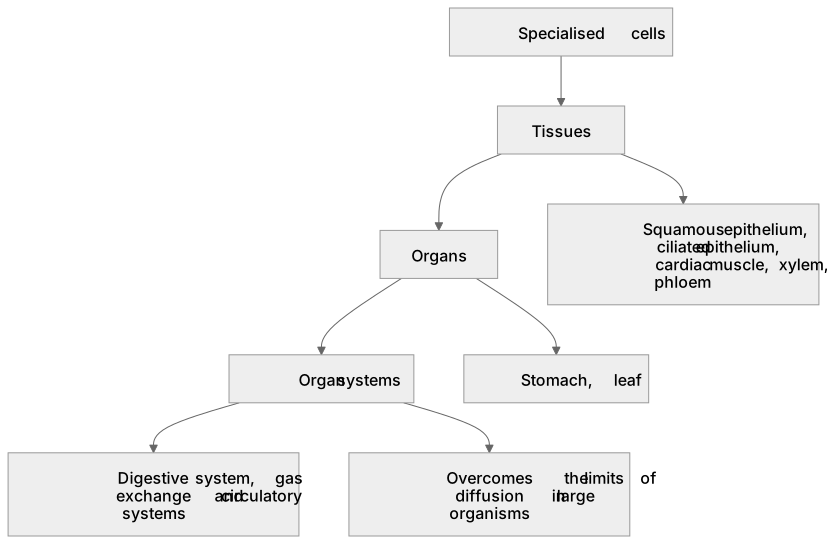
A tissue is a group of similar cells working together to carry out one function: squamous epithelium lining the alveoli, ciliated epithelium lining the trachea, cardiac muscle in the heart wall,…
Checked against the AQA 7402 specification (opens in a new tab) on .
- Point 3 of 4
- 3 key terms
Study notes
From the checked teaching notes for this specification point.
The idea
A tissue is a group of similar cells working together to carry out one function: squamous epithelium lining the alveoli, ciliated epithelium lining the trachea, cardiac muscle in the heart wall, xylem and phloem in a plant. An organ is made of several different tissues working together to perform an overall function; the stomach combines glandular epithelium that secretes enzymes, smooth muscle that churns, connective tissue and blood vessels, and a leaf combines palisade mesophyll, spongy mesophyll, epidermis and vascular tissue. An organ system is a set of organs working together, such as the digestive system of mouth, oesophagus, stomach, ileum, pancreas and liver, or the gas exchange and circulatory systems. This hierarchy allows large organisms to overcome the limits of diffusion, since a small surface area to volume ratio means diffusion alone cannot supply all cells.
What earns the marks
- Award credit for defining a tissue as a group of similar or specialised cells with a shared function.
- Award credit for defining an organ as different tissues working together to perform a particular function.
- Award credit for defining an organ system as a group of organs working together.
- Award credit for a correct worked example running through all the levels, such as epithelial cell, epithelium, ileum, digestive system.
- Award credit for linking the level of organisation to body size and a small surface area to volume ratio, so that diffusion alone is insufficient.
Common mistakes and how to put them right
Calling blood, or xylem, an organ when each is a tissue.
Defining a tissue as 'lots of cells' without saying that they are similar and share a function.
Assigning organs to only one system, for example placing the pancreas in the endocrine system alone when it is also a digestive organ.
Stating that an organ is made of one type of tissue.
Mixing plant and animal examples within the same chain, so the hierarchy no longer holds together.
Exam tips
- Give one worked example at every level in the same answer; examiners credit the chain, not the definitions alone.
- Use plant examples as readily as animal ones, since leaf and root questions are common alongside gut questions.
- If asked why large organisms need organ systems, bring in surface area to volume ratio explicitly.
Try the lesson
The start of the Structure of eukaryotic cells: Specialised cells are organised into tissues, tissues into organs and organs into systems. lesson, made from checked teaching notes for this specification point.
Have a go first
Which level of organisation comes immediately after tissues in the sequence of increasing complexity?
Listen
A tissue is a group of similar cells working together to carry out one function: squamous epithelium lining the alveoli, ciliated epithelium lining the trachea, cardiac muscle in the heart wall, xylem and phloem in a plant. An organ is made of several different tissues working together to perform an overall function; the stomach combines glandular epithelium that secretes enzymes, smooth muscle that churns, connective tissue and blood vessels, and a leaf combines palisade mesophyll, spongy mesophyll, epidermis and vascular tissue. An organ system is a set of organs working together, such as the digestive system of mouth, oesophagus, stomach, ileum, pancreas and liver, or the gas exchange and circulatory systems. This hierarchy allows large organisms to overcome the limits of diffusion, since a small surface area to volume ratio means diffusion alone cannot supply all cells. A strong answer earns marks for these points. Award credit for defining a tissue as a group of similar or specialised cells with a shared function. Award credit for defining an organ as different tissues working together to perform a particular function. Award credit for defining an organ system as a group of organs working together. Award credit for a correct worked example running through all the levels, such as epithelial cell, epithelium, ileum, digestive system. Exam tip: Give one worked example at every level in the same answer; examiners credit the chain, not the definitions alone.
See it
Key words
Say what each word means before you turn the card.
tissue
Try answering aloud or in your head before turning the card.
organ
Try answering aloud or in your head before turning the card.
organ system
Try answering aloud or in your head before turning the card.
See every definition
- tissue
- A group of similar cells working together to carry out one function, such as squamous epithelium lining the alveoli.
- organ
- Made of several different tissues working together to perform an overall function, such as the stomach or a leaf.
- organ system
- A set of organs working together, such as the digestive system or the gas exchange and circulatory systems.
Label the diagram
Some boxes have lost their names. Pick the right name for each number.
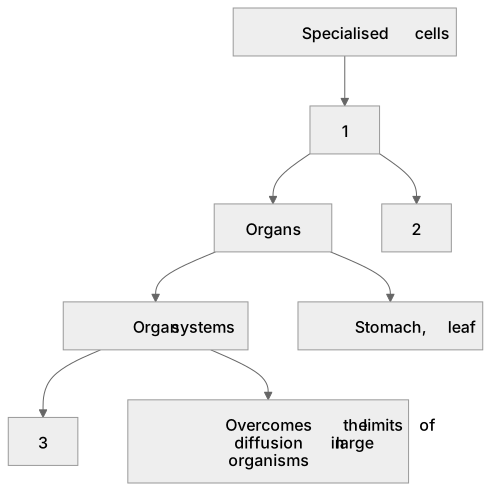
1Box 1
2Box 2
3Box 3
There is more to this lesson
The full lesson goes on to check your understanding and help you earn the marks. Create a free account to carry on, with your progress saved.
A week of Premium from your first lesson · Then the free plan continues · No card, no charge
Test your understanding of Structure of eukaryotic cells: Specialised cells are organised into tissues, tissues into organs and organs into systems.
Active recall beats re-reading. Take an instant quiz now to test what you’ve learned and lock it into long-term memory.
A week of Premium from your first lesson · Then the free plan continues · No card, no charge