AQA · A-Level · Biology
Course version: 7402 · Version from Sept 2016
In complex multicellular organisms, eukaryotic cells become specialised…
Full specification wording
Structure of eukaryotic cells: In complex multicellular organisms, eukaryotic cells become specialised for specific functions.
Most somatic cells in a multicellular organism contain identical genomes.
Checked against the AQA 7402 specification (opens in a new tab) on .
- Point 2 of 4
- 4 key terms
Study notes
From the checked teaching notes for this specification point.
The idea
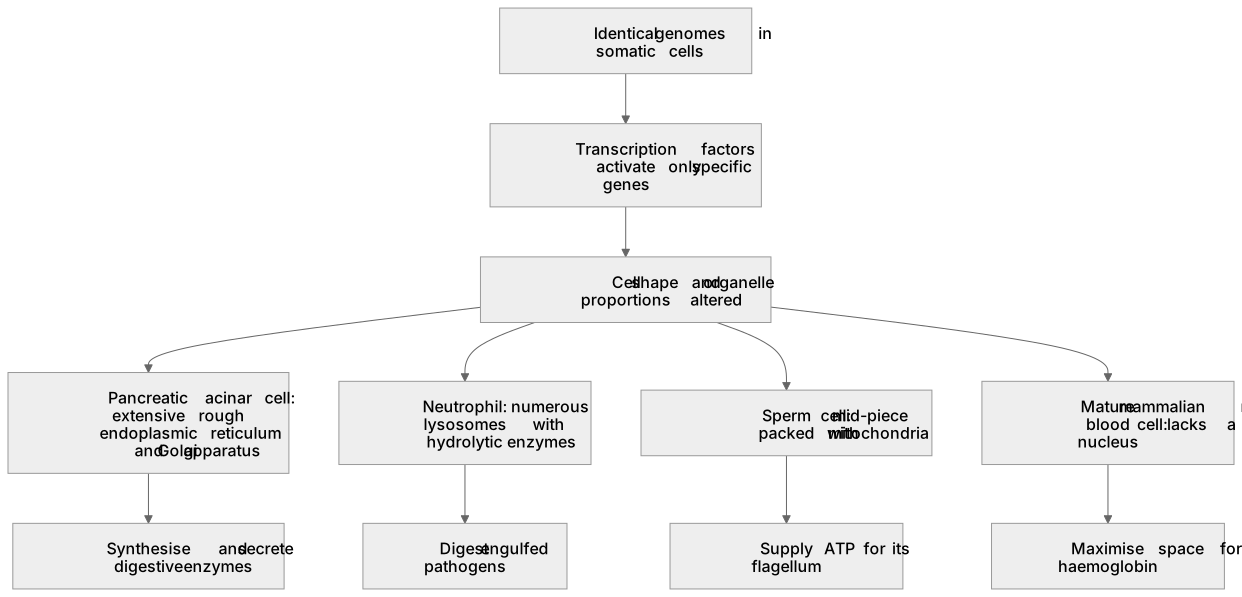
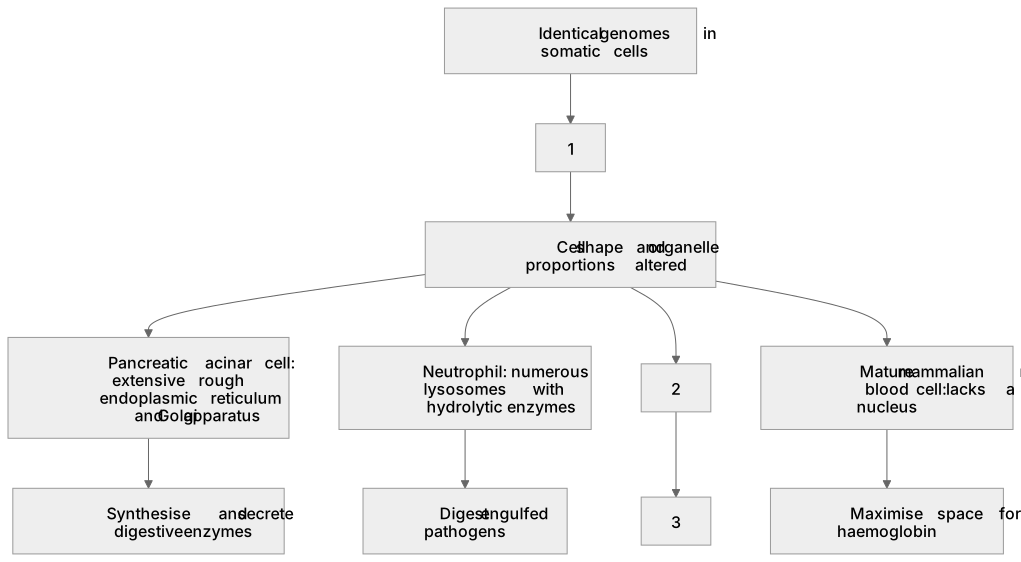
Most somatic cells in a multicellular organism contain identical genomes. Specialisation occurs because transcription factors activate only specific genes, altering the cell's shape and organelle proportions to suit its function. For example, a pancreatic acinar cell contains extensive rough endoplasmic reticulum and Golgi apparatus to synthesise and secrete digestive enzymes. A neutrophil possesses numerous lysosomes with hydrolytic enzymes to digest engulfed pathogens. A sperm cell features a mid-piece packed with mitochondria to supply ATP for its flagellum. Some highly specialised cells even lose their DNA entirely; mature mammalian red blood cells lack a nucleus to maximise space for haemoglobin.
What earns the marks
- Describe how differential gene expression leads to specialisation by altering cell shape and organelle proportions without changing the genome of somatic cells.
- Identify the specific organelle that is abundant or modified in a named specialised cell, such as extensive rough endoplasmic reticulum in pancreatic cells.
- Link the abundance of a specific organelle directly to the cell's function, for example, mitochondria releasing ATP for active transport or movement.
- Explain structural losses as functional adaptations, such as the absence of a nucleus in a mature red blood cell to accommodate more haemoglobin.
Common mistakes and how to put them right
Stating that all cells in a multicellular organism contain identical DNA.
Put it right by noting that mature mammalian red blood cells lack a nucleus and DNA, while gametes are haploid.
Writing that sperm cells or muscle cells 'produce energy'.
Put it right by specifying that their abundant mitochondria release ATP during aerobic respiration.
Claiming a red blood cell 'has no organelles' when asked about a specific missing structure.
Put it right: Explicitly naming the absent structure, such as the nucleus.
Confusing differentiation with mutation.
Put it right by explaining that specialisation usually involves changes in gene expression via transcription factors, not changes to the DNA base sequence.
Exam tips
- When describing cellular adaptations, explicitly link the structural feature to the process it performs and its ultimate function for the cell.
- If presented with an unfamiliar cell in a table or micrograph, identify which organelles are unusually abundant to deduce the cell's primary function.
Try the lesson
The start of the Structure of eukaryotic cells: In complex multicellular organisms, eukaryotic cells become specialised for specific functions. lesson, made from checked teaching notes for this specification point.
Have a go first
What name is given to the process by which eukaryotic cells become adapted for specific functions in a multicellular organism?
Listen
Most somatic cells in a multicellular organism contain identical genomes. Specialisation occurs because transcription factors activate only specific genes, altering the cell's shape and organelle proportions to suit its function. For example, a pancreatic acinar cell contains extensive rough endoplasmic reticulum and Golgi apparatus to synthesise and secrete digestive enzymes. A neutrophil possesses numerous lysosomes with hydrolytic enzymes to digest engulfed pathogens. A sperm cell features a mid-piece packed with mitochondria to supply ATP for its flagellum. Some highly specialised cells even lose their DNA entirely; mature mammalian red blood cells lack a nucleus to maximise space for haemoglobin. A strong answer earns marks for these points. Describe how differential gene expression leads to specialisation by altering cell shape and organelle proportions without changing the genome of somatic cells. Identify the specific organelle that is abundant or modified in a named specialised cell, such as extensive rough endoplasmic reticulum in pancreatic cells. Link the abundance of a specific organelle directly to the cell's function, for example, mitochondria releasing ATP for active transport or movement. Explain structural losses as functional adaptations, such as the absence of a nucleus in a mature red blood cell to accommodate more haemoglobin. A common slip: Stating that all cells in a multicellular organism contain identical DNA. Instead, noting that mature mammalian red blood cells lack a nucleus and DNA, while gametes are haploid. Exam tip: When describing cellular adaptations, explicitly link the structural feature to the process it performs and its ultimate function for the cell.
See it
Key words
Say what each word means before you turn the card.
transcription factors
Try answering aloud or in your head before turning the card.
specialised cells
Try answering aloud or in your head before turning the card.
differentiation
Try answering aloud or in your head before turning the card.
structure and function
Try answering aloud or in your head before turning the card.
See every definition
- transcription factors
- These activate only specific genes, so that eukaryotic cells become specialised for specific functions.
- specialised cells
- Eukaryotic cells in complex multicellular organisms that have become adapted for specific functions, with altered shape and organelle proportions.
- differentiation
- Specialisation that usually involves changes in gene expression via transcription factors, not changes to the DNA base sequence.
- structure and function
- The link between a cell's structural features and organelle proportions and the specific function it performs.
Label the diagram
Some boxes have lost their names. Pick the right name for each number.
1Box 1
2Box 2
3Box 3
There is more to this lesson
The full lesson goes on to check your understanding and help you earn the marks. Create a free account to carry on, with your progress saved.
A week of Premium from your first lesson · Then the free plan continues · No card, no charge
Test your understanding of Structure of eukaryotic cells: In complex multicellular organisms, eukaryotic cells become specialised for specific functions.
Active recall beats re-reading. Take an instant quiz now to test what you’ve learned and lock it into long-term memory.
A week of Premium from your first lesson · Then the free plan continues · No card, no charge