AQA · A-Level · Biology
Course version: 7402 · Version from Sept 2016
The structure of eukaryotic cells, restricted to the structure and…
Full specification wording
Structure of eukaryotic cells: The structure of eukaryotic cells, restricted to the structure and function of: cell-surface membrane nucleus (containing chromosomes, consisting of protein- bound, linear DNA, and one or more nucleoli) mitochondria chloroplasts (in plants and algae) Golgi apparatus and Golgi vesicles lysosomes (a membrane-bound organelle that releases hydrolytic enzymes) ribosomes rough endoplasmic reticulum and smooth endoplasmic reticulum cell wall (in plants, algae and fungi) cell vacuole (in plants).
Eukaryotic cells contain membrane-bound organelles.
Checked against the AQA 7402 specification (opens in a new tab) on .
- Point 1 of 4
- 2 key terms
Study notes
From the checked teaching notes for this specification point.
The idea
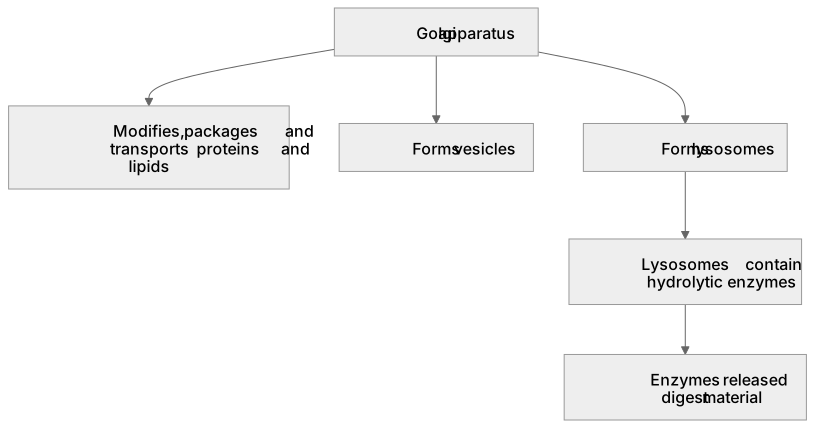
Eukaryotic cells contain membrane-bound organelles. The cell-surface membrane is a phospholipid bilayer controlling exchange. The nucleus has a double-membrane envelope with pores, containing linear DNA bound to histones, and nucleoli. Mitochondria have a folded inner membrane (cristae) and matrix, releasing ATP. Chloroplasts, found in plants and algae, contain thylakoids stacked into grana and stroma for photosynthesis. The Golgi apparatus modifies, packages and transports proteins and lipids, forming vesicles and lysosomes (containing hydrolytic enzymes). Ribosomes synthesise proteins. Rough ER has ribosomes and transports proteins; smooth ER synthesises lipids. Plant, algal and fungal cell walls provide support. Plant cell vacuoles maintain turgor.
What earns the marks
- Identifying a membrane-bound organelle as evidence that a cell is eukaryotic, such as a mitochondrion, nucleus, endoplasmic reticulum, Golgi apparatus, lysosome or vesicle.
- Describing the nucleus as having a double membrane or nuclear envelope with pores, and containing chromosomes of DNA bound to histones plus a nucleolus.
- Stating the Golgi apparatus modifies, packages or transports proteins or lipids, or forms vesicles and lysosomes.
- Identifying that lysosomes contain hydrolytic enzymes that are released to digest material.
- Linking mitochondria to the release of ATP and ribosomes to the production of protein.
- Stating that chloroplasts are found in plants and algae.
Common mistakes and how to put them right
Naming the nucleolus or the cell-surface membrane as evidence that a cell is eukaryotic.
Put it right: Prokaryotes also have a cell-surface membrane, and the nucleolus is a region inside the nucleus rather than a membrane-bound organelle.
Writing 'mitochondria for ATP' without specifying that they release ATP, or stating that they 'produce energy'.
Saying the Golgi apparatus makes proteins, when it modifies, packages and transports them.
Describing ribosomes as membrane-bound structures, whereas they lack a membrane.
Stating that chloroplasts are found in all eukaryotic cells.
Put it right by specifying that they occur in plants and algae.
Exam tips
- Answer structure and function in matched pairs; a list of organelle names without functions rarely provides a complete explanation.
- Read exclusions carefully, as in 'other than the Golgi apparatus, name one structure', because an excluded answer cannot be credited.
- When identifying chloroplasts, state their occurrence in plants and algae to match the specification clause.
Try the lesson
The start of the Structure of eukaryotic cells: The structure of eukaryotic cells, restricted to the structure and function of: cell-surface membrane nucleus (containing chromosomes, consisting of protein- bound, linear DNA, and one or more nucleoli) mitochondria chloroplasts (in plants and algae) Golgi apparatus and Golgi vesicles lysosomes (a membrane-bound organelle that releases hydrolytic enzymes) ribosomes rough endoplasmic reticulum and smooth endoplasmic reticulum cell wall (in plants, algae and fungi) cell vacuole (in plants). lesson, made from checked teaching notes for this specification point.
Have a go first
Which organelle is surrounded by a double membrane and contains the cell's genetic material as linear DNA bound to protein?
Listen
Eukaryotic cells contain membrane-bound organelles. The cell-surface membrane is a phospholipid bilayer controlling exchange. The nucleus has a double-membrane envelope with pores, containing linear DNA bound to histones, and nucleoli. Mitochondria have a folded inner membrane (cristae) and matrix, releasing ATP. Chloroplasts, found in plants and algae, contain thylakoids stacked into grana and stroma for photosynthesis. The Golgi apparatus modifies, packages and transports proteins and lipids, forming vesicles and lysosomes (containing hydrolytic enzymes). Ribosomes synthesise proteins. Rough ER has ribosomes and transports proteins; smooth ER synthesises lipids. Plant, algal and fungal cell walls provide support. Plant cell vacuoles maintain turgor. A strong answer earns marks for these points. identifying a membrane-bound organelle as evidence that a cell is eukaryotic, such as a mitochondrion, nucleus, endoplasmic reticulum, Golgi apparatus, lysosome or vesicle. describing the nucleus as having a double membrane or nuclear envelope with pores, and containing chromosomes of DNA bound to histones plus a nucleolus. stating the Golgi apparatus modifies, packages or transports proteins or lipids, or forms vesicles and lysosomes. identifying that lysosomes contain hydrolytic enzymes that are released to digest material. A common slip: stating that chloroplasts are found in all eukaryotic cells. Instead, specifying that they occur in plants and algae. Exam tip: Answer structure and function in matched pairs; a list of organelle names without functions rarely provides a complete explanation.
See it
Key words
Say what each word means before you turn the card.
lysosomes
Try answering aloud or in your head before turning the card.
Golgi apparatus
Try answering aloud or in your head before turning the card.
See every definition
- lysosomes
- A membrane-bound organelle that releases hydrolytic enzymes.
- Golgi apparatus
- Modifies, packages and transports proteins and lipids, forming vesicles and lysosomes.
Label the diagram
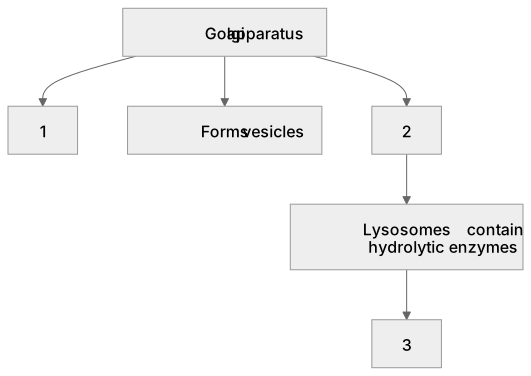
Some boxes have lost their names. Pick the right name for each number.
1Box 1
2Box 2
3Box 3
There is more to this lesson
The full lesson goes on to check your understanding and help you earn the marks. Create a free account to carry on, with your progress saved.
A week of Premium from your first lesson · Then the free plan continues · No card, no charge
Test your understanding of Structure of eukaryotic cells: The structure of eukaryotic cells, restricted to the structure and function of: cell-surface membrane nucleus (containing chromosomes, consisting of protein- bound, linear DNA, and one or more nucleoli) mitochondria chloroplasts (in plants and algae) Golgi apparatus and Golgi vesicles lysosomes (a membrane-bound organelle that releases hydrolytic enzymes) ribosomes rough endoplasmic reticulum and smooth endoplasmic reticulum cell wall (in plants, algae and fungi) cell vacuole (in plants).
Active recall beats re-reading. Take an instant quiz now to test what you’ve learned and lock it into long-term memory.
A week of Premium from your first lesson · Then the free plan continues · No card, no charge