AQA · A-Level · Biology
Course version: 7402 · Version from Sept 2016
Changes to body shape and the development of systems in larger organisms…
Full specification wording
Surface area to volume ratio: Changes to body shape and the development of systems in larger organisms as adaptations that facilitate exchange as this ratio reduces.
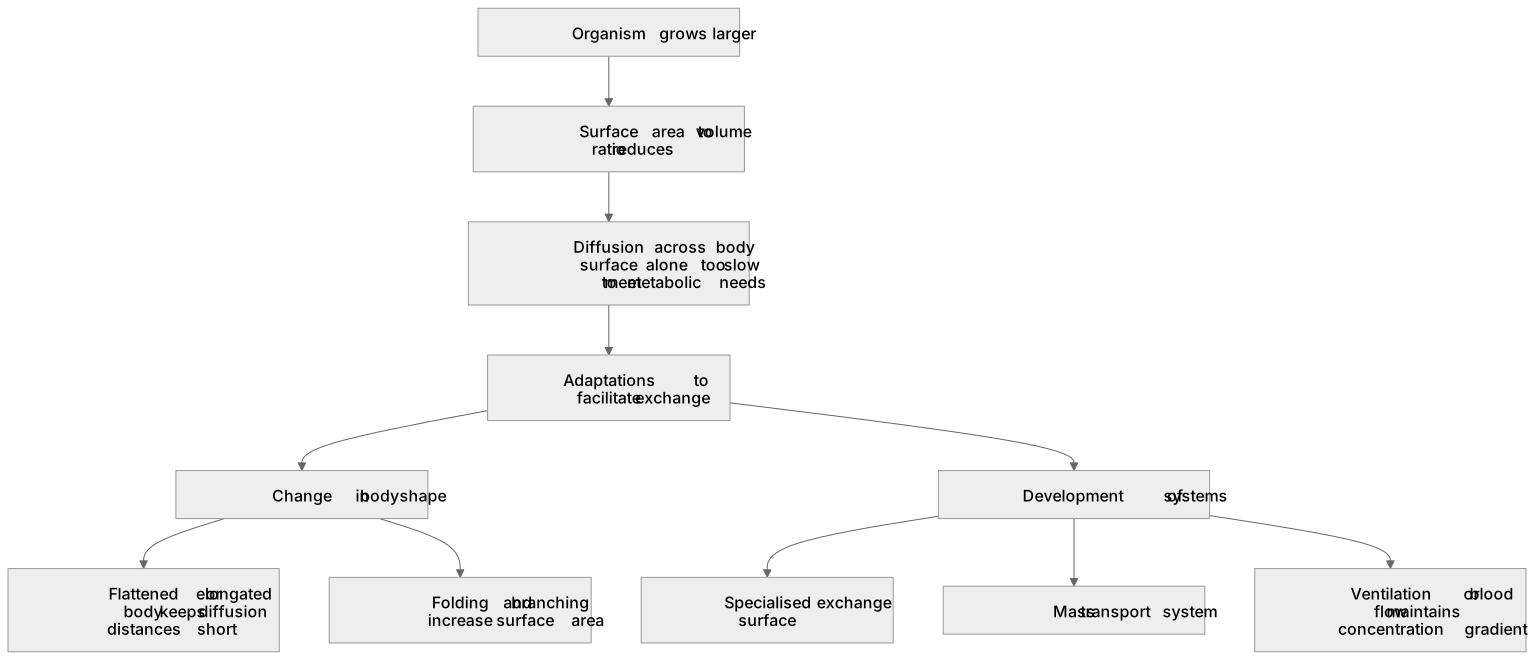
As organisms grow larger, their surface area to volume (SA:V) ratio falls, driving two main adaptations to facilitate exchange.
Checked against the AQA 7402 specification (opens in a new tab) on .
- Point 2 of 3
- 4 key terms
Study notes
From the checked teaching notes for this specification point.
The idea
As organisms grow larger, their surface area to volume (SA:V) ratio falls, driving two main adaptations to facilitate exchange. First, body shape changes: flattened or elongated bodies (like flatworms) keep cells close to the surface, allowing rapid diffusion. Folding and branching in structures like villi or gills increase surface area without significantly raising volume. Second, larger organisms develop specialised exchange surfaces and mass transport systems. Shape also adapts to climate for heat exchange: mammals in cold regions are compact with short extremities to conserve heat, while those in hot regions have large, thin extremities to increase heat loss.
What earns the marks
- State that a larger organism has a smaller surface area to volume ratio, meaning diffusion across the body surface alone is too slow to meet metabolic needs.
- Describe a change in shape that keeps diffusion distances short, such as a flattened body, or folding that increases surface area.
- Explain the development of a specialised exchange surface, such as lungs, gills or a tracheal system, to compensate for a low SA:V ratio.
- Identify that a mass transport system is required to carry substances between the exchange surface and the cells.
- Explain that ventilation or blood flow maintains the concentration gradient across the exchange surface.
Common mistakes and how to put them right
Saying large organisms need more oxygen so they have lungs, with no reference to the ratio or to diffusion distance.
Put it right: Link the need for lungs to a decreasing SA:V ratio and increased diffusion distances.
Describing a lung as increasing volume rather than surface area.
Put it right: Emphasise that folding in lungs increases surface area to maximise diffusion.
Treating body shape adaptations as being only about heat, and ignoring exchange.
Put it right: SA:V ratio affects both heat loss and the exchange of respiratory gases.
Writing that diffusion does not work in large organisms, rather than that it is too slow over long distances.
Put it right: State that diffusion is too slow to meet the metabolic demands of large organisms.
Exam tips
- Every adaptation needs a consequence: flattened body, so short diffusion distance, so diffusion alone is fast enough.
- In cold-climate or hot-climate questions, say which way the ratio changes before explaining the effect on heat loss.
- Name the three systems, exchange surface, mass transport, ventilation, rather than writing generally about being 'more complex'.
Try the lesson
The start of the Surface area to volume ratio: Changes to body shape and the development of systems in larger organisms as adaptations that facilitate exchange as this ratio reduces. lesson, made from checked teaching notes for this specification point.
Have a go first
Which change to body shape helps a large organism exchange substances more effectively?
Listen
As organisms grow larger, their surface area to volume (SA:V) ratio falls, driving two main adaptations to facilitate exchange. First, body shape changes: flattened or elongated bodies (like flatworms) keep cells close to the surface, allowing rapid diffusion. Folding and branching in structures like villi or gills increase surface area without significantly raising volume. Second, larger organisms develop specialised exchange surfaces and mass transport systems. Shape also adapts to climate for heat exchange: mammals in cold regions are compact with short extremities to conserve heat, while those in hot regions have large, thin extremities to increase heat loss. A strong answer earns marks for these points. State that a larger organism has a smaller surface area to volume ratio, meaning diffusion across the body surface alone is too slow to meet metabolic needs. Describe a change in shape that keeps diffusion distances short, such as a flattened body, or folding that increases surface area. Explain the development of a specialised exchange surface, such as lungs, gills or a tracheal system, to compensate for a low SA:V ratio. Identify that a mass transport system is required to carry substances between the exchange surface and the cells. A common slip: Saying large organisms need more oxygen so they have lungs, with no reference to the ratio or to diffusion distance. Instead, link the need for lungs to a decreasing SA:V ratio and increased diffusion distances. Exam tip: Every adaptation needs a consequence: flattened body, so short diffusion distance, so diffusion alone is fast enough.
See it
Key words
Say what each word means before you turn the card.
falling surface area to volume ratio
Try answering aloud or in your head before turning the card.
flattened and folded body forms
Try answering aloud or in your head before turning the card.
specialised exchange surfaces
Try answering aloud or in your head before turning the card.
mass transport systems
Try answering aloud or in your head before turning the card.
See every definition
- falling surface area to volume ratio
- As organisms grow larger, this ratio falls, driving adaptations that facilitate exchange.
- flattened and folded body forms
- Body shape changes that keep cells close to the surface or increase surface area without significantly raising volume.
- specialised exchange surfaces
- Developed by larger organisms to compensate for a low surface area to volume ratio.
- mass transport systems
- Developed by larger organisms to carry substances between the exchange surface and the cells.
Label the diagram
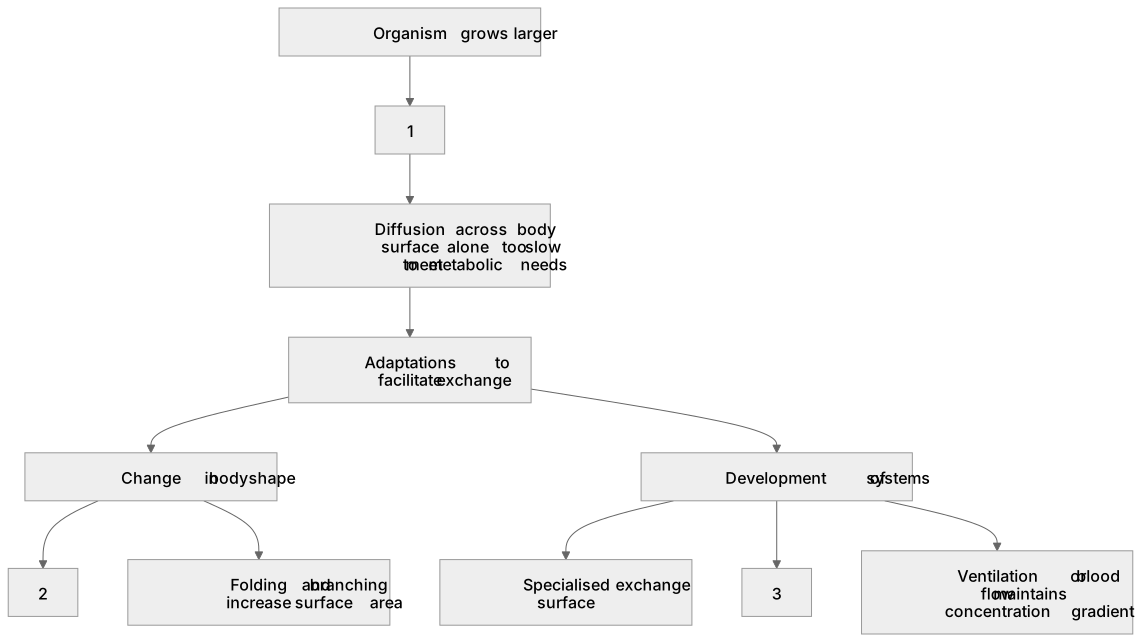
Some boxes have lost their names. Pick the right name for each number.
1Box 1
2Box 2
3Box 3
There is more to this lesson
The full lesson goes on to check your understanding and help you earn the marks. Create a free account to carry on, with your progress saved.
A week of Premium from your first lesson · Then the free plan continues · No card, no charge
Test your understanding of Surface area to volume ratio: Changes to body shape and the development of systems in larger organisms as adaptations that facilitate exchange as this ratio reduces.
Active recall beats re-reading. Take an instant quiz now to test what you’ve learned and lock it into long-term memory.
A week of Premium from your first lesson · Then the free plan continues · No card, no charge