AQA · A-Level · Biology
Course version: 7402 · Version from Sept 2016
Students should be able to appreciate the relationship between surface…
Full specification wording
Surface area to volume ratio: Students should be able to appreciate the relationship between surface area to volume ratio and metabolic rate.
Metabolic rate is the rate an organism uses energy, often measured as oxygen consumption per unit mass.
Checked against the AQA 7402 specification (opens in a new tab) on .
- Point 3 of 3
Study notes
From the checked teaching notes for this specification point.
The idea
Metabolic rate is the rate an organism uses energy, often measured as oxygen consumption per unit mass. Heat is lost across the body surface but generated throughout the volume. A small mammal has a large surface area to volume ratio, losing heat rapidly relative to its mass. To maintain a constant body temperature, it must respire faster, giving it a higher metabolic rate per unit mass than a large mammal. Consequently, a shrew eats almost continuously and has a higher heart and breathing rate than an elephant. This higher oxygen demand requires a larger relative gas exchange surface and faster ventilation to maintain a steep diffusion gradient.
What earns the marks
- State that the smaller organism has a larger surface area to volume ratio.
- Explain that heat is lost across the surface more rapidly relative to body mass.
- Link rapid heat loss to a higher rate of respiration, or metabolic rate per unit mass, to replace the heat lost and maintain body temperature.
- Connect the resulting higher oxygen demand to the requirement for faster ventilation, a faster heart rate, or a larger relative exchange surface.
- When describing a trend in data, quote specific figures from the graph before explaining the biological cause.
Common mistakes and how to put them right
Saying small animals have a higher metabolic rate without the qualification 'per unit mass'.
Put it right: A whale's total metabolic rate is far greater.
Reversing the ratio and claiming large animals have the larger surface area to volume ratio.
Explaining heat loss but failing to link it to respiration rate and oxygen demand.
Describing a graph trend without using any figures from the axes.
Exam tips
- Always attach 'per unit mass' or 'per gram' to metabolic rate when comparing organisms of different sizes.
- Describe first, then explain: state the trend with two sets of figures, then give the ratio explanation.
- Check what the question is asking for before writing about surface area to volume ratio; in some specific gas exchange adaptation questions, it may not be the focus.
Try the lesson
The start of the Surface area to volume ratio: Students should be able to appreciate the relationship between surface area to volume ratio and metabolic rate. lesson, made from checked teaching notes for this specification point.
Have a go first
How does the metabolic rate per gram of body mass usually compare between a small mammal and a large mammal?
Listen
Metabolic rate is the rate an organism uses energy, often measured as oxygen consumption per unit mass. Heat is lost across the body surface but generated throughout the volume. A small mammal has a large surface area to volume ratio, losing heat rapidly relative to its mass. To maintain a constant body temperature, it must respire faster, giving it a higher metabolic rate per unit mass than a large mammal. Consequently, a shrew eats almost continuously and has a higher heart and breathing rate than an elephant. This higher oxygen demand requires a larger relative gas exchange surface and faster ventilation to maintain a steep diffusion gradient. A strong answer earns marks for these points. State that the smaller organism has a larger surface area to volume ratio. Explain that heat is lost across the surface more rapidly relative to body mass. Link rapid heat loss to a higher rate of respiration, or metabolic rate per unit mass, to replace the heat lost and maintain body temperature. Connect the resulting higher oxygen demand to the requirement for faster ventilation, a faster heart rate, or a larger relative exchange surface. Exam tip: Always attach 'per unit mass' or 'per gram' to metabolic rate when comparing organisms of different sizes.
See it
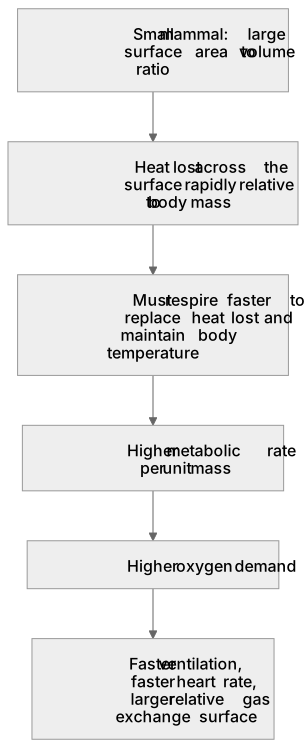
Put it in order
Put these steps in the order they happen.
- 1. Must respire faster to replace heat lost and maintain body temperature
- 2. Heat lost across the surface rapidly relative to body mass
- 3. Small mammal: large surface area to volume ratio
- 4. Faster ventilation, faster heart rate, larger relative gas exchange surface
- 5. Higher oxygen demand
- 6. Higher metabolic rate per unit mass
Label the diagram
Some boxes have lost their names. Pick the right name for each number.
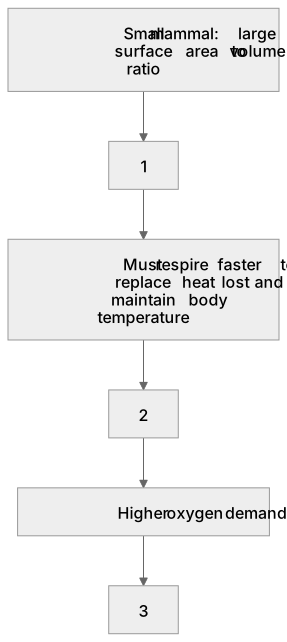
1Box 1
2Box 2
3Box 3
There is more to this lesson
The full lesson goes on to check your understanding and help you earn the marks. Create a free account to carry on, with your progress saved.
A week of Premium from your first lesson · Then the free plan continues · No card, no charge
Test your understanding of Surface area to volume ratio: Students should be able to appreciate the relationship between surface area to volume ratio and metabolic rate.
Active recall beats re-reading. Take an instant quiz now to test what you’ve learned and lock it into long-term memory.
A week of Premium from your first lesson · Then the free plan continues · No card, no charge