AQA · A-Level · Biology
Course version: 7402 · Version from Sept 2016
Taxes and kineses as simple responses that can maintain a mobile organism…
Full specification wording
Survival and response (A-level only): Taxes and kineses as simple responses that can maintain a mobile organism in a favourable environment.
Taxis and kinesis maintain mobile organisms in favourable environments.
Checked against the AQA 7402 specification (opens in a new tab) on .
- Point 4 of 6
- 3 key terms
Study notes
From the checked teaching notes for this specification point.
The idea
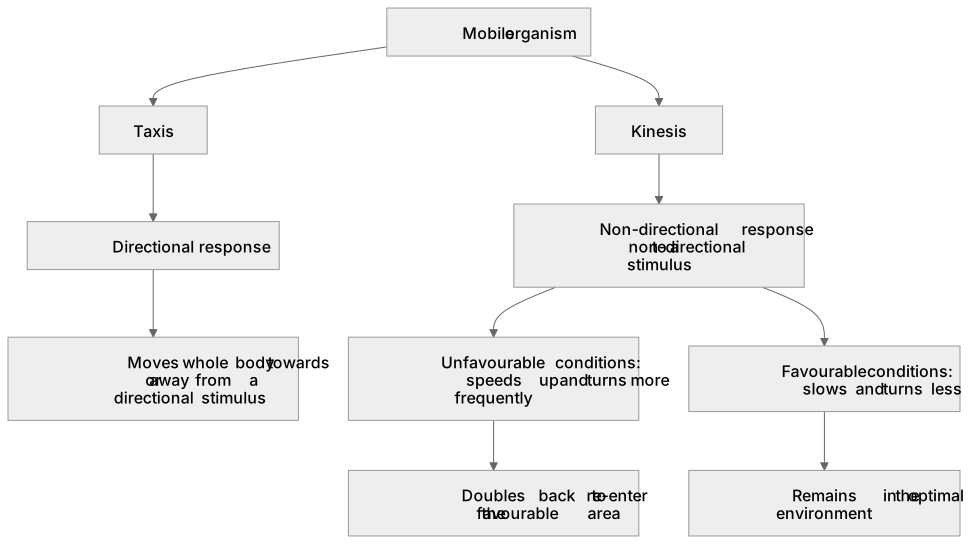
Taxis and kinesis maintain mobile organisms in favourable environments. A taxis is a directional response: the organism moves its whole body towards or away from a directional stimulus (e.g., woodlice showing negative phototaxis move away from light). A kinesis is a non-directional response to a non-directional stimulus like humidity. On meeting unfavourable conditions, the organism speeds up and turns more frequently, doubling back to re-enter the favourable area. In favourable conditions, it slows and turns less, remaining in the optimal environment.
What earns the marks
- Taxis and kinesis maintain mobile organisms in favourable environments to reduce predation or water loss.
- Taxis is a directional response involving movement towards or away from a stimulus.
- Kinesis involves changing the rate of movement or turning in response to a non-directional stimulus.
- Organisms turn more frequently or move faster in unfavourable conditions to return to favourable areas.
Common mistakes and how to put them right
Confusing a tropism (plant growth) with a taxis (movement in mobile organisms, including algae).
Describing a kinesis as movement away from unfavourable conditions, which incorrectly implies direction.
Naming a taxis without specifying the direction (e.g., omitting 'positive' or 'negative').
Exam tips
- Specify the stimulus and the sign, for example negative phototaxis or positive chemotaxis.
- If data show rate of turning or speed, identify it as a kinesis; if showing direction, it is a taxis.
Try the lesson
The start of the Survival and response (A-level only): Taxes and kineses as simple responses that can maintain a mobile organism in a favourable environment. lesson, made from checked teaching notes for this specification point.
Have a go first
Which term describes a directional response in which a mobile organism moves towards or away from a stimulus?
Listen
Taxis and kinesis maintain mobile organisms in favourable environments. A taxis is a directional response: the organism moves its whole body towards or away from a directional stimulus (e.g., woodlice showing negative phototaxis move away from light). A kinesis is a non-directional response to a non-directional stimulus like humidity. On meeting unfavourable conditions, the organism speeds up and turns more frequently, doubling back to re-enter the favourable area. In favourable conditions, it slows and turns less, remaining in the optimal environment. A strong answer earns marks for these points. Taxis and kinesis maintain mobile organisms in favourable environments to reduce predation or water loss. Taxis is a directional response involving movement towards or away from a stimulus. Kinesis involves changing the rate of movement or turning in response to a non-directional stimulus. Organisms turn more frequently or move faster in unfavourable conditions to return to favourable areas. Exam tip: Specify the stimulus and the sign, for example negative phototaxis or positive chemotaxis.
See it
Key words
Say what each word means before you turn the card.
taxis
Try answering aloud or in your head before turning the card.
kinesis
Try answering aloud or in your head before turning the card.
favourable environment
Try answering aloud or in your head before turning the card.
See every definition
- taxis
- A directional response in which the organism moves its whole body towards or away from a directional stimulus.
- kinesis
- A non-directional response to a non-directional stimulus, involving changing the rate of movement or turning.
- favourable environment
- The optimal environment in which a mobile organism is maintained by taxes and kineses, reducing predation or water loss.
Label the diagram
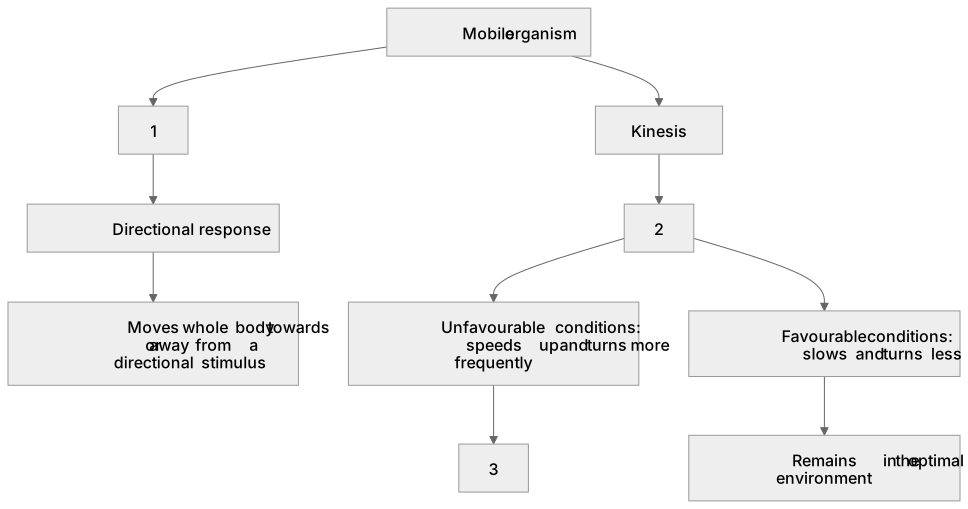
Some boxes have lost their names. Pick the right name for each number.
1Box 1
2Box 2
3Box 3
There is more to this lesson
The full lesson goes on to check your understanding and help you earn the marks. Create a free account to carry on, with your progress saved.
A week of Premium from your first lesson · Then the free plan continues · No card, no charge
Test your understanding of Survival and response (A-level only): Taxes and kineses as simple responses that can maintain a mobile organism in a favourable environment.
Active recall beats re-reading. Take an instant quiz now to test what you’ve learned and lock it into long-term memory.
A week of Premium from your first lesson · Then the free plan continues · No card, no charge