AQA · A-Level · Biology
Course version: 7402 · Version from Sept 2016
The effect of different concentrations of indoleacetic acid (IAA) on cell…
Full specification wording
Survival and response (A-level only): The effect of different concentrations of indoleacetic acid (IAA) on cell elongation in the roots and shoots of flowering plants as an explanation of gravitropism and phototropism in flowering plants.
Indoleacetic acid (IAA) controls tropisms via lateral transport and concentration-dependent effects on cell elongation.
Checked against the AQA 7402 specification (opens in a new tab) on .
- Point 3 of 6
- 2 key terms
Study notes
From the checked teaching notes for this specification point.
The idea
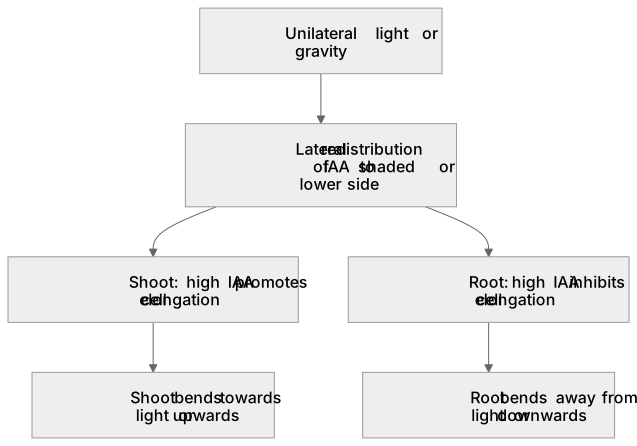
Indoleacetic acid (IAA) controls tropisms via lateral transport and concentration-dependent effects on cell elongation. In shoots, high IAA concentrations promote elongation; in roots, high IAA concentrations inhibit elongation. In phototropism, unilateral light causes IAA to be redistributed to the shaded side. Shoot cells there elongate more, bending the shoot towards light. In roots, IAA on the shaded side inhibits elongation, so the lit side elongates more, bending the root away from light. In gravitropism, gravity is sensed by cells, for example via statoliths, and this triggers the active transport of IAA to the lower side. This promotes elongation in shoots (bending upwards) but inhibits elongation in roots (bending downwards).
What earns the marks
- Explaining that unilateral light or gravity causes the lateral redistribution of IAA to the shaded or lower side.
- Stating that a high concentration of IAA promotes cell elongation in shoots, causing upward or light-directed bending.
- Stating that a high concentration of IAA inhibits cell elongation in roots, causing downward bending in positive gravitropism.
- Explaining negative phototropism in roots by stating IAA accumulates on the shaded side, inhibiting elongation so the lit side grows faster.
- Explaining that gravity is sensed by cells, for example via statoliths, and triggers the active transport of IAA to the lower side, rather than gravity directly pulling IAA molecules.
- Deducing the direction of bending by identifying which side of the organ elongates more.
Common mistakes and how to put them right
Assuming high IAA promotes elongation in roots as it does in shoots.
Put it right: High IAA inhibits root cell elongation.
Stating that cells divide more on one side.
Put it right: The correct mechanism is differential cell elongation, not mitosis.
Describing IAA as being destroyed by light.
Put it right: IAA is redistributed to the shaded side rather than being broken down.
Saying gravity pulls IAA to the lower side.
Put it right: Gravity is sensed by cells, for example via statoliths, and this triggers the active transport of IAA to the lower side.
Exam tips
- Always specify that it is a high concentration of IAA that inhibits root elongation, as roots respond differently to different doses.
- Structure tropism answers by stating where IAA accumulates, its specific effect on elongation in that organ, and the resulting direction of bending.
Try the lesson
The start of the Survival and response (A-level only): The effect of different concentrations of indoleacetic acid (IAA) on cell elongation in the roots and shoots of flowering plants as an explanation of gravitropism and phototropism in flowering plants. lesson, made from checked teaching notes for this specification point.
Have a go first
In flowering plants, which substance is the auxin that stimulates cell elongation in shoots?
Listen
Indoleacetic acid (IAA) controls tropisms via lateral transport and concentration-dependent effects on cell elongation. In shoots, high IAA concentrations promote elongation; in roots, high IAA concentrations inhibit elongation. In phototropism, unilateral light causes IAA to be redistributed to the shaded side. Shoot cells there elongate more, bending the shoot towards light. In roots, IAA on the shaded side inhibits elongation, so the lit side elongates more, bending the root away from light. In gravitropism, gravity is sensed by cells, for example via statoliths, and this triggers the active transport of IAA to the lower side. This promotes elongation in shoots (bending upwards) but inhibits elongation in roots (bending downwards). A strong answer earns marks for these points. Explaining that unilateral light or gravity causes the lateral redistribution of IAA to the shaded or lower side. Stating that a high concentration of IAA promotes cell elongation in shoots, causing upward or light-directed bending. Stating that a high concentration of IAA inhibits cell elongation in roots, causing downward bending in positive gravitropism. Explaining negative phototropism in roots by stating IAA accumulates on the shaded side, inhibiting elongation so the lit side grows faster. A common slip: Assuming high IAA promotes elongation in roots as it does in shoots. Instead, high IAA inhibits root cell elongation. Exam tip: Always specify that it is a high concentration of IAA that inhibits root elongation, as roots respond differently to different doses.
See it
Key words
Say what each word means before you turn the card.
indoleacetic acid
Try answering aloud or in your head before turning the card.
phototropism and gravitropism
Try answering aloud or in your head before turning the card.
See every definition
- indoleacetic acid
- A substance whose different concentrations affect cell elongation in the roots and shoots of flowering plants, explaining gravitropism and phototropism.
- phototropism and gravitropism
- Responses in flowering plants explained by the effect of different concentrations of indoleacetic acid on cell elongation in roots and shoots.
Label the diagram
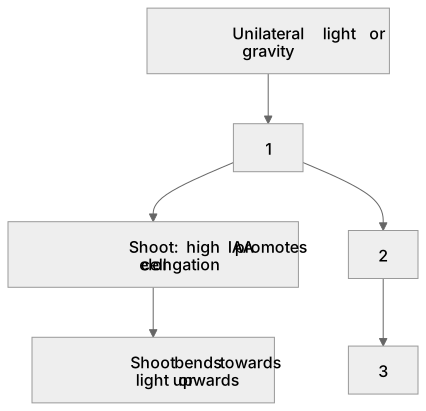
Some boxes have lost their names. Pick the right name for each number.
1Box 1
2Box 2
3Box 3
There is more to this lesson
The full lesson goes on to check your understanding and help you earn the marks. Create a free account to carry on, with your progress saved.
A week of Premium from your first lesson · Then the free plan continues · No card, no charge
Test your understanding of Survival and response (A-level only): The effect of different concentrations of indoleacetic acid (IAA) on cell elongation in the roots and shoots of flowering plants as an explanation of gravitropism and phototropism in flowering plants.
Active recall beats re-reading. Take an instant quiz now to test what you’ve learned and lock it into long-term memory.
A week of Premium from your first lesson · Then the free plan continues · No card, no charge