AQA · A-Level · Biology
Course version: 7402 · Version from Sept 2016
Students should be able to use information provided to predict and explain…
Full specification wording
Synaptic transmission (A-level only): Students should be able to use information provided to predict and explain the effects of specific drugs on a synapse.
You will be given information about an unfamiliar drug and asked to work out what it does.
Checked against the AQA 7402 specification (opens in a new tab) on .
- Point 4 of 4
- 4 key terms
Study notes
From the checked teaching notes for this specification point.
The idea
You will be given information about an unfamiliar drug and asked to work out what it does. Map the drug onto one step of the transmission sequence, then follow the consequences forwards. A drug that blocks calcium ion channels means fewer calcium ions enter the knob, so fewer vesicles fuse, less neurotransmitter is released, fewer receptors are occupied, fewer sodium ions enter the postsynaptic membrane, threshold is not reached and fewer action potentials are produced. A drug that mimics the neurotransmitter binds to the receptor and triggers depolarisation, so more action potentials are produced. A drug with a shape complementary to the receptor but no activating effect blocks it, so fewer. A drug that inhibits acetylcholinesterase leaves acetylcholine in the cleft for longer, so receptors are repeatedly bound and more action potentials follow.
What earns the marks
- Change in calcium ions entering the synaptic knob through its calcium ion channels, stated as no or fewer where the drug blocks them.
- Matching change in synaptic vesicles moving to and fusing with the presynaptic membrane, and so in the neurotransmitter released.
- Change in the amount of neurotransmitter diffusing across the synaptic cleft.
- Change in the amount of neurotransmitter attaching to receptors on the postsynaptic membrane.
- Change in sodium ions entering the postsynaptic neurone, and so in the number of impulses produced, with threshold not being reached accepted for fewer impulses.
Common mistakes and how to put them right
Describing normal synaptic transmission without ever writing more, less, fewer or no, which caps the answer below full marks.
Calling a receptor an active site and the drug a competitive inhibitor of it, since active site is rejected in this context.
Stopping at less neurotransmitter is released without carrying the chain through to action potentials.
Assuming every drug must be inhibitory, when agonists and acetylcholinesterase inhibitors increase transmission.
Recalling a real drug from memory instead of using the information supplied in the question.
Exam tips
- Sketch the five-step sequence in the margin and mark more or less against each step before you begin writing.
- Quote line numbers or details from the passage; these are application marks, not recall marks.
- If the drug relieves a symptom, finish by saying what the patient experiences, not only what the neurone does.
Try the lesson
The start of the Synaptic transmission (A-level only): Students should be able to use information provided to predict and explain the effects of specific drugs on a synapse. lesson, made from checked teaching notes for this specification point.
Have a go first
A drug is applied to a synapse and it binds to receptors on the postsynaptic membrane without opening any ion channels. What effect does this drug have on the postsynaptic membrane?
Listen
You will be given information about an unfamiliar drug and asked to work out what it does. Map the drug onto one step of the transmission sequence, then follow the consequences forwards. A drug that blocks calcium ion channels means fewer calcium ions enter the knob, so fewer vesicles fuse, less neurotransmitter is released, fewer receptors are occupied, fewer sodium ions enter the postsynaptic membrane, threshold is not reached and fewer action potentials are produced. A drug that mimics the neurotransmitter binds to the receptor and triggers depolarisation, so more action potentials are produced. A drug with a shape complementary to the receptor but no activating effect blocks it, so fewer. A drug that inhibits acetylcholinesterase leaves acetylcholine in the cleft for longer, so receptors are repeatedly bound and more action potentials follow. A strong answer earns marks for these points. change in calcium ions entering the synaptic knob through its calcium ion channels, stated as no or fewer where the drug blocks them. matching change in synaptic vesicles moving to and fusing with the presynaptic membrane, and so in the neurotransmitter released. change in the amount of neurotransmitter diffusing across the synaptic cleft. change in the amount of neurotransmitter attaching to receptors on the postsynaptic membrane. Exam tip: Sketch the five-step sequence in the margin and mark more or less against each step before you begin writing.
See it
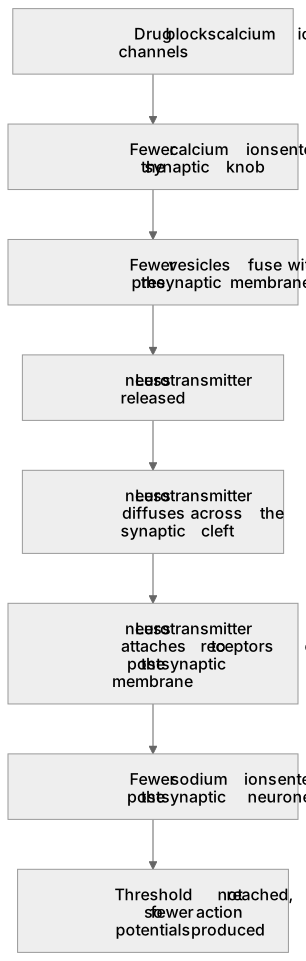
Put it in order
Put these steps in the order they happen.
- 1. Less neurotransmitter diffuses across the synaptic cleft
- 2. Threshold not reached, so fewer action potentials produced
- 3. Less neurotransmitter attaches to receptors on the postsynaptic membrane
- 4. Drug blocks calcium ion channels
- 5. Fewer calcium ions enter the synaptic knob
- 6. Fewer sodium ions enter the postsynaptic neurone
- 7. Fewer vesicles fuse with the presynaptic membrane
- 8. Less neurotransmitter released
Key words
Say what each word means before you turn the card.
calcium channel blockers
Try answering aloud or in your head before turning the card.
acetylcholinesterase inhibition
Try answering aloud or in your head before turning the card.
agonists and antagonists
Try answering aloud or in your head before turning the card.
stating the direction of change
Try answering aloud or in your head before turning the card.
See every definition
- calcium channel blockers
- A drug that blocks calcium ion channels, so fewer calcium ions enter the knob and fewer vesicles fuse.
- acetylcholinesterase inhibition
- A drug that inhibits acetylcholinesterase leaves acetylcholine in the cleft for longer, so receptors are repeatedly bound and more action potentials follow.
- agonists and antagonists
- A drug that mimics the neurotransmitter triggers depolarisation and more action potentials, while one with a shape complementary to the receptor but no activating effect blocks it.
- stating the direction of change
- Writing more, less, fewer or no at each step, since describing normal synaptic transmission without this caps the answer below full marks.
Label the diagram
Some boxes have lost their names. Pick the right name for each number.
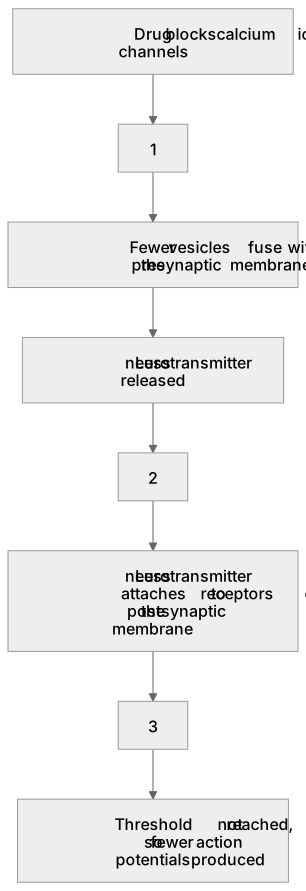
1Box 1
2Box 2
3Box 3
There is more to this lesson
The full lesson goes on to check your understanding and help you earn the marks. Create a free account to carry on, with your progress saved.
A week of Premium from your first lesson · Then the free plan continues · No card, no charge
Test your understanding of Synaptic transmission (A-level only): Students should be able to use information provided to predict and explain the effects of specific drugs on a synapse.
Active recall beats re-reading. Take an instant quiz now to test what you’ve learned and lock it into long-term memory.
A week of Premium from your first lesson · Then the free plan continues · No card, no charge