AQA · A-Level · Biology
Course version: 7402 · Version from Sept 2016
A comparison of transmission across a cholinergic synapse and across a…
Full specification wording
Synaptic transmission (A-level only): A comparison of transmission across a cholinergic synapse and across a neuromuscular junction.
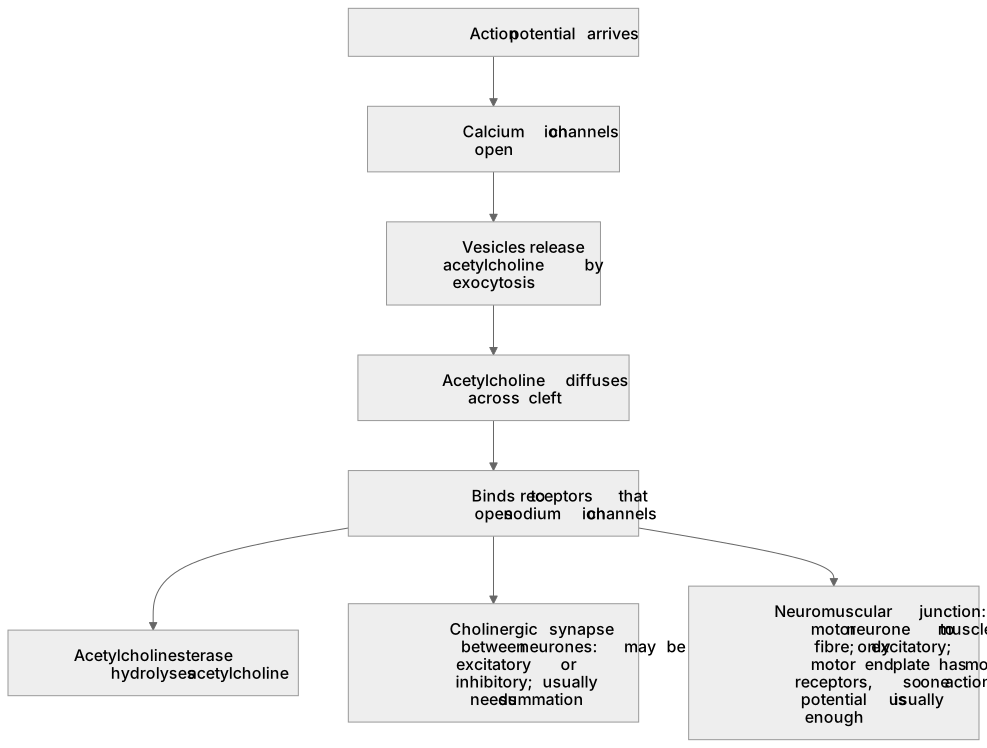
Both use the same mechanism: an action potential opens calcium ion channels, vesicles release acetylcholine by exocytosis, the neurotransmitter diffuses across a cleft and binds to receptors that…
Checked against the AQA 7402 specification (opens in a new tab) on .
- Point 3 of 4
- 4 key terms
Study notes
From the checked teaching notes for this specification point.
The idea
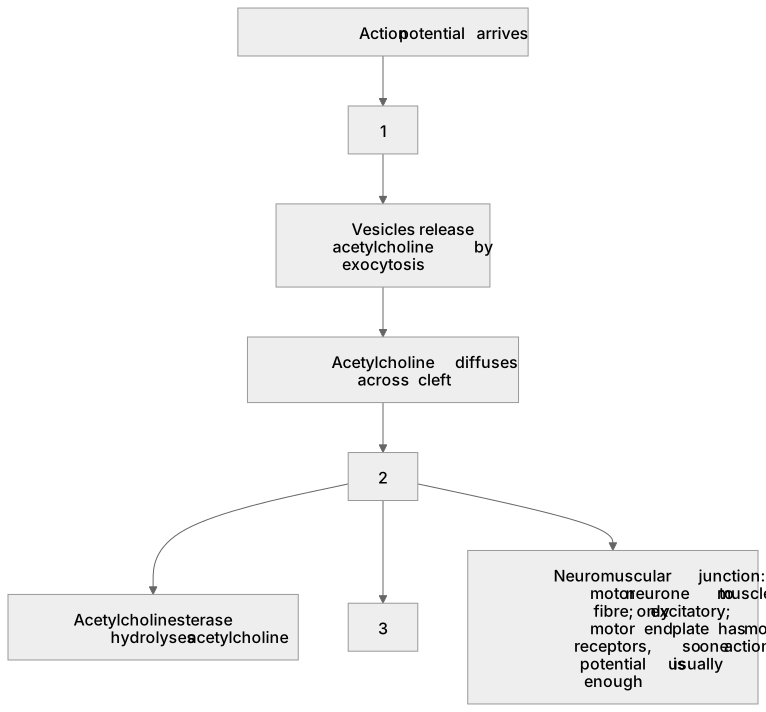
Both use the same mechanism: an action potential opens calcium ion channels, vesicles release acetylcholine by exocytosis, the neurotransmitter diffuses across a cleft and binds to receptors that open sodium ion channels, and acetylcholinesterase hydrolyses it afterwards. The differences lie in what sits on the other side. A neuromuscular junction occurs only between a motor neurone and a muscle fibre and is always excitatory, with no inhibitory version, and a single action potential arriving is normally enough to make the muscle fibre contract because the folded sarcolemma of the motor end plate carries far more receptors. A cholinergic synapse between neurones may be excitatory or inhibitory, usually needs summation to reach threshold, and the postsynaptic neurone may receive input from many presynaptic neurones and pass impulses on to several others.
What earns the marks
- A shared feature, such as acetylcholine released by exocytosis and hydrolysed by acetylcholinesterase at both.
- The neuromuscular junction occurring only between a motor neurone and a muscle fibre, whereas a cholinergic synapse joins two neurones.
- The neuromuscular junction being only excitatory, whereas a cholinergic synapse may be excitatory or inhibitory.
- The motor end plate carrying more receptors, so one action potential is usually enough without summation.
- The different end points: contraction of a muscle fibre against an action potential in the next neurone.
Common mistakes and how to put them right
Listing as differences features that are in fact the same at both, such as the use of acetylcholine.
Saying an impulse passes into the muscle, when what crosses is neurotransmitter and what follows is depolarisation of the sarcolemma.
Claiming a neuromuscular junction can be inhibitory.
Comparing structures without naming the sarcolemma or the motor end plate.
Answering a comparison question with two separate descriptions and no comparative words.
Exam tips
- Use comparative language in every line: whereas, but, compared with.
- If a table is provided, fill in both columns of every row; a row with one side blank scores nothing.
- Keep similarities and differences in separate paragraphs so the examiner can find each one.
Try the lesson
The start of the Synaptic transmission (A-level only): A comparison of transmission across a cholinergic synapse and across a neuromuscular junction. lesson, made from checked teaching notes for this specification point.
Have a go first
Which neurotransmitter is released at both a cholinergic synapse and a neuromuscular junction?
Listen
Both use the same mechanism: an action potential opens calcium ion channels, vesicles release acetylcholine by exocytosis, the neurotransmitter diffuses across a cleft and binds to receptors that open sodium ion channels, and acetylcholinesterase hydrolyses it afterwards. The differences lie in what sits on the other side. A neuromuscular junction occurs only between a motor neurone and a muscle fibre and is always excitatory, with no inhibitory version, and a single action potential arriving is normally enough to make the muscle fibre contract because the folded sarcolemma of the motor end plate carries far more receptors. A cholinergic synapse between neurones may be excitatory or inhibitory, usually needs summation to reach threshold, and the postsynaptic neurone may receive input from many presynaptic neurones and pass impulses on to several others. A strong answer earns marks for these points. a shared feature, such as acetylcholine released by exocytosis and hydrolysed by acetylcholinesterase at both. the neuromuscular junction occurring only between a motor neurone and a muscle fibre, whereas a cholinergic synapse joins two neurones. the neuromuscular junction being only excitatory, whereas a cholinergic synapse may be excitatory or inhibitory. the motor end plate carrying more receptors, so one action potential is usually enough without summation. Exam tip: Use comparative language in every line: whereas, but, compared with.
See it
Key words
Say what each word means before you turn the card.
shared transmission mechanism
Try answering aloud or in your head before turning the card.
motor end plate
Try answering aloud or in your head before turning the card.
excitatory only at the neuromuscular junction
Try answering aloud or in your head before turning the card.
summation not needed
Try answering aloud or in your head before turning the card.
See every definition
- shared transmission mechanism
- An action potential opens calcium ion channels, vesicles release acetylcholine by exocytosis, it diffuses across a cleft and binds to receptors that open sodium ion channels, and acetylcholinesterase hydrolyses it afterwards.
- motor end plate
- The folded sarcolemma of a muscle fibre, which carries far more receptors so a single action potential is normally enough to make the muscle fibre contract.
- excitatory only at the neuromuscular junction
- A neuromuscular junction is always excitatory, with no inhibitory version, whereas a cholinergic synapse between neurones may be excitatory or inhibitory.
- summation not needed
- A single action potential arriving is normally enough to make the muscle fibre contract because the motor end plate carries far more receptors, whereas a cholinergic synapse usually needs summation to reach threshold.
Label the diagram
Some boxes have lost their names. Pick the right name for each number.
1Box 1
2Box 2
3Box 3
There is more to this lesson
The full lesson goes on to check your understanding and help you earn the marks. Create a free account to carry on, with your progress saved.
A week of Premium from your first lesson · Then the free plan continues · No card, no charge
Test your understanding of Synaptic transmission (A-level only): A comparison of transmission across a cholinergic synapse and across a neuromuscular junction.
Active recall beats re-reading. Take an instant quiz now to test what you’ve learned and lock it into long-term memory.
A week of Premium from your first lesson · Then the free plan continues · No card, no charge