AQA · A-Level · Biology
Course version: 7402 · Version from Sept 2016
The sequence of events involved in transmission across a cholinergic…
Full specification wording
Synaptic transmission (A-level only): The sequence of events involved in transmission across a cholinergic synapse in sufficient detail to explain: unidirectionality temporal and spatial summation inhibition by inhibitory synapses.
Action potentials open voltage-gated Ca²⁺ channels in the presynaptic knob.
Checked against the AQA 7402 specification (opens in a new tab) on .
- Point 2 of 4
- 3 key terms
Study notes
From the checked teaching notes for this specification point.
The idea
Action potentials open voltage-gated Ca²⁺ channels in the presynaptic knob. Ca²⁺ influx causes vesicles to release acetylcholine (ACh) by exocytosis. ACh diffuses across the cleft, binding to postsynaptic receptors to open Na⁺ channels. If Na⁺ influx reaches threshold, an action potential fires. Acetylcholinesterase hydrolyses ACh to stop the response. Transmission is unidirectional as only the presynaptic knob has vesicles and only the postsynaptic membrane has receptors. Summation allows sub-threshold impulses to reach threshold: spatial uses multiple neurones firing simultaneously, while temporal uses one neurone firing rapidly. Inhibitory synapses release neurotransmitters that open Cl⁻ and K⁺ channels, causing hyperpolarisation, preventing threshold being reached.
What earns the marks
- Depolarisation of the presynaptic membrane opens voltage-gated Ca²⁺ channels, allowing Ca²⁺ to diffuse into the synaptic knob.
- Vesicles fuse with the presynaptic membrane, releasing acetylcholine into the synaptic cleft by exocytosis.
- Acetylcholine diffuses across the cleft and binds to specific receptors on the postsynaptic membrane, opening Na⁺ channels.
- In spatial summation, neurotransmitter released simultaneously from multiple presynaptic neurones combines to exceed the threshold.
- Inhibitory synapses cause hyperpolarisation of the postsynaptic membrane by opening Cl⁻ and K⁺ channels, preventing threshold from being reached.
Common mistakes and how to put them right
Writing 'signals' or 'messages' instead of 'action potentials' or 'impulses'.
Put it right: Use the correct neurobiological terminology.
Confusing temporal and spatial summation.
Put it right: Temporal is one neurone firing rapidly over time, whereas spatial is multiple neurones firing simultaneously in space.
Stating that inhibitory synapses 'block' the impulse.
Put it right by explaining they cause hyperpolarisation (making the membrane potential more negative) via Cl⁻ influx or K⁺ efflux, so threshold is not reached.
Claiming acetylcholine is destroyed by the postsynaptic membrane.
Put it right: It is actually hydrolysed by the enzyme acetylcholinesterase in the synaptic cleft.
Exam tips
- Learn the sequence of synaptic transmission as a numbered list; questions often ask you to apply this sequence to a novel drug or toxin by stating which specific step is disrupted.
- When explaining how a drug reduces synaptic transmission, explicitly state the comparative change, such as 'fewer Na⁺ channels open' or 'less depolarisation occurs'.
Try the lesson
The start of the Synaptic transmission (A-level only): The sequence of events involved in transmission across a cholinergic synapse in sufficient detail to explain: unidirectionality temporal and spatial summation inhibition by inhibitory synapses. lesson, made from checked teaching notes for this specification point.
Have a go first
Which event occurs first when a nerve impulse arrives at the presynaptic membrane of a cholinergic synapse?
Listen
Action potentials open voltage-gated Ca²⁺ channels in the presynaptic knob. Ca²⁺ influx causes vesicles to release acetylcholine (ACh) by exocytosis. ACh diffuses across the cleft, binding to postsynaptic receptors to open Na⁺ channels. If Na⁺ influx reaches threshold, an action potential fires. Acetylcholinesterase hydrolyses ACh to stop the response. Transmission is unidirectional as only the presynaptic knob has vesicles and only the postsynaptic membrane has receptors. Summation allows sub-threshold impulses to reach threshold: spatial uses multiple neurones firing simultaneously, while temporal uses one neurone firing rapidly. Inhibitory synapses release neurotransmitters that open Cl⁻ and K⁺ channels, causing hyperpolarisation, preventing threshold being reached. A strong answer earns marks for these points. Depolarisation of the presynaptic membrane opens voltage-gated Ca²⁺ channels, allowing Ca²⁺ to diffuse into the synaptic knob. Vesicles fuse with the presynaptic membrane, releasing acetylcholine into the synaptic cleft by exocytosis. Acetylcholine diffuses across the cleft and binds to specific receptors on the postsynaptic membrane, opening Na⁺ channels. In spatial summation, neurotransmitter released simultaneously from multiple presynaptic neurones combines to exceed the threshold. A common slip: Stating that inhibitory synapses 'block' the impulse. Instead, explaining they cause hyperpolarisation (making the membrane potential more negative) via Cl⁻ influx or K⁺ efflux, so threshold is not reached. Exam tip: Learn the sequence of synaptic transmission as a numbered list; questions often ask you to apply this sequence to a novel drug or toxin by stating which specific step is disrupted.
See it
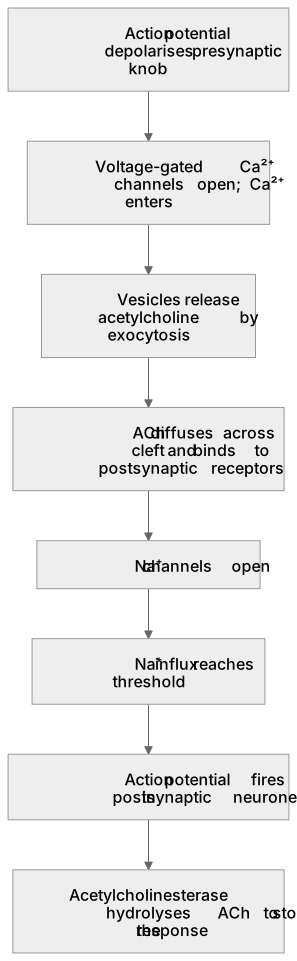
Put it in order
Put these steps in the order they happen.
- 1. Na⁺ channels open
- 2. Acetylcholinesterase hydrolyses ACh to stop the response
- 3. Na⁺ influx reaches threshold
- 4. Action potential depolarises presynaptic knob
- 5. Voltage-gated Ca²⁺ channels open; Ca²⁺ enters
- 6. Action potential fires in postsynaptic neurone
- 7. Vesicles release acetylcholine by exocytosis
- 8. ACh diffuses across cleft and binds to postsynaptic receptors
Key words
Say what each word means before you turn the card.
Unidirectionality
Try answering aloud or in your head before turning the card.
Temporal and spatial summation
Try answering aloud or in your head before turning the card.
Inhibitory synapses and hyperpolarisation
Try answering aloud or in your head before turning the card.
See every definition
- Unidirectionality
- Transmission is unidirectional as only the presynaptic knob has vesicles and only the postsynaptic membrane has receptors.
- Temporal and spatial summation
- Summation allows sub-threshold impulses to reach threshold: spatial uses multiple neurones firing simultaneously, while temporal uses one neurone firing rapidly.
- Inhibitory synapses and hyperpolarisation
- Inhibitory synapses release neurotransmitters that open Cl⁻ and K⁺ channels, causing hyperpolarisation, preventing threshold being reached.
Label the diagram
Some boxes have lost their names. Pick the right name for each number.
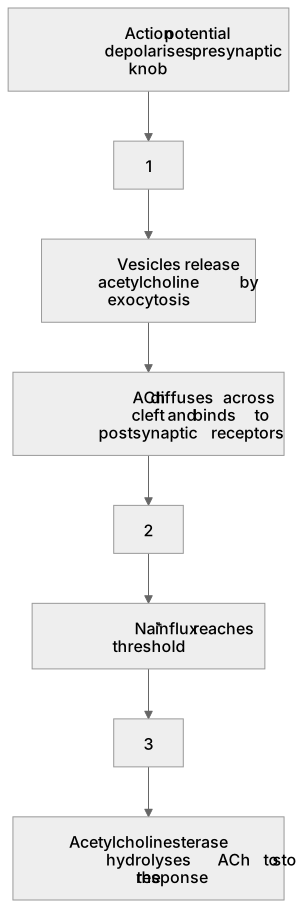
1Box 1
2Box 2
3Box 3
There is more to this lesson
The full lesson goes on to check your understanding and help you earn the marks. Create a free account to carry on, with your progress saved.
A week of Premium from your first lesson · Then the free plan continues · No card, no charge
Test your understanding of Synaptic transmission (A-level only): The sequence of events involved in transmission across a cholinergic synapse in sufficient detail to explain: unidirectionality temporal and spatial summation inhibition by inhibitory synapses.
Active recall beats re-reading. Take an instant quiz now to test what you’ve learned and lock it into long-term memory.
A week of Premium from your first lesson · Then the free plan continues · No card, no charge