AQA · A-Level · Biology
Course version: 7402 · Version from Sept 2016
The arrangement and any movement of phospholipids, proteins, glycoproteins…
Full specification wording
Transport across cell membranes: The arrangement and any movement of phospholipids, proteins, glycoproteins and glycolipids in the fluid-mosaic model of membrane structure.
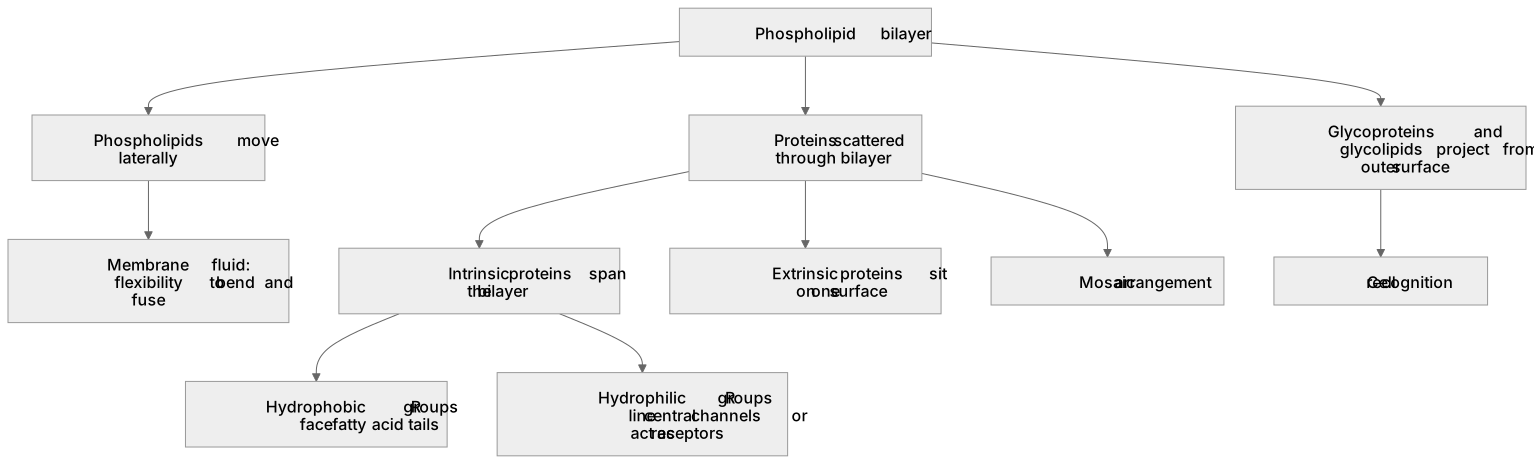
Fluid refers to the lateral movement of phospholipids, proteins, glycoproteins, and glycolipids within the membrane, giving it flexibility to bend and fuse.
Checked against the AQA 7402 specification (opens in a new tab) on .
- Point 2 of 8
- 4 key terms
Study notes
From the checked teaching notes for this specification point.
The idea
Fluid refers to the lateral movement of phospholipids, proteins, glycoproteins, and glycolipids within the membrane, giving it flexibility to bend and fuse. Mosaic refers to the scattered arrangement of proteins. Phospholipids form a bilayer. Intrinsic proteins span the bilayer; their hydrophobic R groups face the fatty acid tails, while hydrophilic R groups line central channels for water-soluble substances, or act as receptors. Extrinsic proteins sit on one surface. Glycoproteins and glycolipids project from the outer surface for cell recognition. While many molecules move laterally, some proteins are anchored.
What earns the marks
- Phospholipids, proteins, glycoproteins and glycolipids being able to move laterally, making the membrane fluid.
- Proteins scattered through the bilayer in a mosaic, with some spanning it and some on one surface.
- Hydrophobic regions of an intrinsic protein lying next to the fatty acid tails.
- Hydrophilic regions forming a channel for ions or polar molecules.
- Glycoproteins and glycolipids projecting from the outer surface for cell recognition.
Common mistakes and how to put them right
Placing glycoproteins and glycolipids on both faces of the membrane, or on the inner face.
Describing proteins as floating on top of the bilayer rather than embedded in or spanning it.
Stating all spanning proteins are transport proteins, ignoring that many are integral receptors.
Saying the membrane is fluid because liquid passes through it.
Exam tips
- Explain fluid and mosaic separately; each word usually carries its own mark.
- When describing intrinsic proteins, mention both hydrophobic regions facing tails and hydrophilic regions lining channels.
Try the lesson
The start of the Transport across cell membranes: The arrangement and any movement of phospholipids, proteins, glycoproteins and glycolipids in the fluid-mosaic model of membrane structure. lesson, made from checked teaching notes for this specification point.
Have a go first
In the fluid-mosaic model of membrane structure, what forms the bilayer?
Listen
Fluid refers to the lateral movement of phospholipids, proteins, glycoproteins, and glycolipids within the membrane, giving it flexibility to bend and fuse. Mosaic refers to the scattered arrangement of proteins. Phospholipids form a bilayer. Intrinsic proteins span the bilayer; their hydrophobic R groups face the fatty acid tails, while hydrophilic R groups line central channels for water-soluble substances, or act as receptors. Extrinsic proteins sit on one surface. Glycoproteins and glycolipids project from the outer surface for cell recognition. While many molecules move laterally, some proteins are anchored. A strong answer earns marks for these points. phospholipids, proteins, glycoproteins and glycolipids being able to move laterally, making the membrane fluid. proteins scattered through the bilayer in a mosaic, with some spanning it and some on one surface. hydrophobic regions of an intrinsic protein lying next to the fatty acid tails. hydrophilic regions forming a channel for ions or polar molecules. Exam tip: Explain fluid and mosaic separately; each word usually carries its own mark.
See it
Key words
Say what each word means before you turn the card.
fluid-mosaic model
Try answering aloud or in your head before turning the card.
lateral movement of membrane components
Try answering aloud or in your head before turning the card.
intrinsic and extrinsic proteins
Try answering aloud or in your head before turning the card.
glycoproteins and glycolipids
Try answering aloud or in your head before turning the card.
See every definition
- fluid-mosaic model
- The arrangement and any movement of phospholipids, proteins, glycoproteins and glycolipids in the membrane.
- lateral movement of membrane components
- Phospholipids, proteins, glycoproteins and glycolipids able to move laterally, giving the membrane flexibility to bend and fuse.
- intrinsic and extrinsic proteins
- Proteins scattered through the bilayer, with some spanning it and some sitting on one surface.
- glycoproteins and glycolipids
- Molecules projecting from the outer surface for cell recognition.
Label the diagram
Some boxes have lost their names. Pick the right name for each number.
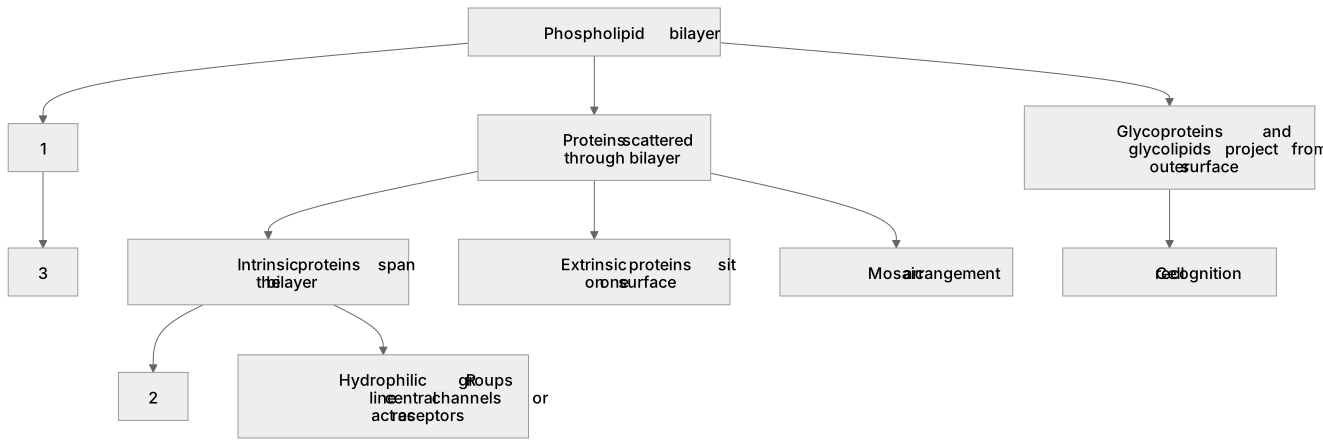
1Box 1
2Box 2
3Box 3
There is more to this lesson
The full lesson goes on to check your understanding and help you earn the marks. Create a free account to carry on, with your progress saved.
A week of Premium from your first lesson · Then the free plan continues · No card, no charge
Test your understanding of Transport across cell membranes: The arrangement and any movement of phospholipids, proteins, glycoproteins and glycolipids in the fluid-mosaic model of membrane structure.
Active recall beats re-reading. Take an instant quiz now to test what you’ve learned and lock it into long-term memory.
A week of Premium from your first lesson · Then the free plan continues · No card, no charge