AQA · A-Level · Biology
Course version: 7402 · Version from Sept 2016
The basic structure of all cell membranes, including cell-surface…
Full specification wording
Transport across cell membranes: The basic structure of all cell membranes, including cell-surface membranes and the membranes around the cell organelles of eukaryotes, is the same.
Every membrane in a cell is built to the same basic plan: a phospholipid bilayer about 7 nanometres thick with proteins embedded in it.
Checked against the AQA 7402 specification (opens in a new tab) on .
- Point 1 of 8
- 4 key terms
Study notes
From the checked teaching notes for this specification point.
The idea
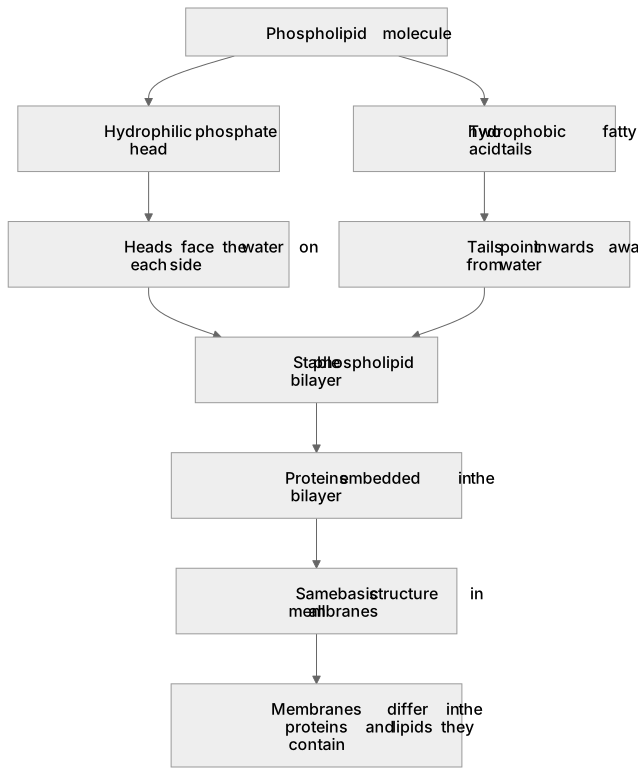
Every membrane in a cell is built to the same basic plan: a phospholipid bilayer about 7 nanometres thick with proteins embedded in it. The reason lies in the phospholipid molecule itself, which has a hydrophilic phosphate head and two hydrophobic fatty acid tails. In an aqueous environment the molecules arrange themselves automatically so that the heads face the water on each side of the membrane while the tails point inwards away from it, producing a stable double layer. Because that arrangement follows from the molecule, it is the same whether you are looking at the cell-surface membrane, the double membrane of the nuclear envelope, mitochondrion or chloroplast, the endoplasmic reticulum, the Golgi apparatus, a lysosome or a vesicle. Membranes differ in the proteins and lipids they contain, which gives each membrane its particular functions.
What earns the marks
- Every membrane consisting of a phospholipid bilayer with proteins embedded in it.
- Explaining the bilayer from hydrophilic phosphate heads facing the aqueous surroundings and hydrophobic fatty acid tails facing inwards.
- Naming organelle membranes built on the same plan, such as the nuclear envelope, mitochondrial or chloroplast membranes, endoplasmic reticulum, Golgi apparatus, lysosomes and vesicles.
- The difference between membranes lying in the proteins and lipids present rather than in the basic bilayer structure.
- The shared structure allowing membranes to fuse, for example when vesicles join the cell-surface membrane.
Common mistakes and how to put them right
Describing organelle membranes as structurally different from the cell-surface membrane.
Putting the fatty acid tails on the outside facing the aqueous surroundings and the heads inwards.
Writing phospholipid layer rather than phospholipid bilayer.
Calling the membrane a cell wall, or claiming an animal cell has both.
Saying membranes differ only in their proteins, when lipid composition (cholesterol, glycolipids, phospholipid types) also differs.
Exam tips
- Explain the bilayer from the properties of the phospholipid; simply stating that there are two layers is a description, not an explanation.
- Name a specific organelle membrane when asked for an example; organelles is too vague.
- Remember the number: about 7 nanometres, which is why membranes cannot be resolved with a light microscope.
Try the lesson
The start of the Transport across cell membranes: The basic structure of all cell membranes, including cell-surface membranes and the membranes around the cell organelles of eukaryotes, is the same. lesson, made from checked teaching notes for this specification point.
Have a go first
Which two classes of molecule form the main structural framework of all cell membranes?
Listen
Every membrane in a cell is built to the same basic plan: a phospholipid bilayer about 7 nanometres thick with proteins embedded in it. The reason lies in the phospholipid molecule itself, which has a hydrophilic phosphate head and two hydrophobic fatty acid tails. In an aqueous environment the molecules arrange themselves automatically so that the heads face the water on each side of the membrane while the tails point inwards away from it, producing a stable double layer. Because that arrangement follows from the molecule, it is the same whether you are looking at the cell-surface membrane, the double membrane of the nuclear envelope, mitochondrion or chloroplast, the endoplasmic reticulum, the Golgi apparatus, a lysosome or a vesicle. Membranes differ in the proteins and lipids they contain, which gives each membrane its particular functions. A strong answer earns marks for these points. every membrane consisting of a phospholipid bilayer with proteins embedded in it. explaining the bilayer from hydrophilic phosphate heads facing the aqueous surroundings and hydrophobic fatty acid tails facing inwards. naming organelle membranes built on the same plan, such as the nuclear envelope, mitochondrial or chloroplast membranes, endoplasmic reticulum, Golgi apparatus, lysosomes and vesicles. the difference between membranes lying in the proteins and lipids present rather than in the basic bilayer structure. Exam tip: Explain the bilayer from the properties of the phospholipid; simply stating that there are two layers is a description, not an explanation.
See it
Key words
Say what each word means before you turn the card.
phospholipid bilayer
Try answering aloud or in your head before turning the card.
hydrophilic heads and hydrophobic tails
Try answering aloud or in your head before turning the card.
organelle membranes
Try answering aloud or in your head before turning the card.
proteins and lipids give specialisation
Try answering aloud or in your head before turning the card.
See every definition
- phospholipid bilayer
- A stable double layer about 7 nanometres thick with proteins embedded in it, formed because the molecules arrange themselves automatically in an aqueous environment.
- hydrophilic heads and hydrophobic tails
- The phosphate head faces the water on each side of the membrane while the two fatty acid tails point inwards away from it.
- organelle membranes
- The nuclear envelope, mitochondrion, chloroplast, endoplasmic reticulum, Golgi apparatus, lysosome or vesicle are built on the same basic plan as the cell-surface membrane.
- proteins and lipids give specialisation
- Membranes differ in the proteins and lipids they contain, which gives each membrane its particular functions.
Label the diagram
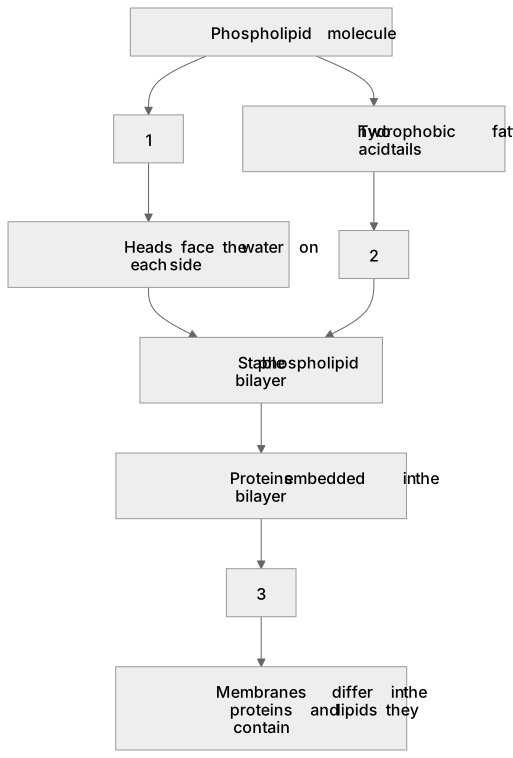
Some boxes have lost their names. Pick the right name for each number.
1Box 1
2Box 2
3Box 3
There is more to this lesson
The full lesson goes on to check your understanding and help you earn the marks. Create a free account to carry on, with your progress saved.
A week of Premium from your first lesson · Then the free plan continues · No card, no charge
Test your understanding of Transport across cell membranes: The basic structure of all cell membranes, including cell-surface membranes and the membranes around the cell organelles of eukaryotes, is the same.
Active recall beats re-reading. Take an instant quiz now to test what you’ve learned and lock it into long-term memory.
A week of Premium from your first lesson · Then the free plan continues · No card, no charge