AQA · A-Level · Biology
Course version: 7402 · Version from Sept 2016
This may have many applications, including the identification of potential…
Full specification wording
Using genome projects (A-level only): This may have many applications, including the identification of potential antigens for use in vaccine production.
Once a pathogen's genome is sequenced, its proteome can be deduced, and from the proteome scientists can pick out the proteins likely to be displayed on the outside of the cell or virus.
Checked against the AQA 7402 specification (opens in a new tab) on .
- Point 3 of 5
- 4 key terms
Study notes
From the checked teaching notes for this specification point.
The idea
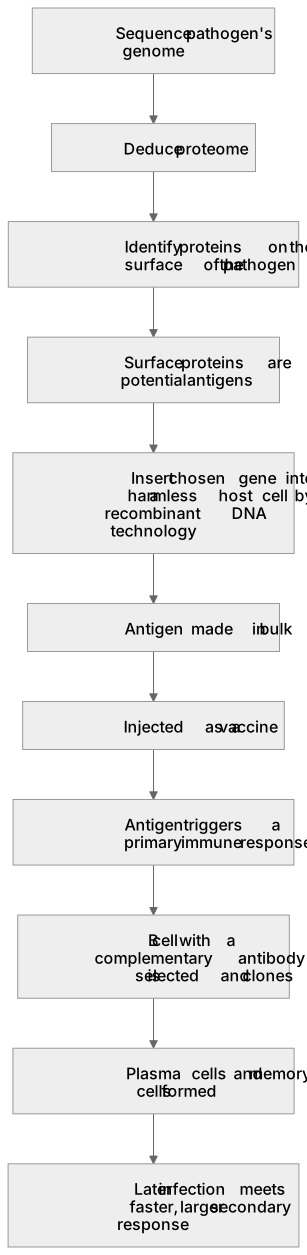
Once a pathogen's genome is sequenced, its proteome can be deduced, and from the proteome scientists can pick out the proteins likely to be displayed on the outside of the cell or virus. These surface proteins are the antigens the immune system will actually meet, so they are the candidates for a vaccine. The approach means antigens can be identified without ever culturing the pathogen, which matters when an organism is dangerous to grow or will not grow in the laboratory, and it is far faster than testing cultures one at a time. The chosen gene is then inserted into a harmless host cell by recombinant DNA technology so the protein can be made in bulk. Injected as a vaccine, the antigen triggers a primary immune response: a B cell with a complementary antibody is selected, clones and forms plasma and memory cells, so a later infection meets a faster, larger secondary response.
What earns the marks
- Sequencing the pathogen's genome and using it to determine the proteome.
- Identifying proteins found on the surface of the pathogen as potential antigens.
- Explaining that these antigens trigger an immune response, producing antibodies and memory cells.
- A stated advantage, such as identifying antigens without having to culture a dangerous pathogen, or doing so more quickly.
- Producing the antigen in quantity using recombinant DNA technology before it is used in a vaccine.
Common mistakes and how to put them right
Saying the vaccine contains the pathogen's gene, rather than the antigen the gene codes for.
Saying the vaccine contains antibodies, which would describe passive immunity instead.
Writing that the vaccine 'kills the pathogen' with no account of the immune response it provokes.
Assuming any protein in the proteome would work as an antigen, when it must be exposed on the surface.
Leaving out memory cells, so the answer never explains long-term protection.
Exam tips
- Keep antigen and antibody straight: the antigen is the pathogen's protein, the antibody is what the body makes against it.
- Write the chain in order - genome, proteome, surface protein, antigen, vaccine, memory cells.
- When asked for an advantage, make it specific: no need to culture the pathogen, or many candidates screened at once.
Try the lesson
The start of the Using genome projects (A-level only): This may have many applications, including the identification of potential antigens for use in vaccine production. lesson, made from checked teaching notes for this specification point.
Have a go first
How can genome sequencing help in the production of a vaccine against a pathogen?
Listen
Once a pathogen's genome is sequenced, its proteome can be deduced, and from the proteome scientists can pick out the proteins likely to be displayed on the outside of the cell or virus. These surface proteins are the antigens the immune system will actually meet, so they are the candidates for a vaccine. The approach means antigens can be identified without ever culturing the pathogen, which matters when an organism is dangerous to grow or will not grow in the laboratory, and it is far faster than testing cultures one at a time. The chosen gene is then inserted into a harmless host cell by recombinant DNA technology so the protein can be made in bulk. Injected as a vaccine, the antigen triggers a primary immune response: a B cell with a complementary antibody is selected, clones and forms plasma and memory cells, so a later infection meets a faster, larger secondary response. A strong answer earns marks for these points. sequencing the pathogen's genome and using it to determine the proteome. identifying proteins found on the surface of the pathogen as potential antigens. explaining that these antigens trigger an immune response, producing antibodies and memory cells. a stated advantage, such as identifying antigens without having to culture a dangerous pathogen, or doing so more quickly. Exam tip: Keep antigen and antibody straight: the antigen is the pathogen's protein, the antibody is what the body makes against it.
See it
Key words
Say what each word means before you turn the card.
potential antigens
Try answering aloud or in your head before turning the card.
surface proteins
Try answering aloud or in your head before turning the card.
vaccine production
Try answering aloud or in your head before turning the card.
memory cells
Try answering aloud or in your head before turning the card.
See every definition
- potential antigens
- Proteins found on the surface of the pathogen, identified from the proteome, which the immune system will actually meet and which are candidates for a vaccine.
- surface proteins
- Proteins likely to be displayed on the outside of the cell or virus, picked out from the proteome once the genome is sequenced.
- vaccine production
- The chosen gene is inserted into a harmless host cell by recombinant DNA technology so the protein can be made in bulk before use.
- memory cells
- Formed when a B cell with a complementary antibody is selected and clones after the antigen triggers a primary immune response, so a later infection meets a faster, larger secondary response.
Label the diagram
Some boxes have lost their names. Pick the right name for each number.
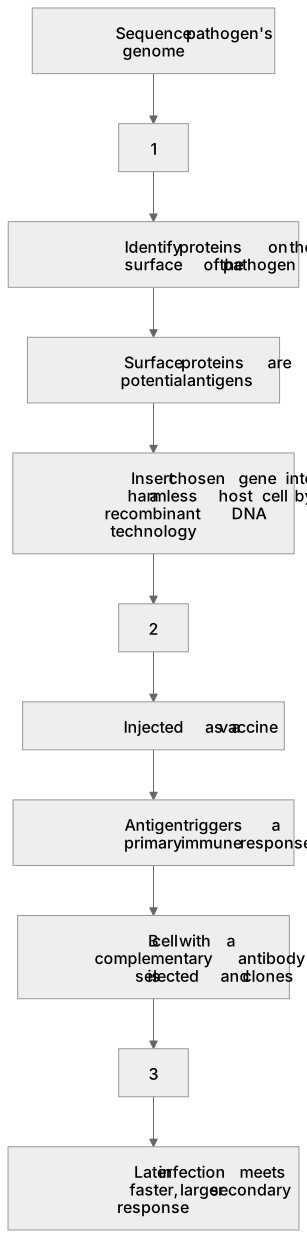
1Box 1
2Box 2
3Box 3
There is more to this lesson
The full lesson goes on to check your understanding and help you earn the marks. Create a free account to carry on, with your progress saved.
A week of Premium from your first lesson · Then the free plan continues · No card, no charge
Test your understanding of Using genome projects (A-level only): This may have many applications, including the identification of potential antigens for use in vaccine production.
Active recall beats re-reading. Take an instant quiz now to test what you’ve learned and lock it into long-term memory.
A week of Premium from your first lesson · Then the free plan continues · No card, no charge