AQA · GCSE · Biology
Bioenergetics
Master the engine room of life! This guide covers photosynthesis and respiration, essential processes that transfer energy in all living things, and is packed with the exact terminology examiners look for to award top marks.
- 8 min read
- 3 worked examples
- 5 practice questions
- 6 key terms
Study Notes
Overview
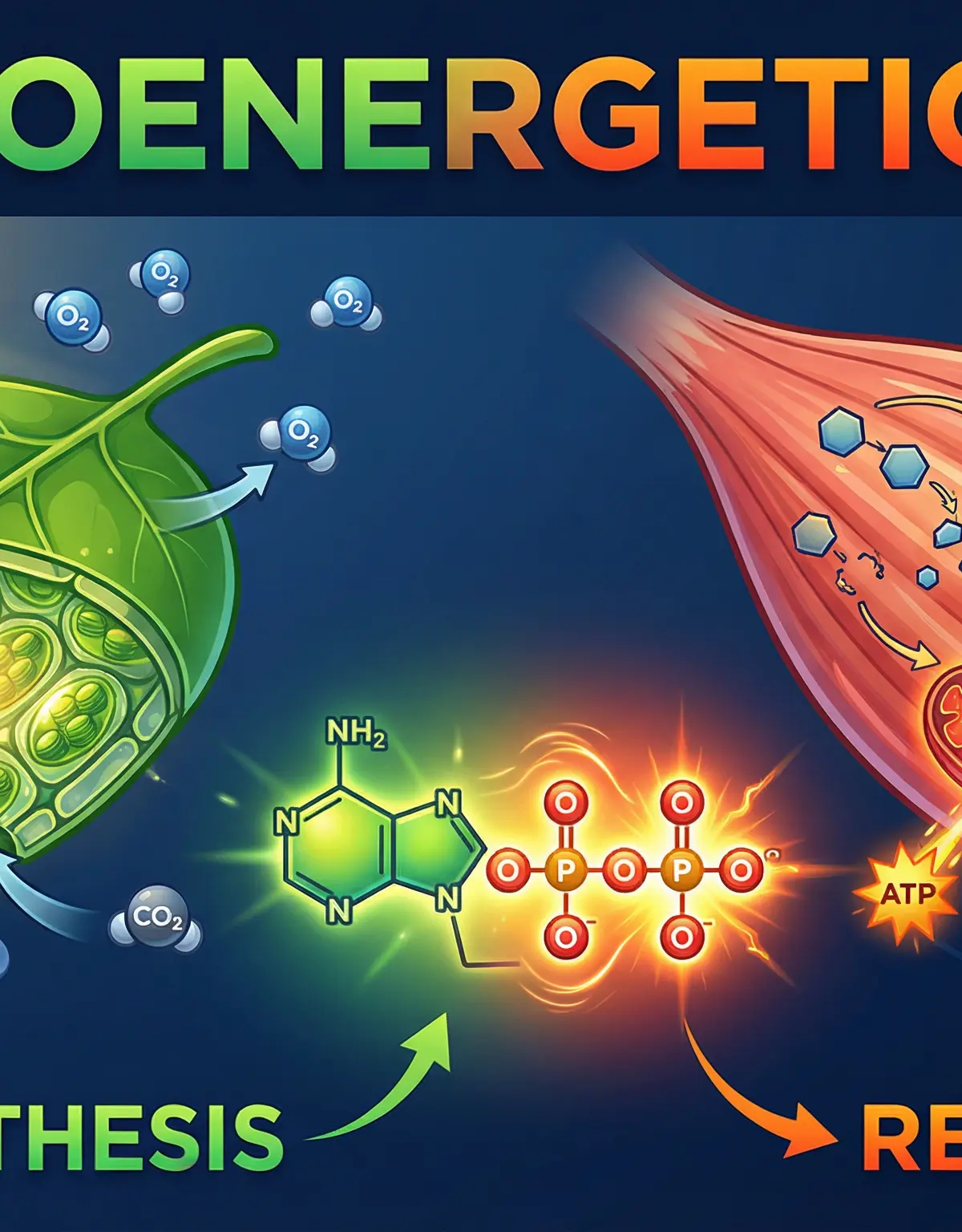
Welcome to the Bioenergetics topic. This section of the GCSE Biology specification is fundamentally about how organisms obtain, transfer, and use energy. It is a cornerstone of Biology because every single living cell requires energy to survive.
In this topic, we will explore two main processes: photosynthesis, where plants capture light energy to synthesize glucose, and respiration, where all living organisms transfer energy from glucose to power their metabolic reactions.
Understanding bioenergetics connects directly to ecology (food chains and biomass) and human biology (exercise and the circulatory system). Examiners frequently test this topic using data analysis questions, graph interpretations of limiting factors, and extended response questions comparing aerobic and anaerobic respiration.
Listen to the podcast below for a comprehensive 10-minute audio review of the entire topic:
Key Concepts
Concept 1: Photosynthesis
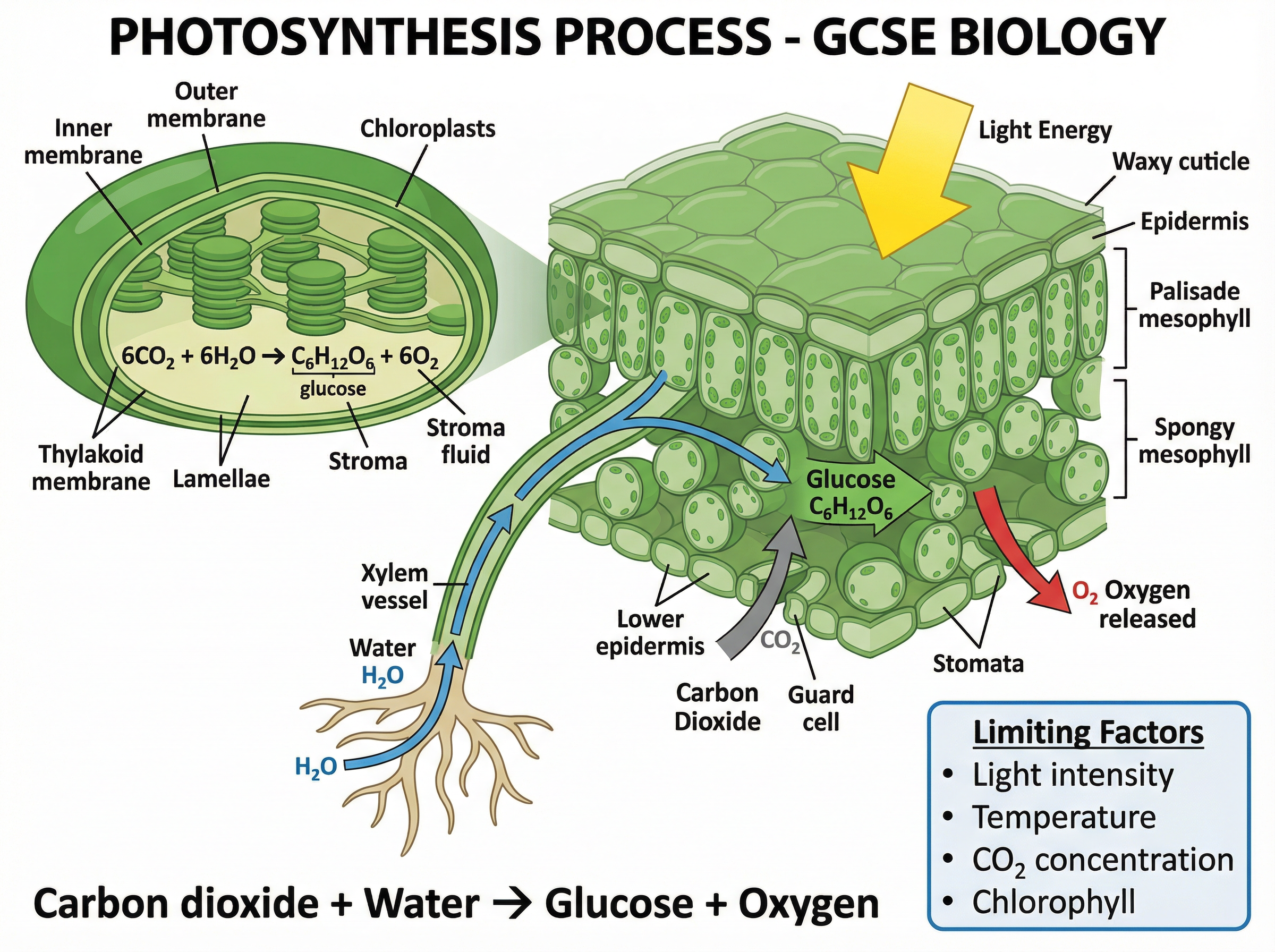
Photosynthesis is an endothermic reaction in which energy is transferred from the environment to the chloroplasts by light. This is a vital concept: plants do not 'make' energy; they transfer light energy into chemical energy stored in the bonds of glucose molecules.
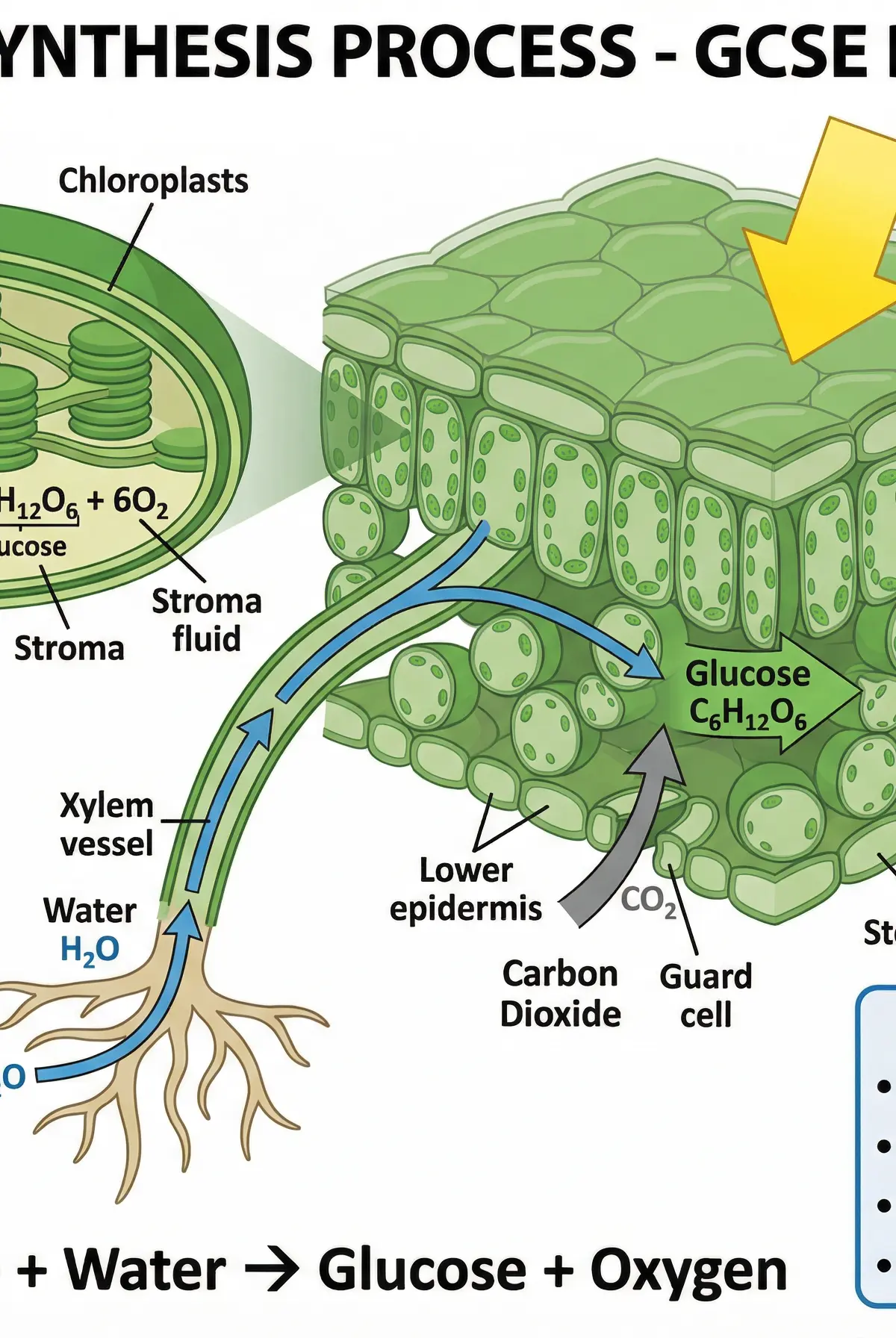
The process occurs in the chloroplasts of plant cells and algae, which contain the green pigment chlorophyll. Chlorophyll absorbs the light energy required to drive the reaction.
**The Equations:**You must be able to recall both the word and balanced chemical equations for photosynthesis.
- Word Equation: Carbon dioxide + Water → Glucose + Oxygen
- Chemical Equation: 6CO₂ + 6H₂O → C₆H₁₂O₆ + 6O₂
**How the plant uses glucose:**Once glucose is produced, the plant uses it in several ways:
- For respiration to transfer energy.
- Converted into insoluble starch for storage (so it doesn't affect osmosis).
- Used to produce fat or oil for storage.
- Used to produce cellulose, which strengthens the cell wall.
- Combined with nitrate ions absorbed from the soil to produce amino acids for protein synthesis.
Concept 2: Limiting Factors of Photosynthesis
The rate of photosynthesis is not constant; it is controlled by the factor that is in the shortest supply. This is known as a limiting factor. The main limiting factors are:
- Light Intensity: As light intensity increases, the rate of photosynthesis increases steadily, but only up to a certain point. Beyond that point, the rate plateaus because another factor (like CO₂ or temperature) becomes limiting.
- Carbon Dioxide Concentration: CO₂ is a reactant. Increasing its concentration increases the rate up to a point, after which the graph levels off.
- Temperature: Photosynthesis is controlled by enzymes. As temperature increases, the rate increases due to more kinetic energy. However, if it gets too hot (usually above 40°C), the enzymes denature, and the rate drops rapidly to zero.
- Amount of Chlorophyll: If a plant has a magnesium deficiency, it cannot make enough chlorophyll (chlorosis), which limits the amount of light it can absorb, reducing the rate of photosynthesis.
Concept 3: Respiration
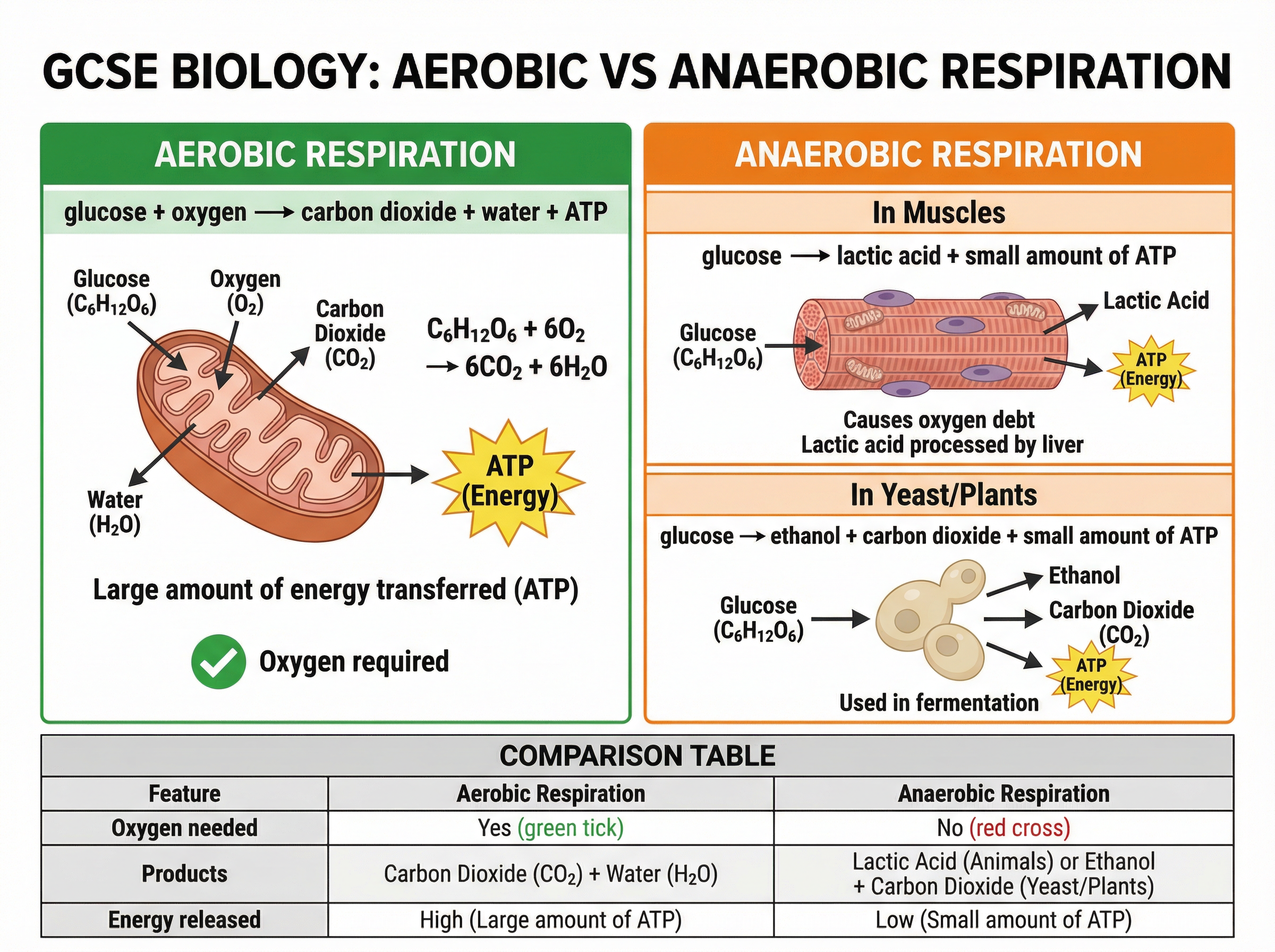
Respiration is an exothermic reaction that occurs continuously in living cells. It transfers energy from glucose so that all living processes can occur.
Crucial Examiner Tip: Never write that respiration "produces" or "creates" energy. Energy cannot be created or destroyed. Always write that respiration transfers energy or releases energy.
Organisms need this transferred energy for:
- Chemical reactions to build larger molecules (e.g., proteins from amino acids).
- Movement (muscle contraction in animals).
- Keeping warm (in birds and mammals).
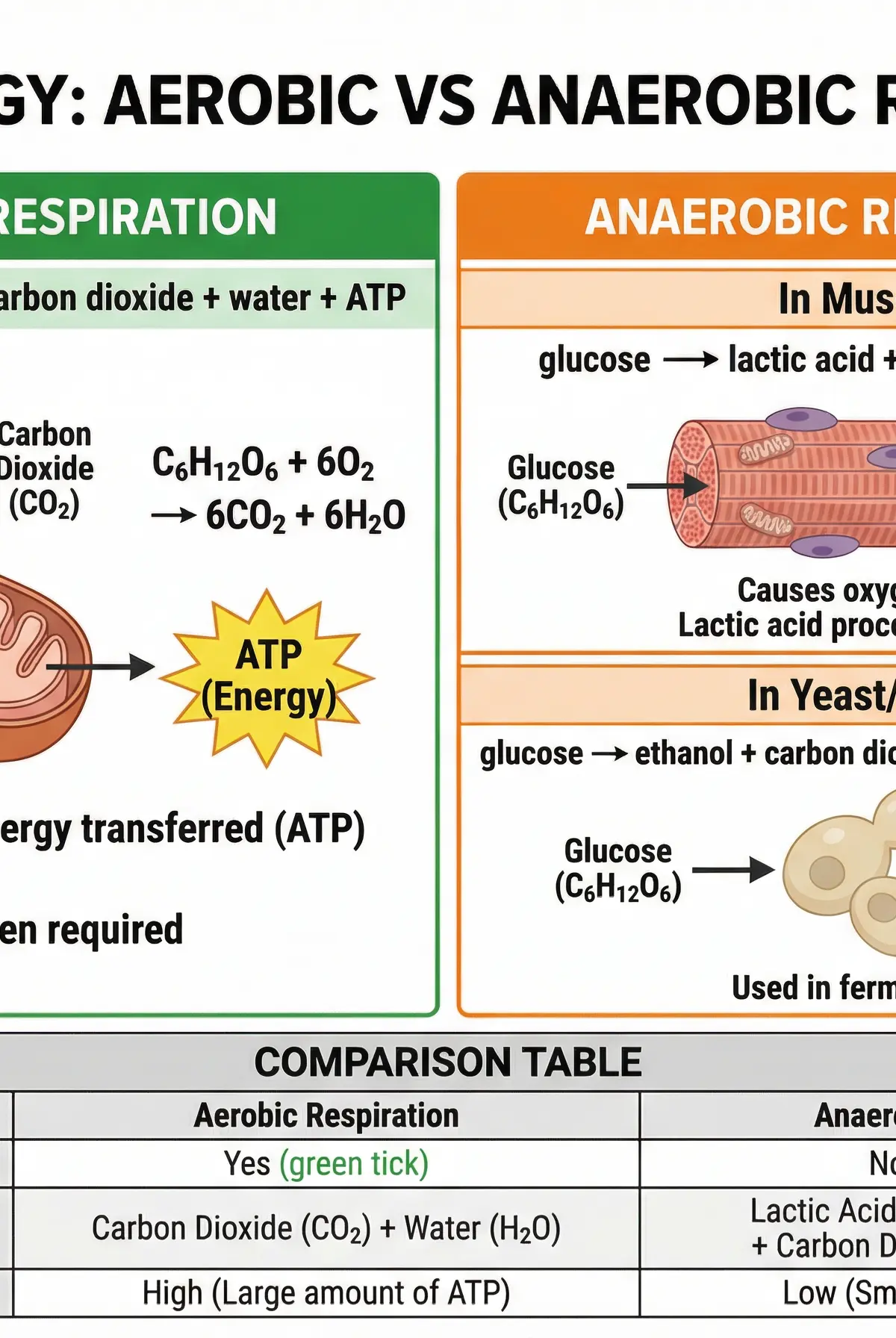
There are two types of respiration: Aerobic (with oxygen) and Anaerobic (without oxygen).
**Aerobic Respiration:**This occurs mainly in the mitochondria and yields a large amount of energy because the glucose is fully oxidized.
- Word Equation: Glucose + Oxygen → Carbon dioxide + Water
- Chemical Equation: C₆H₁₂O₆ + 6O₂ → 6CO₂ + 6H₂O
**Anaerobic Respiration in Animals:**During vigorous exercise, muscles may not get enough oxygen. Glucose is only partially broken down, transferring much less energy than aerobic respiration.
- Word Equation: Glucose → Lactic acid
**Anaerobic Respiration in Plants and Yeast:**In plant and yeast cells, anaerobic respiration produces different products. In yeast, this process is called fermentation and is economically important in the manufacture of bread and alcoholic drinks.
- Word Equation: Glucose → Ethanol + Carbon dioxide
Concept 4: Response to Exercise and Oxygen Debt
During exercise, the human body reacts to the increased demand for energy. The heart rate, breathing rate, and breath volume all increase to supply the muscles with more oxygenated blood.
If insufficient oxygen is supplied, anaerobic respiration takes place in muscles. The incomplete oxidation of glucose causes a build-up of lactic acid and creates an oxygen debt. Lactic acid causes muscle fatigue and stops them contracting efficiently.
The Oxygen Debt: This is the amount of extra oxygen the body needs after exercise to react with the accumulated lactic acid and remove it from the cells. Blood flowing through the muscles transports the lactic acid to the liver where it is converted back into glucose.
Concept 5: Metabolism
Metabolism is the sum of all the reactions in a cell or the body.
The energy transferred by respiration in cells is used by the organism for the continual enzyme-controlled processes of metabolism that synthesize new molecules. Key metabolic processes include:
- Conversion of glucose to starch, glycogen, and cellulose.
- The formation of lipid molecules from a molecule of glycerol and three molecules of fatty acids.
- The use of glucose and nitrate ions to form amino acids, which in turn are used to synthesize proteins.
- Respiration.
- Breakdown of excess proteins to form urea for excretion.
Mathematical/Scientific Relationships
The Inverse Square Law (Higher Tier)
When investigating the effect of light intensity on the rate of photosynthesis, you must understand that light intensity obeys the inverse square law.
This means that as the distance (d) of a light source from the plant increases, the light intensity (I) decreases in proportion to the square of the distance.
Formula:
I \propto \frac{1}{d^2}
- I = Light Intensity (arbitrary units)
- d = Distance from the light source (m or cm)
When to use it: If an exam question states that the distance between a lamp and a pondweed is doubled (e.g., from 10 cm to 20 cm), the light intensity does not halve; it falls by a factor of 2^2 (which is 4). So the light intensity becomes a quarter of what it was.
Practical Applications
Required Practical: Investigating the effect of light intensity on the rate of photosynthesis using an aquatic organism such as pondweed.
- Apparatus: Boiling tube, LED lamp, ruler, sodium hydrogencarbonate solution (to provide excess CO₂), pondweed (e.g., Cabomba or Elodea), stopwatch.
- Method:
- Place pondweed in a boiling tube containing sodium hydrogencarbonate solution.
- Position an LED lamp at a specific distance (e.g., 10 cm) measured with a ruler. (LED is used because it emits very little heat, controlling the temperature variable).
- Allow the pondweed to acclimatize for 5 minutes.
- Start the stopwatch and count the number of oxygen bubbles produced in 1 minute.
- Repeat the count twice more to calculate a mean.
- Move the lamp to different distances (20 cm, 30 cm, 40 cm) and repeat the process.
- Common Errors: Counting bubbles is subjective and bubbles can be different sizes. A more accurate method is to collect the oxygen in a gas syringe or an inverted measuring cylinder to measure the volume of gas produced.
- Examiner Focus: Examiners will test your understanding of variables. The independent variable is distance from the lamp. The dependent variable is the number of bubbles per minute (rate). Control variables include temperature (use an LED bulb or a water bath) and CO₂ concentration (use the same concentration of sodium hydrogencarbonate).
Visual Resources
2 diagrams and illustrations
Interactive Diagrams
2 interactive diagrams to visualise key concepts
Conceptual Flow Outline
Flowchart showing the pathways of respiration depending on the presence of oxygen and the type of organism.
Conceptual Flow Outline
The pathway of lactic acid processing and the repayment of the oxygen debt.
Worked Examples
3 worked examples — open one to explore the question and available guidance.
Practice Questions
Test your understanding — click to reveal model answers
State the balanced chemical equation for photosynthesis. (2 marks)
Hint: Remember there are 6s in front of everything except glucose.
Explain why the rate of photosynthesis decreases at temperatures above 40°C. (2 marks)
Hint: Think about what controls the chemical reactions in photosynthesis and how heat affects them.
During a 100m sprint, an athlete's muscles respire anaerobically. Explain why this happens and describe the consequences for the athlete after the race. (4 marks)
Hint: Link the oxygen supply to the type of respiration, then define what the oxygen debt is.
A student investigated the effect of light intensity on photosynthesis using pondweed. Suggest why they used an LED lamp instead of a traditional filament bulb. (2 marks)
Hint: What do traditional bulbs produce besides light that could affect the experiment?
Describe the role of the liver in the recovery from vigorous exercise. (3 marks)
Hint: Where does the lactic acid go, and what does the liver do to it?