AQA · GCSE · Biology
Key ideas
Master the fundamental principles that underpin all of GCSE Biology. Understanding these core concepts is the secret to unlocking the highest grades and tackling synoptic questions with confidence.
- 7 min read
- 3 worked examples
- 5 practice questions
- 6 key terms
Study Notes
Overview

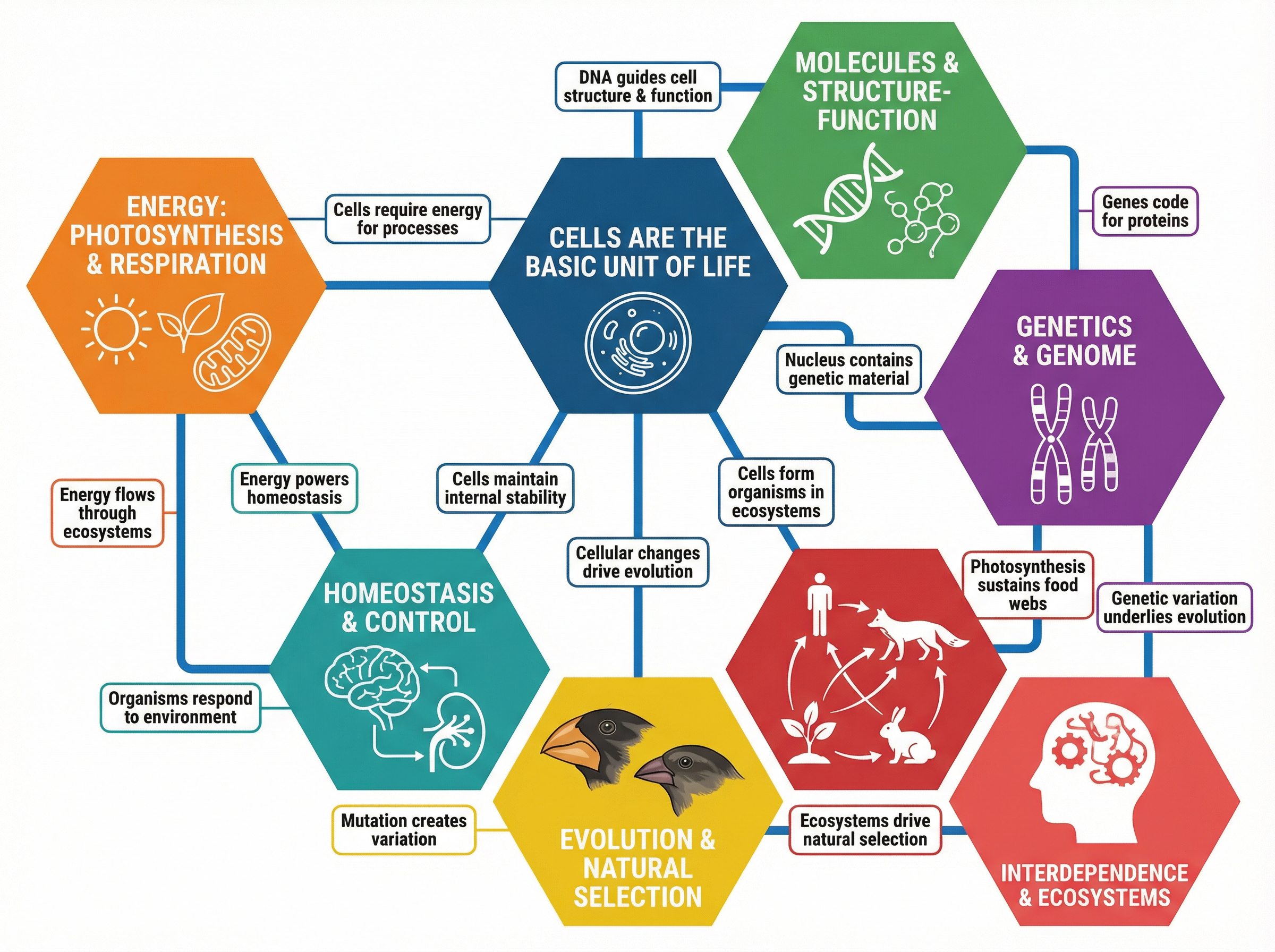
Welcome to the foundation of your GCSE Biology course. The 'Key Ideas' aren't just another topic to memorise; they are the fundamental principles that connect every single chapter of your specification. Examiners design their most challenging questions to test whether you can see the 'big picture'—linking respiration to ecology, or genetics to evolution.
Understanding these core concepts is crucial because they appear in almost every exam paper. When you grasp that cells are the basic units of life, or that molecular structure dictates function, you stop memorising isolated facts and start thinking like a true biologist. This topic will equip you with the synoptic thinking skills required to access the highest mark bands, particularly in extended response questions.
Key Concepts
Concept 1: Cells are the Fundamental Units of Life
Every living organism, from microscopic bacteria to giant redwoods, is composed of cells. This is the starting point for all biological processes. When examiners ask you to explain a complex physiological response, the answer invariably lies at the cellular level. For instance, muscle contraction is powered by mitochondria within muscle cells; nerve impulses are transmitted by specialised neurons.
Why this works: Cells provide compartmentalisation. By keeping specific reactions contained within organelles (like respiration in mitochondria or photosynthesis in chloroplasts), organisms can maintain the optimal conditions for these vital processes without them interfering with one another.
Example: When discussing how the lungs function, you must link the macroscopic organ to the cellular adaptations of the alveoli, such as the single-cell thick walls that provide a short diffusion pathway.
Concept 2: Structure Determines Function
This principle applies at every level of biology, but it is most powerfully seen at the molecular level. The shape of a molecule is directly responsible for what it can do. If the shape changes (for example, due to extreme temperature or pH), the function is lost.
Why this works: Biological molecules interact through physical binding. An enzyme's active site has a specific 3D shape that is complementary to its substrate. If the shape of the active site denatures, the substrate can no longer bind, and the reaction stops.
Example: The biconcave disc shape of red blood cells increases their surface area to volume ratio, allowing for rapid diffusion of oxygen. Furthermore, they contain no nucleus, leaving more room for the oxygen-carrying molecule haemoglobin.
Concept 3: Energy Flow in Living Systems
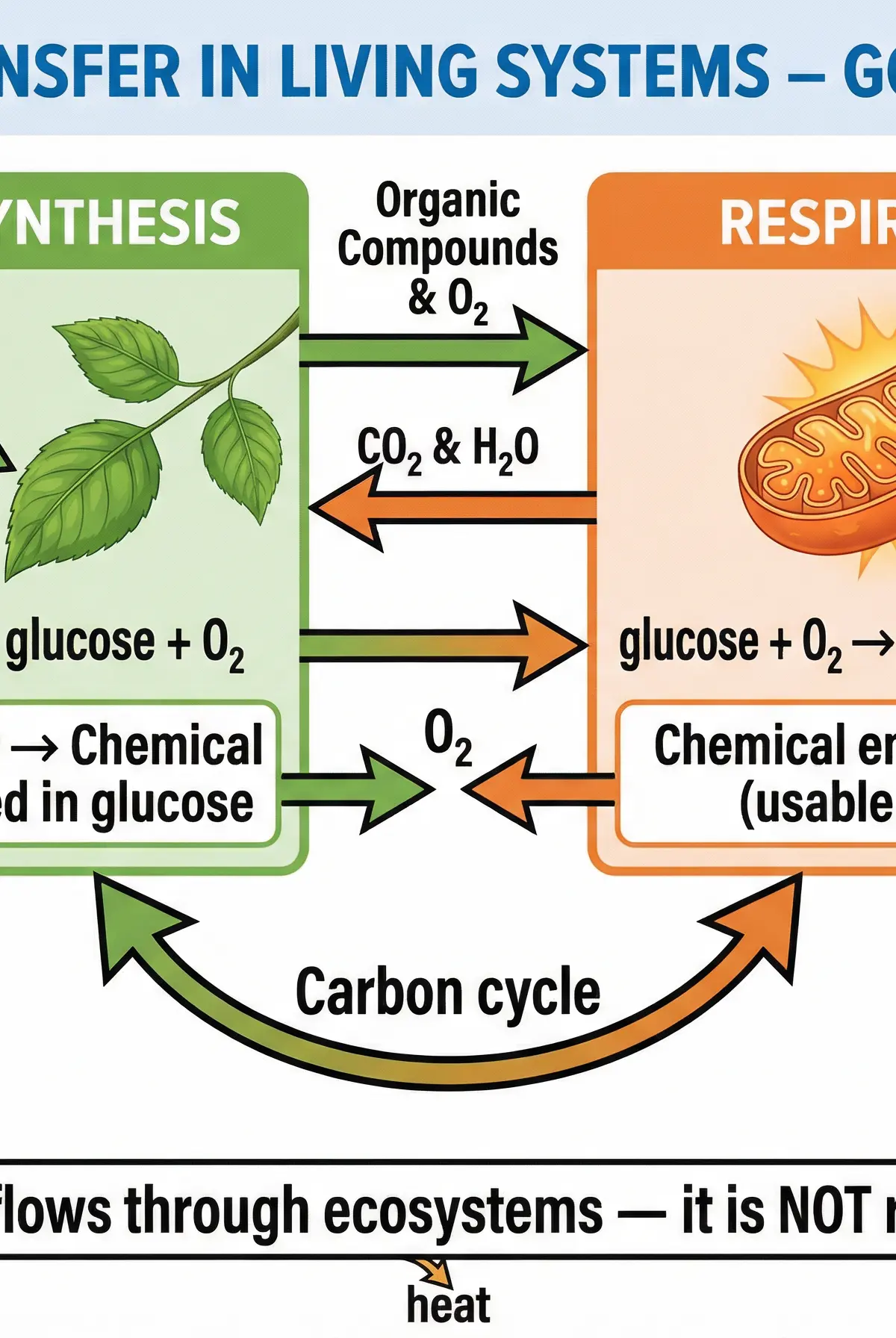
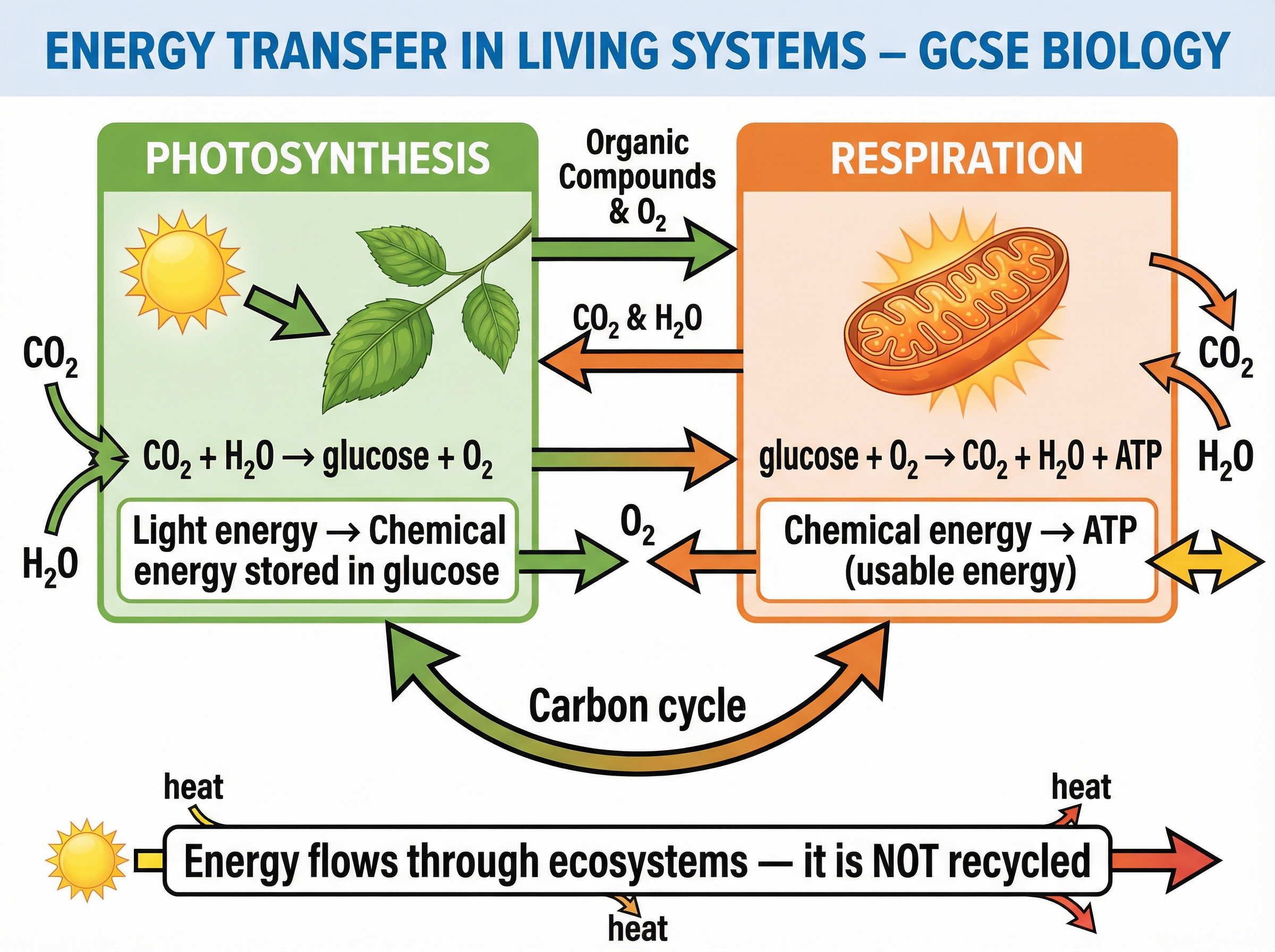
All life requires energy, and this energy is governed by two vital processes: photosynthesis and respiration. It is essential to understand that energy flows through an ecosystem; it is not recycled. It enters as sunlight, is converted to chemical energy by producers, and is eventually lost to the environment as heat.
Why this works: Photosynthesis (an endothermic reaction) captures light energy to build complex glucose molecules. Respiration (an exothermic reaction) breaks down these glucose molecules to release energy in the form of ATP, which cells use for movement, active transport, and building new molecules.
Example: Calculating the efficiency of energy transfer between trophic levels. If a producer contains 10,000 kJ of energy and the primary consumer stores 1,000 kJ, the efficiency is (1,000 / 10,000) × 100 = 10%.
Concept 4: Genetics and the Environment
The characteristics of any organism are the result of an intricate interplay between its genetic makeup (genome) and its environment. Genes provide the instructions for making proteins, but environmental factors can influence how those traits are expressed.
Why this works: DNA contains the code for sequences of amino acids, which fold into specific proteins. These proteins determine physical traits. However, environmental factors (like diet, light, or physical stress) can affect growth and development, leading to continuous variation within a population.
Example: A plant may have the genetic potential to grow tall, but if it is grown in nutrient-poor soil with insufficient light, it will remain stunted. This demonstrates that phenotype = genotype + environment.
Concept 5: Interdependence and Adaptation
No organism lives in isolation. Within an ecosystem, species depend on each other for resources such as food, shelter, and pollination. Furthermore, organisms possess adaptations—structural, behavioural, or physiological features—that make them well-suited to survive in their specific habitat.
Why this works: In a stable community, the population sizes of different species remain relatively constant because the resources are balanced. Adaptations reduce competition by allowing organisms to exploit specific ecological niches.
Example: Cacti have reduced leaves (spines) to minimise water loss via transpiration, and a thick waxy cuticle. These structural adaptations allow them to survive in arid desert environments.
Concept 6: Evolution by Natural Selection
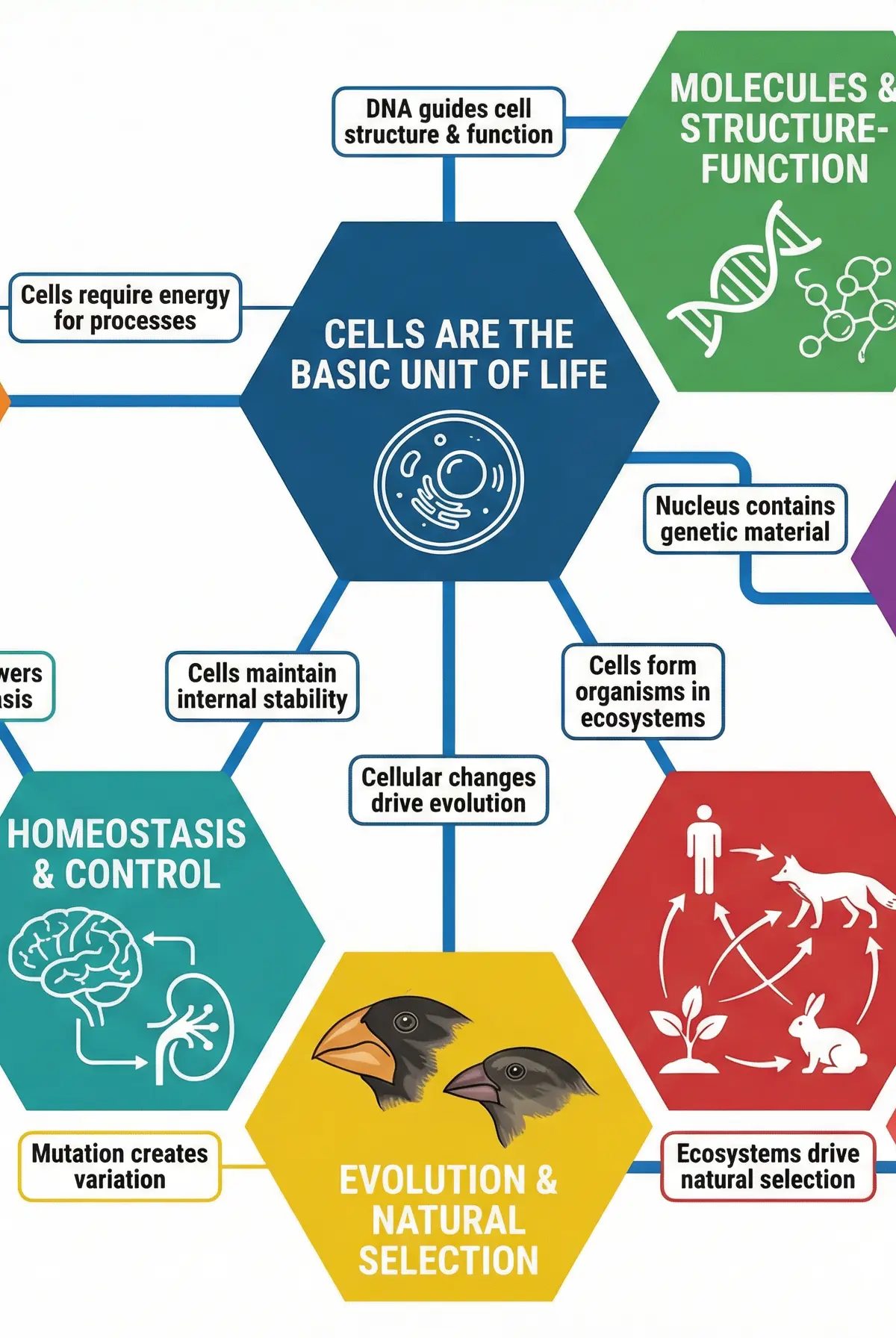
Evolution is the unifying theory of biology. It explains how the immense diversity of life on Earth arose from common ancestors through the process of natural selection, as proposed by Charles Darwin.
Why this works: The mechanism relies on four key steps:
- Variation: Random mutations create genetic differences within a population.
- Competition: Organisms produce more offspring than the environment can support, leading to a struggle for survival.
- Survival of the fittest: Individuals with phenotypes best adapted to the environment are more likely to survive.
- Reproduction: These survivors reproduce and pass their advantageous alleles to the next generation.
Example: The evolution of antibiotic resistance in bacteria. A random mutation gives a bacterium resistance to penicillin. When treated with penicillin, the non-resistant bacteria die, but the resistant one survives, reproduces, and passes on the resistance allele.
Mathematical/Scientific Relationships
- Efficiency of energy transfer: (Energy available to next trophic level / Energy available at previous trophic level) × 100
- Surface Area to Volume Ratio (SA:V): Calculated by finding the total surface area and dividing by the total volume. A larger ratio means faster diffusion. (Must memorise)
- Magnification: Image size = Actual size × Magnification (I = A × M) (Must memorise)
Practical Applications
Understanding these key ideas is crucial for interpreting unfamiliar contexts in the exam. For instance, if presented with a novel disease, you should immediately consider its cellular impact (Concept 1), how it affects molecular structures like enzymes (Concept 2), or how it might disrupt an ecosystem's interdependence (Concept 5).
Audio Resource
Listen to our comprehensive 10-minute podcast covering all these key ideas and how to apply them in your exam:
Visual Resources
2 diagrams and illustrations
Interactive Diagrams
2 interactive diagrams to visualise key concepts
Conceptual Flow Outline
The interdependent relationship between photosynthesis and respiration, showing the cycling of matter and the flow of energy.
Conceptual Flow Outline
Flowchart demonstrating the chronological steps of evolution by natural selection.
Worked Examples
3 worked examples — open one to explore the question and available guidance.
Practice Questions
Test your understanding — click to reveal model answers
State the two main products of aerobic respiration. (2 marks)
Hint: Think about what you breathe out and what condenses on a cold window.
Describe how the structure of a red blood cell is adapted to its function. (3 marks)
Hint: Consider its shape and what it is missing compared to a normal animal cell.
Explain why a change in the DNA sequence of a gene may result in a non-functional enzyme. (4 marks)
Hint: Connect Concept 4 (Genetics) to Concept 2 (Structure and Function). Think about the sequence of events from DNA to protein shape.
Compare the processes of aerobic and anaerobic respiration in human muscle cells. (4 marks)
Hint: Remember to identify both similarities AND differences for a 'compare' question.
An arctic fox has small ears and a thick coat. Explain how these adaptations help it survive in a cold climate. (3 marks)
Hint: Relate the structural features to heat transfer.