AQA · GCSE · Biology
Course version: 8461 · Version from Sept 2018
Pollution kills plants and animals which can reduce biodiversity.
Full specification wording
Waste management: Pollution kills plants and animals which can reduce biodiversity.
Pollution is the release of harmful substances into an environment.
Checked against the AQA 8461 specification (opens in a new tab) on .
- Point 4 of 4
- 4 key terms
Study notes
From the checked teaching notes for this specification point.
The idea
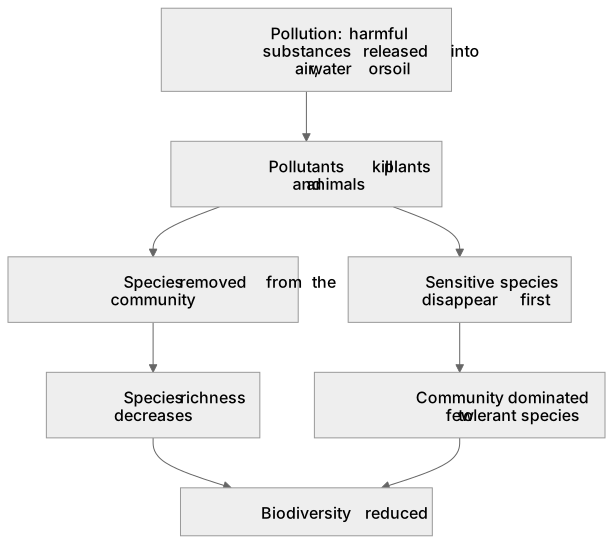
Pollution is the release of harmful substances into an environment. When pollutants enter air, water or soil, organisms may be poisoned, suffocated or have their habitats altered so that they cannot survive. For example, fertiliser washed from fields into a lake causes eutrophication: algae grow rapidly, then decompose, and the oxygen concentration falls so fish and other animals die. Similarly, sulfur dioxide from burning fossil fuels can damage leaves and acidify soils, while oil spills coat feathers and gills. Because different species tolerate pollution differently, sensitive species disappear first. The community becomes dominated by a few tolerant species, so species richness and genetic diversity fall. This is a reduction in biodiversity. The effect depends on the pollutant, its concentration, how long it persists and how quickly it is broken down or dispersed.
What earns the marks
- Pollution is the release of harmful substances into the environment, including air, water and soil.
- Pollutants can kill organisms directly by poisoning them or indirectly by damaging habitats and food sources.
- A named example, such as fertiliser causing eutrophication or sulfur dioxide damaging leaves, shows how a pollutant kills organisms.
- Killing plants and animals removes species from the community, so species richness decreases.
- The surviving community may contain only a few pollution-tolerant species, so biodiversity is reduced.
- The scale of the reduction depends on pollutant concentration, persistence and the sensitivity of different species.
Common mistakes and how to put them right
Treating pollution as only visible litter.
Put it right: Pollution includes gases, excess nutrients, pesticides, oil and other harmful substances that may be invisible.
Assuming all species are affected equally.
Put it right: Species differ in tolerance, so sensitive species are lost first and tolerant species may survive.
Saying biodiversity increases because a few tolerant species become abundant.
Put it right: Biodiversity depends on the variety of species, not the number of individuals of one species.
Exam tips
- Name a specific pollutant and a specific affected organism to make the link between pollution and death concrete.
- Use the chain pollution → kills organisms → fewer species → reduced biodiversity rather than stopping at the word pollution.
- When describing eutrophication, keep the sequence in order: nutrient enrichment, algal growth, decomposition, oxygen depletion, death of animals.
Try the lesson
The start of the Waste management: Pollution kills plants and animals which can reduce biodiversity. lesson, made from checked teaching notes for this specification point.
Have a go first
A river receives a large volume of untreated sewage. Many fish in the river die. What is the most likely effect of this on the biodiversity of the river?
Listen
Pollution is the release of harmful substances into an environment. When pollutants enter air, water or soil, organisms may be poisoned, suffocated or have their habitats altered so that they cannot survive. For example, fertiliser washed from fields into a lake causes eutrophication: algae grow rapidly, then decompose, and the oxygen concentration falls so fish and other animals die. Similarly, sulfur dioxide from burning fossil fuels can damage leaves and acidify soils, while oil spills coat feathers and gills. Because different species tolerate pollution differently, sensitive species disappear first. The community becomes dominated by a few tolerant species, so species richness and genetic diversity fall. This is a reduction in biodiversity. The effect depends on the pollutant, its concentration, how long it persists and how quickly it is broken down or dispersed. A strong answer earns marks for these points. Pollution is the release of harmful substances into the environment, including air, water and soil. Pollutants can kill organisms directly by poisoning them or indirectly by damaging habitats and food sources. A named example, such as fertiliser causing eutrophication or sulfur dioxide damaging leaves, shows how a pollutant kills organisms. Killing plants and animals removes species from the community, so species richness decreases. A common slip: Treating pollution as only visible litter. Instead, pollution includes gases, excess nutrients, pesticides, oil and other harmful substances that may be invisible. Exam tip: Name a specific pollutant and a specific affected organism to make the link between pollution and death concrete.
See it
Key words
Say what each word means before you turn the card.
Pollution
Try answering aloud or in your head before turning the card.
Biodiversity
Try answering aloud or in your head before turning the card.
Species richness
Try answering aloud or in your head before turning the card.
Eutrophication
Try answering aloud or in your head before turning the card.
See every definition
- Pollution
- The release of harmful substances into an environment, including air, water and soil.
- Biodiversity
- The variety of species in a community, which falls when pollution kills plants and animals.
- Species richness
- The number of species in a community, which decreases when pollution removes species.
- Eutrophication
- Fertiliser washed from fields into a lake causes algae to grow rapidly, then decompose, and the oxygen concentration falls so fish and other animals die.
Label the diagram
Some boxes have lost their names. Pick the right name for each number.
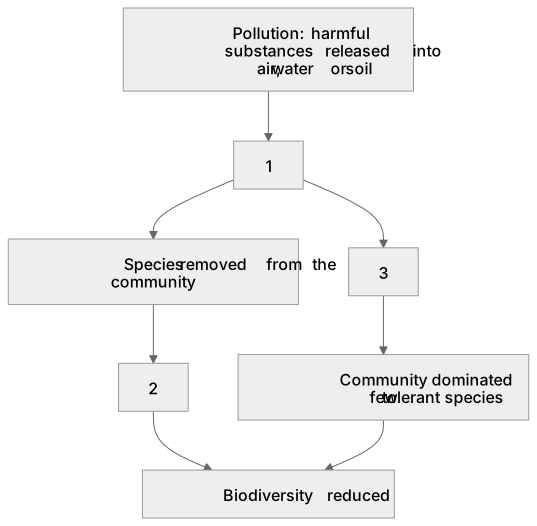
1Box 1
2Box 2
3Box 3
There is more to this lesson
The full lesson goes on to check your understanding and help you earn the marks. Create a free account to carry on, with your progress saved.
A week of Premium from your first lesson · Then the free plan continues · No card, no charge
Test your understanding of Waste management: Pollution kills plants and animals which can reduce biodiversity.
Active recall beats re-reading. Take an instant quiz now to test what you’ve learned and lock it into long-term memory.
A week of Premium from your first lesson · Then the free plan continues · No card, no charge