OCR · A-Level · Biology
Course version: H420 · Version from Sept 2025
(b) use of appropriate mathematical skills for analysis of quantitative data
Full specification wording
Analysis: (b) use of appropriate mathematical skills for analysis of quantitative data
Quantitative analysis in biology requires selecting the right mathematical tool for the data and applying it accurately.
Checked against the OCR H420 specification (opens in a new tab) on .
- Point 1 of 4
- 4 key terms
Study notes
From the checked teaching notes for this specification point.
The idea
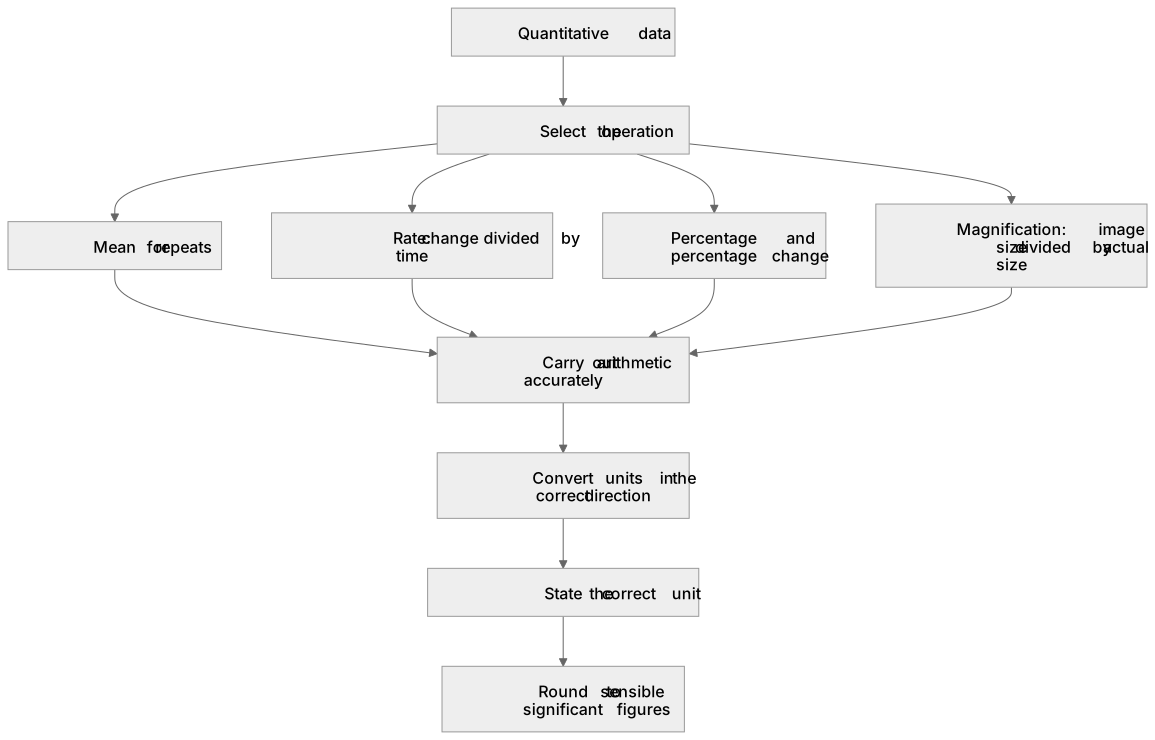
Quantitative analysis in biology requires selecting the right mathematical tool for the data and applying it accurately. Typical skills include calculating a mean from repeat measurements, finding a rate by dividing a change by the time taken, using percentages and percentage change, converting units such as mm to µm (multiply by 1000) or cm³ to dm³ (divide by 1000), and using magnification as image size divided by actual size. Choosing appropriately means matching the operation to the question: a mean summarises repeats, a rate describes change over time, a percentage allows comparison between different starting sizes. Units must be carried through and stated, and significant figures should reflect the precision of the measurements. A multiple-choice item tests whether the correct operation and unit have both been selected, so check the arithmetic and the unit before choosing an option.
What earns the marks
- The correct mathematical operation is selected for the data, such as a mean for repeats or a rate for change over time.
- Arithmetic is carried out accurately, including correct handling of decimals and significant figures.
- Unit conversions are performed in the correct direction, for example multiplying by 1000 to convert mm to µm.
- The final answer carries the correct unit and is expressed to a sensible number of significant figures.
Common mistakes and how to put them right
Converting units in the wrong direction, for example dividing when converting mm to µm.
Put it right: Multiply by 1000 because there are 1000 µm in 1 mm.
Averaging repeat measurements without checking for an anomalous value.
Put it right: Identify the anomaly and consider its effect on the mean.
Reporting a rate without its unit or with the wrong unit.
Put it right: State the unit, such as change per unit time.
Rounding intermediate values too early.
Put it right: Keep full precision during the calculation and round only the final answer.
Exam tips
- Write down the operation and the unit before doing the arithmetic, then check both against the options.
- Keep full precision through intermediate steps and round only the final answer.
- Sanity-check the magnitude of the answer against the data to catch a conversion error.
Try the lesson
The start of the Analysis: (b) use of appropriate mathematical skills for analysis of quantitative data lesson, made from checked teaching notes for this specification point.
Have a go first
A student counts 24 stomata in one field of view of a microscope. A second field of view contains 18 stomata. Calculate the mean number of stomata per field of view.
Listen
Quantitative analysis in biology requires selecting the right mathematical tool for the data and applying it accurately. Typical skills include calculating a mean from repeat measurements, finding a rate by dividing a change by the time taken, using percentages and percentage change, converting units such as mm to µm (multiply by 1000) or cm³ to dm³ (divide by 1000), and using magnification as image size divided by actual size. Choosing appropriately means matching the operation to the question: a mean summarises repeats, a rate describes change over time, a percentage allows comparison between different starting sizes. Units must be carried through and stated, and significant figures should reflect the precision of the measurements. A multiple-choice item tests whether the correct operation and unit have both been selected, so check the arithmetic and the unit before choosing an option. A strong answer earns marks for these points. The correct mathematical operation is selected for the data, such as a mean for repeats or a rate for change over time. Arithmetic is carried out accurately, including correct handling of decimals and significant figures. Unit conversions are performed in the correct direction, for example multiplying by 1000 to convert mm to µm. The final answer carries the correct unit and is expressed to a sensible number of significant figures. A common slip: Converting units in the wrong direction, for example dividing when converting mm to µm. Instead, multiply by 1000 because there are 1000 µm in 1 mm. Exam tip: Write down the operation and the unit before doing the arithmetic, then check both against the options.
See it
Key words
Say what each word means before you turn the card.
Selecting the appropriate operation
Try answering aloud or in your head before turning the card.
Accurate arithmetic and significant figures
Try answering aloud or in your head before turning the card.
Correct unit conversion direction
Try answering aloud or in your head before turning the card.
Carrying units through to the answer
Try answering aloud or in your head before turning the card.
See every definition
- Selecting the appropriate operation
- Matching the mathematical operation to the question, such as a mean to summarise repeats or a rate to describe change over time.
- Accurate arithmetic and significant figures
- Carrying out arithmetic accurately, including correct handling of decimals, with significant figures reflecting the precision of the measurements.
- Correct unit conversion direction
- Performing unit conversions in the correct direction, for example multiplying by 1000 to convert mm to µm.
- Carrying units through to the answer
- Carrying units through and stating them, so the final answer carries the correct unit.
Label the diagram
Some boxes have lost their names. Pick the right name for each number.
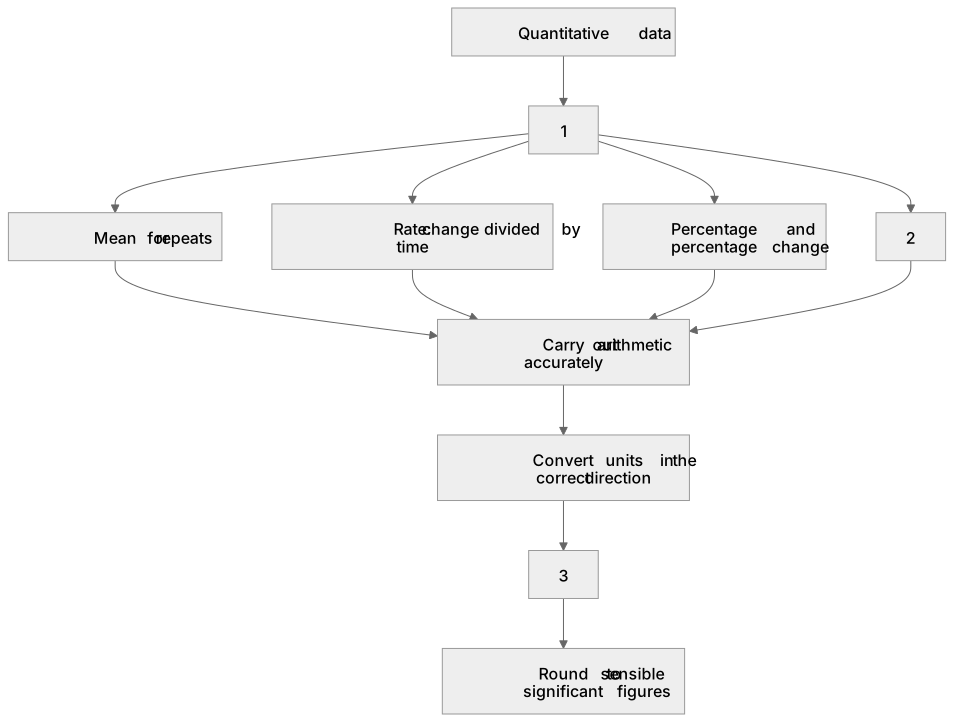
1Box 1
2Box 2
3Box 3
There is more to this lesson
The full lesson goes on to check your understanding and help you earn the marks. Create a free account to carry on, with your progress saved.
A week of Premium from your first lesson · Then the free plan continues · No card, no charge
Test your understanding of Analysis: (b) use of appropriate mathematical skills for analysis of quantitative data
Active recall beats re-reading. Take an instant quiz now to test what you’ve learned and lock it into long-term memory.
A week of Premium from your first lesson · Then the free plan continues · No card, no charge