OCR · A-Level · Biology
Course version: H420 · Version from Sept 2025
Biodiversity: (f) the factors affecting biodiversity
Biodiversity is the variety of living organisms in an area, measured at habitat, species and genetic levels.
Checked against the OCR H420 specification (opens in a new tab) on .
- Point 7 of 10
- 4 key terms
Study notes
From the checked teaching notes for this specification point.
The idea
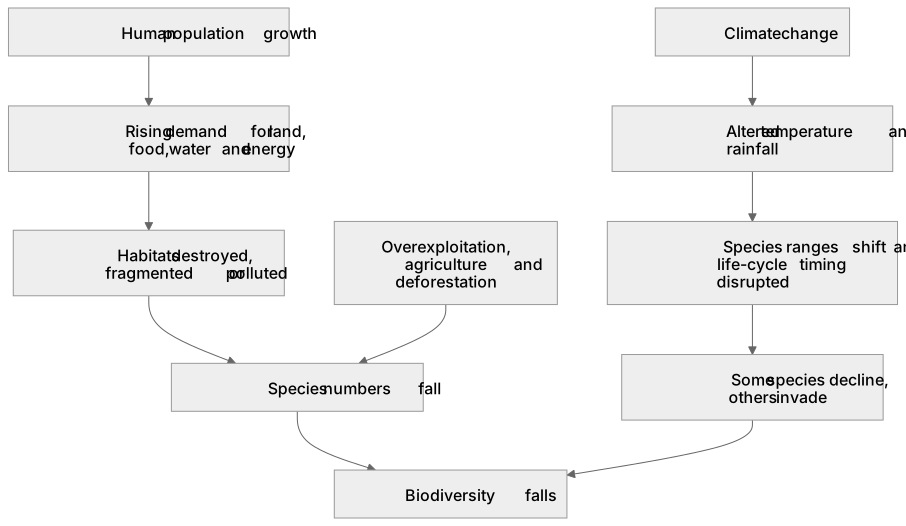
Biodiversity is the variety of living organisms in an area, measured at habitat, species and genetic levels. Learners must be able to identify the factors that affect it. These include human population growth, which raises demand for land, food, water and energy, so habitats are destroyed, fragmented or polluted and species numbers fall. Climate change alters temperature and rainfall patterns, shifting the ranges of species and disrupting the timing of life cycles, so some species decline and others invade. Other factors include overexploitation, agriculture and deforestation. A question may give a scenario and ask which factor is acting, or which change would reduce biodiversity. Read the scenario carefully, name the specific factor, then explain the mechanism by which it lowers variety.
What earns the marks
- Human population growth is a factor: rising numbers increase demand for land, food, water and energy, so habitats are destroyed or degraded and biodiversity falls.
- Climate change is a factor: altered temperature and rainfall shift species ranges and disrupt life-cycle timing, so some species decline and others move in.
- Habitat destruction, fragmentation and pollution reduce the variety of species and habitats able to survive in an area.
- Overexploitation and intensive agriculture reduce species numbers by removing organisms or simplifying habitats.
- The effect on biodiversity can be explained through loss of habitat, loss of species and loss of genetic variation within populations.
Common mistakes and how to put them right
Listing only 'pollution' and ignoring the two named factors.
Put it right: The answer must include human population growth and climate change as factors affecting biodiversity.
Treating biodiversity as simply 'the number of species' and forgetting habitat and genetic variety, which are also affected by these factors.
Describing a factor without linking it to a mechanism, such as saying 'climate change is bad' rather than explaining how changed conditions shift ranges and disrupt life cycles.
Exam tips
- Learn the named factors, especially human population growth and climate change, and be ready to match each to a scenario.
- When a scenario is given, name the specific factor first, then state the mechanism that reduces biodiversity.
- Use the three levels of biodiversity (habitat, species, genetic) to structure an explanation of how a factor acts.
Try the lesson
The start of the Biodiversity: (f) the factors affecting biodiversity lesson, made from checked teaching notes for this specification point.
Have a go first
Which factor would most directly increase the biodiversity of a farmland area?
Listen
Biodiversity is the variety of living organisms in an area, measured at habitat, species and genetic levels. Learners must be able to identify the factors that affect it. These include human population growth, which raises demand for land, food, water and energy, so habitats are destroyed, fragmented or polluted and species numbers fall. Climate change alters temperature and rainfall patterns, shifting the ranges of species and disrupting the timing of life cycles, so some species decline and others invade. Other factors include overexploitation, agriculture and deforestation. A question may give a scenario and ask which factor is acting, or which change would reduce biodiversity. Read the scenario carefully, name the specific factor, then explain the mechanism by which it lowers variety. A strong answer earns marks for these points. Human population growth is a factor: rising numbers increase demand for land, food, water and energy, so habitats are destroyed or degraded and biodiversity falls. Climate change is a factor: altered temperature and rainfall shift species ranges and disrupt life-cycle timing, so some species decline and others move in. Habitat destruction, fragmentation and pollution reduce the variety of species and habitats able to survive in an area. Overexploitation and intensive agriculture reduce species numbers by removing organisms or simplifying habitats. Exam tip: Learn the named factors, especially human population growth and climate change, and be ready to match each to a scenario.
See it
Key words
Say what each word means before you turn the card.
Human population growth
Try answering aloud or in your head before turning the card.
Climate change
Try answering aloud or in your head before turning the card.
Habitat destruction, fragmentation and pollution
Try answering aloud or in your head before turning the card.
Overexploitation and intensive agriculture
Try answering aloud or in your head before turning the card.
See every definition
- Human population growth
- Rising numbers increase demand for land, food, water and energy, so habitats are destroyed or degraded and biodiversity falls.
- Climate change
- Altered temperature and rainfall shift species ranges and disrupt life-cycle timing, so some species decline and others move in.
- Habitat destruction, fragmentation and pollution
- These reduce the variety of species and habitats able to survive in an area.
- Overexploitation and intensive agriculture
- These reduce species numbers by removing organisms or simplifying habitats.
Label the diagram
Some boxes have lost their names. Pick the right name for each number.
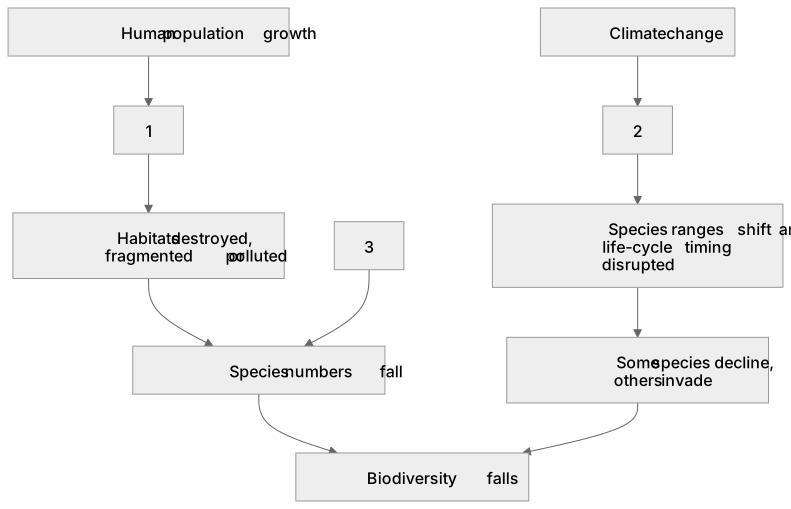
1Box 1
2Box 2
3Box 3
There is more to this lesson
The full lesson goes on to check your understanding and help you earn the marks. Create a free account to carry on, with your progress saved.
A week of Premium from your first lesson · Then the free plan continues · No card, no charge
Test your understanding of Biodiversity: (f) the factors affecting biodiversity
Active recall beats re-reading. Take an instant quiz now to test what you’ve learned and lock it into long-term memory.
A week of Premium from your first lesson · Then the free plan continues · No card, no charge