OCR · A-Level · Biology
Course version: H420 · Version from Sept 2025
(b) the fluid mosaic model of membrane structure and the roles of its…
Full specification wording
Biological membranes: (b) the fluid mosaic model of membrane structure and the roles of its components
The fluid mosaic model describes membranes as a phospholipid bilayer in which proteins are scattered like tiles in a mosaic and can move laterally, giving fluidity.
Checked against the OCR H420 specification (opens in a new tab) on .
- Point 2 of 8
- 4 key terms
Study notes
From the checked teaching notes for this specification point.
The idea
The fluid mosaic model describes membranes as a phospholipid bilayer in which proteins are scattered like tiles in a mosaic and can move laterally, giving fluidity. Teach the arrangement: hydrophilic phosphate heads face the aqueous exterior and cytoplasm, hydrophobic fatty acid tails point inwards, forming a barrier to water-soluble substances. Components and roles: phospholipids create the bilayer and its selective barrier; cholesterol sits between tails, restricting movement at high temperature and preventing packing at low temperature, so it buffers fluidity; intrinsic (integral) proteins span the bilayer, often acting as channel or carrier proteins for transport; extrinsic (peripheral) proteins sit on one surface, often as enzymes or receptors; glycoproteins and glycolipids on the outer surface act in cell recognition, receptors and as antigens. Glycocalyx aids adhesion.
What earns the marks
- Phospholipid bilayer with hydrophilic heads facing aqueous environments and hydrophobic tails facing inwards, forming a barrier to water-soluble substances.
- Proteins are embedded in or attached to the bilayer and are scattered in a mosaic pattern; the bilayer and proteins can move laterally, giving the fluid property.
- Cholesterol lies between the fatty acid tails and regulates membrane fluidity, reducing it at higher temperatures and preventing close packing at lower temperatures.
- Intrinsic (integral) proteins span the bilayer and can act as channel or carrier proteins for facilitated diffusion and active transport.
- Extrinsic (peripheral) proteins and glycoproteins/glycolipids on the outer surface act as receptors, enzymes, antigens and in cell recognition and adhesion.
- The hydrophobic core restricts movement of polar and charged particles, so membrane proteins are required for their transport.
Common mistakes and how to put them right
Describing the membrane as a rigid static structure.
Put it right by stating that phospholipids and many proteins move laterally, which is why the model is called fluid.
Placing cholesterol on the outer surface as a receptor.
Put it right by locating cholesterol within the hydrophobic core between the fatty acid tails, where it regulates fluidity.
Claiming the hydrophobic core allows ions to pass freely.
Put it right by explaining that the core repels charged and polar particles, so channel and carrier proteins are needed.
Exam tips
- When a question asks for a role, always link the named component to a specific function, for example cholesterol to fluidity regulation rather than just naming it.
- Use precise terms: intrinsic/integral versus extrinsic/peripheral, and hydrophilic heads versus hydrophobic tails.
- If asked why the model is described as fluid and mosaic, address both words separately in your answer.
Try the lesson
The start of the Biological membranes: (b) the fluid mosaic model of membrane structure and the roles of its components lesson, made from checked teaching notes for this specification point.
Have a go first
In the fluid mosaic model, which component forms the continuous bilayer that acts as the main barrier to polar molecules?
Listen
The fluid mosaic model describes membranes as a phospholipid bilayer in which proteins are scattered like tiles in a mosaic and can move laterally, giving fluidity. Teach the arrangement: hydrophilic phosphate heads face the aqueous exterior and cytoplasm, hydrophobic fatty acid tails point inwards, forming a barrier to water-soluble substances. Components and roles: phospholipids create the bilayer and its selective barrier; cholesterol sits between tails, restricting movement at high temperature and preventing packing at low temperature, so it buffers fluidity; intrinsic (integral) proteins span the bilayer, often acting as channel or carrier proteins for transport; extrinsic (peripheral) proteins sit on one surface, often as enzymes or receptors; glycoproteins and glycolipids on the outer surface act in cell recognition, receptors and as antigens. Glycocalyx aids adhesion. A strong answer earns marks for these points. Phospholipid bilayer with hydrophilic heads facing aqueous environments and hydrophobic tails facing inwards, forming a barrier to water-soluble substances. Proteins are embedded in or attached to the bilayer and are scattered in a mosaic pattern; the bilayer and proteins can move laterally, giving the fluid property. Cholesterol lies between the fatty acid tails and regulates membrane fluidity, reducing it at higher temperatures and preventing close packing at lower temperatures. Intrinsic (integral) proteins span the bilayer and can act as channel or carrier proteins for facilitated diffusion and active transport. A common slip: Describing the membrane as a rigid static structure. Instead, stating that phospholipids and many proteins move laterally, which is why the model is called fluid. Exam tip: When a question asks for a role, always link the named component to a specific function, for example cholesterol to fluidity regulation rather than just naming it.
See it

Key words
Say what each word means before you turn the card.
Fluid mosaic model
Try answering aloud or in your head before turning the card.
Cholesterol
Try answering aloud or in your head before turning the card.
Intrinsic (integral) proteins
Try answering aloud or in your head before turning the card.
Glycoproteins and glycolipids
Try answering aloud or in your head before turning the card.
See every definition
- Fluid mosaic model
- Describes membranes as a phospholipid bilayer in which proteins are scattered like tiles in a mosaic and can move laterally, giving fluidity.
- Cholesterol
- Sits between the fatty acid tails, restricting movement at high temperature and preventing packing at low temperature, so it buffers fluidity.
- Intrinsic (integral) proteins
- Span the bilayer, often acting as channel or carrier proteins for transport.
- Glycoproteins and glycolipids
- On the outer surface, act in cell recognition, receptors and as antigens.
Label the diagram
Some boxes have lost their names. Pick the right name for each number.
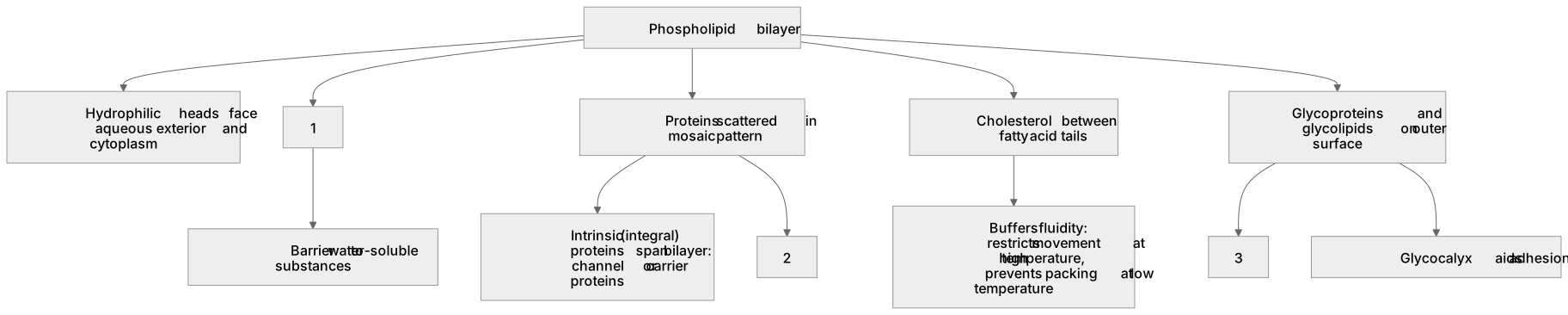
1Box 1
2Box 2
3Box 3
There is more to this lesson
The full lesson goes on to check your understanding and help you earn the marks. Create a free account to carry on, with your progress saved.
A week of Premium from your first lesson · Then the free plan continues · No card, no charge
Test your understanding of Biological membranes: (b) the fluid mosaic model of membrane structure and the roles of its components
Active recall beats re-reading. Take an instant quiz now to test what you’ve learned and lock it into long-term memory.
A week of Premium from your first lesson · Then the free plan continues · No card, no charge