OCR · A-Level · Biology
Course version: H420 · Version from Sept 2025
(ii) practical investigations into the effects of solutions of different…
Full specification wording
Biological membranes: (ii) practical investigations into the effects of solutions of different water potential on plant and animal cells.
Water potential (Ψ) is the tendency of water to move; pure water at atmospheric pressure is 0 kPa, and solutions have negative values.
Checked against the OCR H420 specification (opens in a new tab) on .
- Point 8 of 8
- 3 key terms
Study notes
From the checked teaching notes for this specification point.
The idea
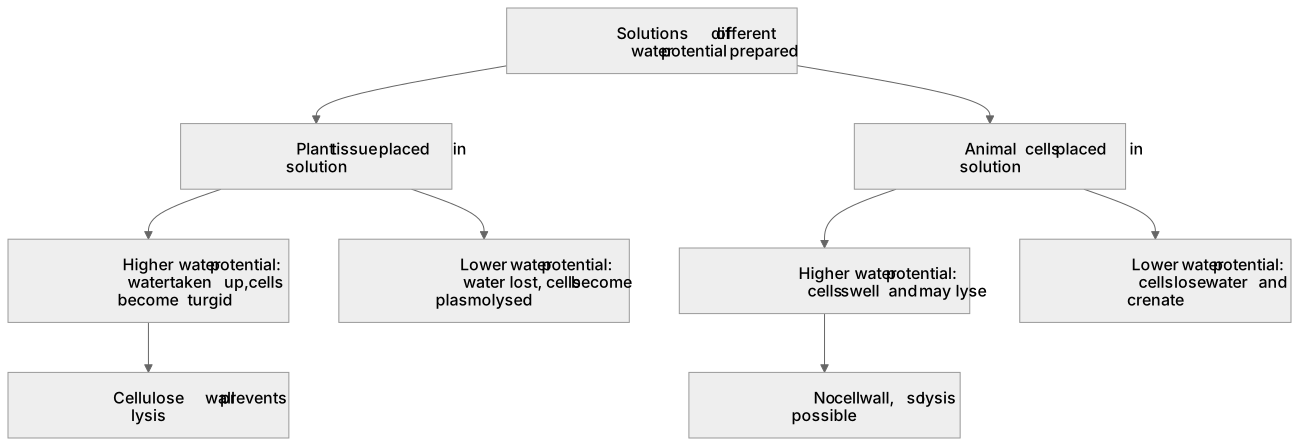
Water potential (Ψ) is the tendency of water to move; pure water at atmospheric pressure is 0 kPa, and solutions have negative values. In a practical investigation you prepare a series of solutions of known water potential, for example sucrose solutions, and place samples of plant tissue (such as potato cylinders or onion epidermis) and animal cells (such as red blood cells or cheek epithelial cells) into them. You record mass change in plant tissue or observe lysis and crenation in animal cells. Plant cells with a cellulose wall resist bursting: in a solution of higher (less negative) water potential they take up water and become turgid, while in a solution of lower (more negative) water potential they lose water and become plasmolysed. Animal cells lack a wall, so in pure water or very dilute solution they swell and lyse, and in concentrated solution they shrink and crenate.
What earns the marks
- Water potential is measured in kPa; pure water is 0 kPa and solutions have negative water potential values.
- Water moves by osmosis from a region of higher (less negative) water potential to a region of lower (more negative) water potential across a partially permeable membrane.
- Plant cells placed in a solution of higher water potential gain water, become turgid, and the cellulose wall prevents lysis; in a solution of lower water potential they lose water and become plasmolysed.
- Animal cells placed in a solution of higher water potential swell and may lyse because they lack a cell wall; in a solution of lower water potential they lose water and crenate.
- Percentage change in mass is calculated as (final mass − initial mass) ÷ initial mass × 100, and controlled variables such as temperature, time and tissue size must be kept constant.
Common mistakes and how to put them right
Thinking pure water has a high positive water potential.
Put it right by stating pure water is 0 kPa and solutions are negative.
Assuming plant cells burst in pure water.
Put it right by explaining the cellulose wall resists expansion so cells become turgid, not lysed.
Confusing the direction of osmosis.
Put it right by stating water moves from higher (less negative) to lower (more negative) water potential.
Exam tips
- Always state the direction of water movement in terms of higher and lower water potential, not just 'high' and 'low' concentration.
- Link the presence or absence of a cell wall to the observed outcome (turgid versus lysed).
- When describing a method, name the controlled variables and explain why each is kept constant.
Try the lesson
The start of the Biological membranes: (ii) practical investigations into the effects of solutions of different water potential on plant and animal cells. lesson, made from checked teaching notes for this specification point.
Have a go first
A student places strips of potato tissue into a beaker of pure water. Compared with the potato cells' contents, the pure water has a higher water potential, so water enters the cells. What happens to the potato tissue?
Listen
Water potential (Ψ) is the tendency of water to move; pure water at atmospheric pressure is 0 kPa, and solutions have negative values. In a practical investigation you prepare a series of solutions of known water potential, for example sucrose solutions, and place samples of plant tissue (such as potato cylinders or onion epidermis) and animal cells (such as red blood cells or cheek epithelial cells) into them. You record mass change in plant tissue or observe lysis and crenation in animal cells. Plant cells with a cellulose wall resist bursting: in a solution of higher (less negative) water potential they take up water and become turgid, while in a solution of lower (more negative) water potential they lose water and become plasmolysed. Animal cells lack a wall, so in pure water or very dilute solution they swell and lyse, and in concentrated solution they shrink and crenate. A strong answer earns marks for these points. Water potential is measured in kPa; pure water is 0 kPa and solutions have negative water potential values. Water moves by osmosis from a region of higher (less negative) water potential to a region of lower (more negative) water potential across a partially permeable membrane. Plant cells placed in a solution of higher water potential gain water, become turgid, and the cellulose wall prevents lysis; in a solution of lower water potential they lose water and become plasmolysed. Animal cells placed in a solution of higher water potential swell and may lyse because they lack a cell wall; in a solution of lower water potential they lose water and crenate. A common slip: Thinking pure water has a high positive water potential. Instead, stating pure water is 0 kPa and solutions are negative. Exam tip: Always state the direction of water movement in terms of higher and lower water potential, not just 'high' and 'low' concentration.
See it
Key words
Say what each word means before you turn the card.
Water potential
Try answering aloud or in your head before turning the card.
Turgid
Try answering aloud or in your head before turning the card.
Plasmolysed
Try answering aloud or in your head before turning the card.
See every definition
- Water potential
- The tendency of water to move, measured in kPa, where pure water at atmospheric pressure is 0 kPa and solutions have negative values.
- Turgid
- The state of a plant cell in a solution of higher (less negative) water potential, where it takes up water and the cellulose wall prevents lysis.
- Plasmolysed
- The state of a plant cell in a solution of lower (more negative) water potential, where it loses water.
Label the diagram
Some boxes have lost their names. Pick the right name for each number.
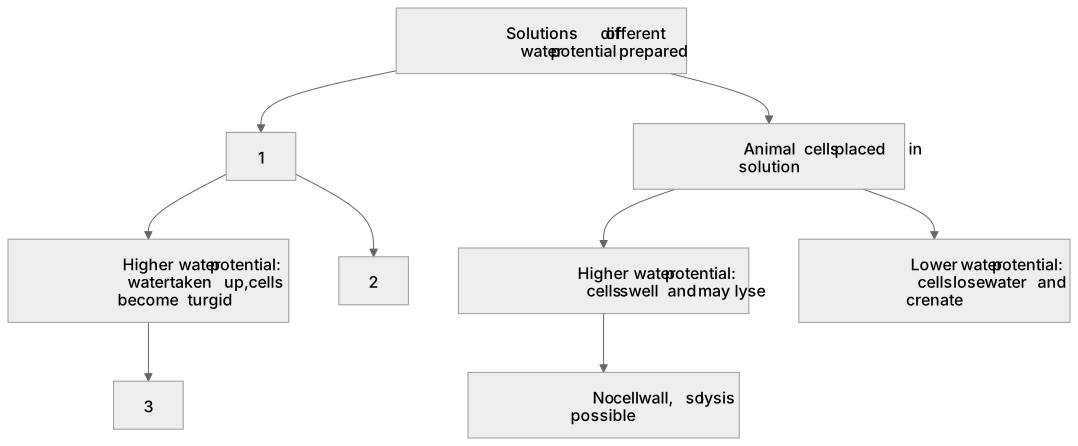
1Box 1
2Box 2
3Box 3
There is more to this lesson
The full lesson goes on to check your understanding and help you earn the marks. Create a free account to carry on, with your progress saved.
A week of Premium from your first lesson · Then the free plan continues · No card, no charge
Test your understanding of Biological membranes: (ii) practical investigations into the effects of solutions of different water potential on plant and animal cells.
Active recall beats re-reading. Take an instant quiz now to test what you’ve learned and lock it into long-term memory.
A week of Premium from your first lesson · Then the free plan continues · No card, no charge