OCR · A-Level · Biology
Course version: H420 · Version from Sept 2025
(b) the concept of monomers and polymers and the importance of…
Full specification wording
Biological molecules: (b) the concept of monomers and polymers and the importance of condensation and hydrolysis reactions in a range of biological molecules
A monomer is a small, repeating subunit; a polymer is a large molecule made of many monomers joined together.
Checked against the OCR H420 specification (opens in a new tab) on .
- Point 2 of 20
- 3 key terms
Study notes
From the checked teaching notes for this specification point.
The idea
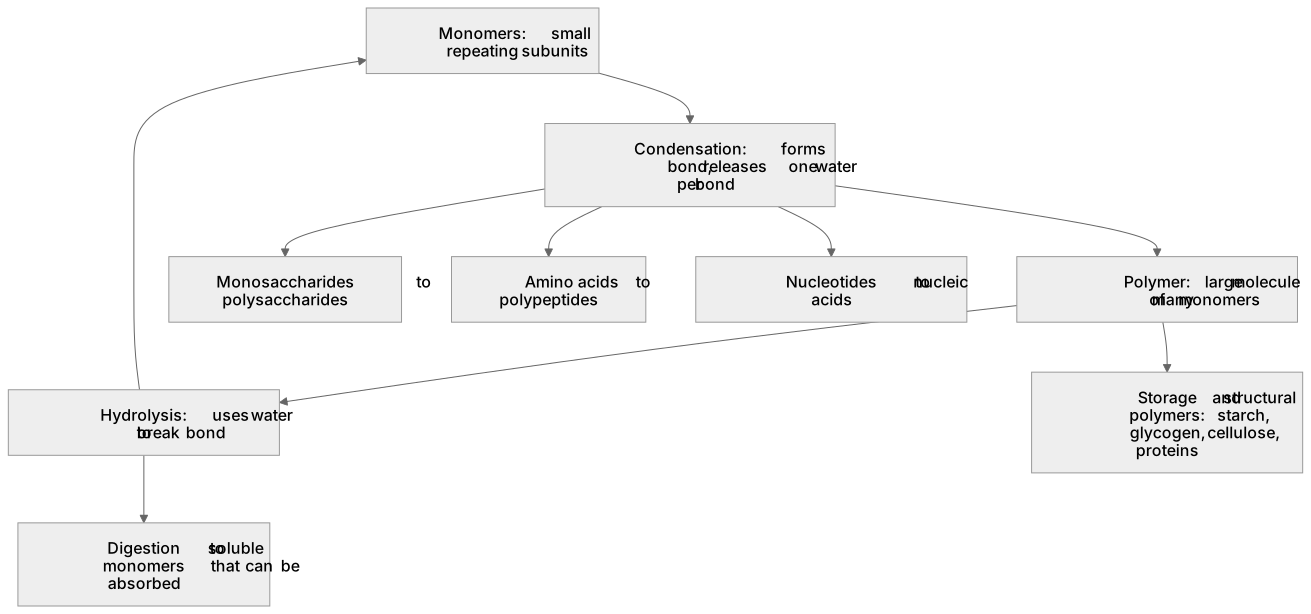
A monomer is a small, repeating subunit; a polymer is a large molecule made of many monomers joined together. Examples include monosaccharides forming polysaccharides, amino acids forming polypeptides and proteins, and nucleotides forming nucleic acids. Monomers join by condensation reactions, which form a chemical bond and release one molecule of water per bond formed. Polymers are broken down by hydrolysis reactions, which use a molecule of water to break the bond and release the monomers. These reactions are central to building storage and structural molecules (such as starch, glycogen and cellulose) and to digesting food so that soluble products can be absorbed. They also allow polymers to be assembled and dismantled as needed, for example during protein synthesis and digestion.
What earns the marks
- A monomer is a small repeating subunit; a polymer is a large molecule formed from many monomers joined together.
- Condensation reactions join monomers, forming a bond and releasing one molecule of water per bond formed.
- Hydrolysis reactions use water to break bonds in polymers, releasing the constituent monomers.
- Examples include monosaccharides forming polysaccharides, amino acids forming polypeptides, and nucleotides forming nucleic acids.
- Condensation builds storage and structural polymers such as starch, glycogen, cellulose and proteins.
- Hydrolysis allows digestion of polymers into soluble monomers that can be absorbed, and allows polymers to be broken down when required.
Common mistakes and how to put them right
Reversing the reactions, saying condensation adds water.
Put it right by stating condensation releases water and hydrolysis uses water.
Thinking a polymer is a single large monomer.
Put it right by stating a polymer is many monomers joined together.
Forgetting that one water molecule is released or used per bond formed or broken.
Put it right by linking the number of water molecules to the number of bonds.
Assuming hydrolysis only occurs in digestion.
Put it right by noting it also breaks down polymers inside cells when needed.
Exam tips
- Check whether the question asks about building (condensation) or breaking (hydrolysis) before selecting an option.
- Link each reaction to a named biological example, such as amino acids forming a polypeptide by condensation.
- Watch for options that confuse the direction of water movement in the two reactions.
Try the lesson
The start of the Biological molecules: (b) the concept of monomers and polymers and the importance of condensation and hydrolysis reactions in a range of biological molecules lesson, made from checked teaching notes for this specification point.
Have a go first
Which of these biological molecules is a polymer built from many nucleotide monomers?
Listen
A monomer is a small, repeating subunit; a polymer is a large molecule made of many monomers joined together. Examples include monosaccharides forming polysaccharides, amino acids forming polypeptides and proteins, and nucleotides forming nucleic acids. Monomers join by condensation reactions, which form a chemical bond and release one molecule of water per bond formed. Polymers are broken down by hydrolysis reactions, which use a molecule of water to break the bond and release the monomers. These reactions are central to building storage and structural molecules (such as starch, glycogen and cellulose) and to digesting food so that soluble products can be absorbed. They also allow polymers to be assembled and dismantled as needed, for example during protein synthesis and digestion. A strong answer earns marks for these points. A monomer is a small repeating subunit; a polymer is a large molecule formed from many monomers joined together. Condensation reactions join monomers, forming a bond and releasing one molecule of water per bond formed. Hydrolysis reactions use water to break bonds in polymers, releasing the constituent monomers. Examples include monosaccharides forming polysaccharides, amino acids forming polypeptides, and nucleotides forming nucleic acids. A common slip: Reversing the reactions, saying condensation adds water. Instead, stating condensation releases water and hydrolysis uses water. Exam tip: Check whether the question asks about building (condensation) or breaking (hydrolysis) before selecting an option.
See it
Watch it explained
What is the one idea the video explains? Say it in a sentence.
Read the described scene instead
Biological molecules are often built from small repeating subunits. A monomer is one small subunit, while a polymer is a large molecule made from many monomers joined together. This simple idea helps explain how carbohydrates, proteins and nucleic acids are assembled and broken down. Monosaccharides are monomers that can form polysaccharides. Amino acids are monomers that form polypeptides and proteins. Nucleotides are monomers that form nucleic acids. In each case, the polymer is not one giant monomer; it is many subunits joined together. Monomers join by condensation reactions. Each condensation reaction forms a chemical bond and releases one molecule of water per bond formed. This is how condensation builds storage and structural polymers such as starch, glycogen, cellulose and proteins. So condensation is a building reaction, and the water released is linked to the number of new bonds. Polymers are broken down by hydrolysis reactions. Hydrolysis uses a molecule of water to break the bond and release the monomers. This happens during digestion, so soluble products can be absorbed. It also lets polymers be dismantled inside cells when they are no longer needed, so hydrolysis is not only a digestive process. A common mistake is to reverse the two reactions. Condensation releases water; hydrolysis uses water. Another mistake is to think a polymer is a single large monomer, when it is many monomers joined together. Also remember that one water molecule is released or used per bond formed or broken, not just one water molecule for the whole polymer. To recap, monomers are small repeating subunits, and polymers are many monomers joined together. Condensation forms bonds and releases water per bond, building molecules such as polysaccharides and proteins. Hydrolysis uses water to break bonds, releasing monomers for absorption or for use inside cells. Check whether a question is about building or breaking before you choose an answer.
Key words
Say what each word means before you turn the card.
Polymer
Try answering aloud or in your head before turning the card.
Condensation reactions
Try answering aloud or in your head before turning the card.
Hydrolysis reactions
Try answering aloud or in your head before turning the card.
See every definition
- Polymer
- A large molecule made of many monomers joined together.
- Condensation reactions
- Reactions that join monomers, forming a chemical bond and releasing one molecule of water per bond formed.
- Hydrolysis reactions
- Reactions that use a molecule of water to break the bond in polymers and release the monomers.
Label the diagram
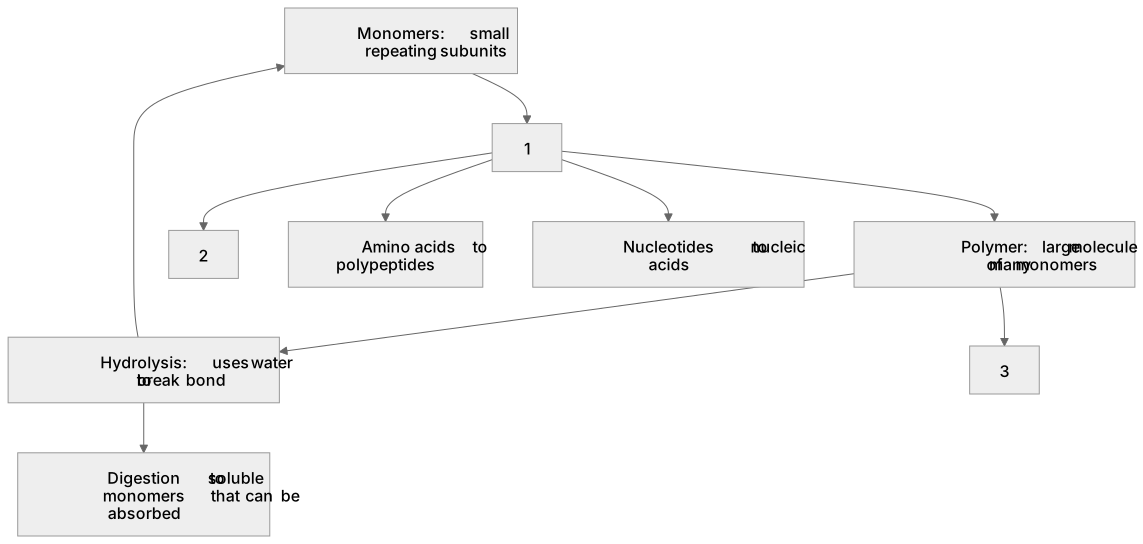
Some boxes have lost their names. Pick the right name for each number.
1Box 1
2Box 2
3Box 3
There is more to this lesson
The full lesson goes on to check your understanding and help you earn the marks. Create a free account to carry on, with your progress saved.
A week of Premium from your first lesson · Then the free plan continues · No card, no charge
Test your understanding of Biological molecules: (b) the concept of monomers and polymers and the importance of condensation and hydrolysis reactions in a range of biological molecules
Active recall beats re-reading. Take an instant quiz now to test what you’ve learned and lock it into long-term memory.
A week of Premium from your first lesson · Then the free plan continues · No card, no charge