OCR · A-Level · Biology
Course version: H420 · Version from Sept 2025
(c) the main stages of mitosis
Full specification wording
Cell division, cell diversity and cellular organisation: (c) the main stages of mitosis
Mitosis is nuclear division producing two genetically identical daughter nuclei, and it is conventionally described in stages.
Checked against the OCR H420 specification (opens in a new tab) on .
- Point 3 of 13
- 4 key terms
Study notes
From the checked teaching notes for this specification point.
The idea
Mitosis is nuclear division producing two genetically identical daughter nuclei, and it is conventionally described in stages. In prophase, chromosomes condense and become visible, the nuclear envelope breaks down and the spindle forms. In metaphase, chromosomes line up along the equator (metaphase plate) of the cell and spindle fibres attach to centromeres. In anaphase, spindle fibres shorten and pull sister chromatids apart to opposite poles. In telophase, chromosomes decondense, nuclear envelopes reform around each set of chromosomes and the spindle disassembles. Cytokinesis then divides the cytoplasm, completing the formation of two daughter cells.
What earns the marks
- Prophase: chromosomes condense and become visible, the nuclear envelope breaks down and spindle fibres form.
- Metaphase: chromosomes align at the cell equator and spindle fibres attach to centromeres.
- Anaphase: spindle fibres shorten, separating sister chromatids which move to opposite poles.
- Telophase: chromosomes decondense, nuclear envelopes reform and the spindle disassembles.
- Cytokinesis follows mitosis, dividing the cytoplasm to produce two genetically identical daughter cells.
Common mistakes and how to put them right
Placing chromosome alignment at the poles rather than at the equator.
Put it right: Alignment at the equator is metaphase.
Saying whole chromosomes are pulled apart in anaphase.
Put it right: It is sister chromatids that separate at the centromere.
Confusing telophase with cytokinesis.
Put it right: Telophase concerns nuclear reformation, while cytokinesis divides the cytoplasm.
Describing the nuclear envelope breaking down in metaphase.
Put it right: It breaks down in prophase.
Exam tips
- Learn the stages in order (prophase, metaphase, anaphase, telophase) with one key event for each.
- Use precise terms: sister chromatids, centromere, spindle fibres, equator, poles.
- Distinguish mitosis (nuclear division) from cytokinesis (cytoplasmic division) when describing the outcome.
Try the lesson
The start of the Cell division, cell diversity and cellular organisation: (c) the main stages of mitosis lesson, made from checked teaching notes for this specification point.
Have a go first
During which stage of mitosis do the chromosomes line up along the equator of the cell?
Listen
Mitosis is nuclear division producing two genetically identical daughter nuclei, and it is conventionally described in stages. In prophase, chromosomes condense and become visible, the nuclear envelope breaks down and the spindle forms. In metaphase, chromosomes line up along the equator (metaphase plate) of the cell and spindle fibres attach to centromeres. In anaphase, spindle fibres shorten and pull sister chromatids apart to opposite poles. In telophase, chromosomes decondense, nuclear envelopes reform around each set of chromosomes and the spindle disassembles. Cytokinesis then divides the cytoplasm, completing the formation of two daughter cells. A strong answer earns marks for these points. Prophase: chromosomes condense and become visible, the nuclear envelope breaks down and spindle fibres form. Metaphase: chromosomes align at the cell equator and spindle fibres attach to centromeres. Anaphase: spindle fibres shorten, separating sister chromatids which move to opposite poles. Telophase: chromosomes decondense, nuclear envelopes reform and the spindle disassembles. Exam tip: Learn the stages in order (prophase, metaphase, anaphase, telophase) with one key event for each.
See it
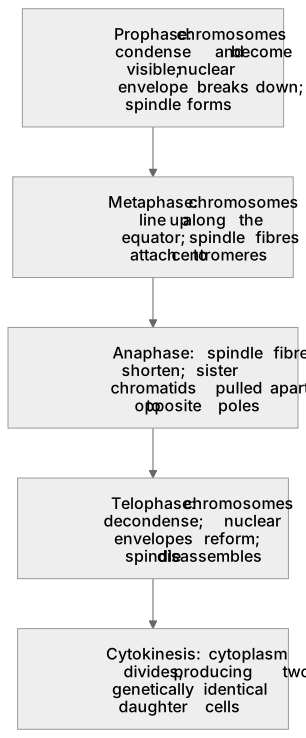
Put it in order
Put these steps in the order they happen.
- 1. Metaphase: chromosomes line up along the equator; spindle fibres attach to centromeres
- 2. Anaphase: spindle fibres shorten; sister chromatids pulled apart to opposite poles
- 3. Prophase: chromosomes condense and become visible; nuclear envelope breaks down; spindle forms
- 4. Cytokinesis: cytoplasm divides, producing two genetically identical daughter cells
- 5. Telophase: chromosomes decondense; nuclear envelopes reform; spindle disassembles
Key words
Say what each word means before you turn the card.
Stages of mitosis
Try answering aloud or in your head before turning the card.
Chromosome behaviour during division
Try answering aloud or in your head before turning the card.
Role of the spindle apparatus
Try answering aloud or in your head before turning the card.
Production of genetically identical daughter cells
Try answering aloud or in your head before turning the card.
See every definition
- Stages of mitosis
- Nuclear division conventionally described in stages: prophase, metaphase, anaphase and telophase.
- Chromosome behaviour during division
- Chromosomes condense and become visible in prophase, line up along the equator in metaphase, sister chromatids are pulled apart to opposite poles in anaphase, and chromosomes decondense in telophase.
- Role of the spindle apparatus
- Spindle fibres form in prophase, attach to centromeres in metaphase, shorten in anaphase to pull sister chromatids apart, and disassemble in telophase.
- Production of genetically identical daughter cells
- Cytokinesis follows mitosis, dividing the cytoplasm to complete the formation of two genetically identical daughter cells.
Label the diagram
Some boxes have lost their names. Pick the right name for each number.
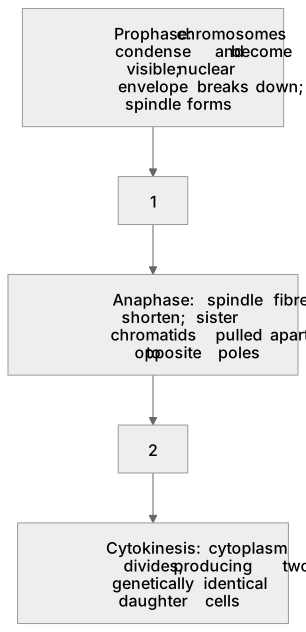
1Box 1
2Box 2
There is more to this lesson
The full lesson goes on to check your understanding and help you earn the marks. Create a free account to carry on, with your progress saved.
A week of Premium from your first lesson · Then the free plan continues · No card, no charge
Test your understanding of Cell division, cell diversity and cellular organisation: (c) the main stages of mitosis
Active recall beats re-reading. Take an instant quiz now to test what you’ve learned and lock it into long-term memory.
A week of Premium from your first lesson · Then the free plan continues · No card, no charge