OCR · A-Level · Biology
Course version: H420 · Version from Sept 2025
(e) the significance of mitosis in life cycles
Full specification wording
Cell division, cell diversity and cellular organisation: (e) the significance of mitosis in life cycles
This point asks you to explain why mitosis matters across the life cycle of organisms.
Checked against the OCR H420 specification (opens in a new tab) on .
- Point 5 of 13
- 4 key terms
Study notes
From the checked teaching notes for this specification point.
The idea
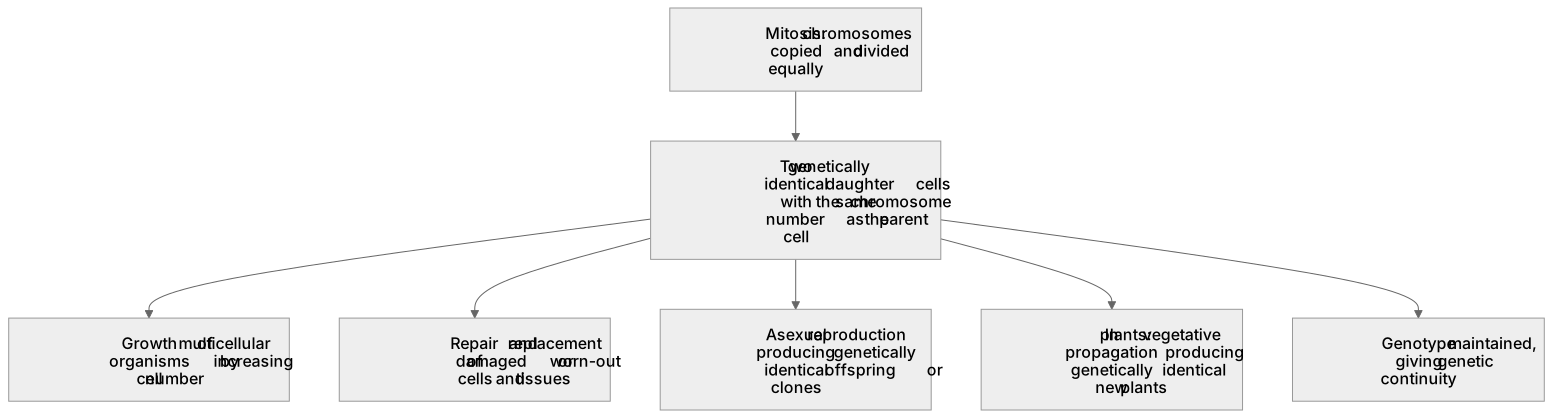
This point asks you to explain why mitosis matters across the life cycle of organisms. Mitosis produces genetically identical daughter cells, so it maintains a constant chromosome number and preserves the genotype. Its significance includes growth of multicellular organisms by increasing cell number, repair and replacement of damaged or worn-out cells and tissues, asexual reproduction producing clones, and, in plants, vegetative propagation. Because the genetic material is copied and divided equally, offspring cells are genetically identical to the parent cell (barring mutation), which is why mitosis supports continuity and stability of the genome. You should be able to link each of these roles to the underlying feature of identical chromosome copies being separated into two nuclei.
What earns the marks
- Mitosis produces two genetically identical daughter cells with the same chromosome number as the parent cell.
- Mitosis enables growth of multicellular organisms by increasing cell number.
- Mitosis enables repair and replacement of damaged or worn-out cells and tissues.
- Mitosis enables asexual reproduction, producing genetically identical offspring or clones.
- In plants, mitosis underlies vegetative propagation, producing genetically identical new plants.
- Because chromosomes are copied and divided equally, the genotype is maintained, giving genetic continuity.
Common mistakes and how to put them right
Claiming mitosis produces genetic variation.
Put it right: Mitosis produces genetically identical cells, whereas variation arises through meiosis and sexual reproduction.
Confusing growth with reproduction.
Put it right: Growth increases cell number within an organism, while asexual reproduction produces new individuals, and both use mitosis.
Stating that mitosis halves the chromosome number.
Put it right: Chromosome number is maintained, whereas meiosis halves it.
Exam tips
- Link each significance (growth, repair, asexual reproduction, vegetative propagation) explicitly to the production of genetically identical cells.
- Use the phrase 'genetically identical' and 'same chromosome number' to show the underlying reason, not just the outcome.
- When a question asks for significance, give the biological consequence, not just the name of the process.
Try the lesson
The start of the Cell division, cell diversity and cellular organisation: (e) the significance of mitosis in life cycles lesson, made from checked teaching notes for this specification point.
Have a go first
Which outcome of mitosis makes it important for growth of a multicellular organism?
Listen
This point asks you to explain why mitosis matters across the life cycle of organisms. Mitosis produces genetically identical daughter cells, so it maintains a constant chromosome number and preserves the genotype. Its significance includes growth of multicellular organisms by increasing cell number, repair and replacement of damaged or worn-out cells and tissues, asexual reproduction producing clones, and, in plants, vegetative propagation. Because the genetic material is copied and divided equally, offspring cells are genetically identical to the parent cell (barring mutation), which is why mitosis supports continuity and stability of the genome. You should be able to link each of these roles to the underlying feature of identical chromosome copies being separated into two nuclei. A strong answer earns marks for these points. Mitosis produces two genetically identical daughter cells with the same chromosome number as the parent cell. Mitosis enables growth of multicellular organisms by increasing cell number. Mitosis enables repair and replacement of damaged or worn-out cells and tissues. Mitosis enables asexual reproduction, producing genetically identical offspring or clones. A common slip: Claiming mitosis produces genetic variation. Instead, mitosis produces genetically identical cells, whereas variation arises through meiosis and sexual reproduction. Exam tip: Link each significance (growth, repair, asexual reproduction, vegetative propagation) explicitly to the production of genetically identical cells.
See it
Key words
Say what each word means before you turn the card.
Genetically identical daughter cells
Try answering aloud or in your head before turning the card.
Growth and cell replacement
Try answering aloud or in your head before turning the card.
Asexual reproduction and cloning
Try answering aloud or in your head before turning the card.
Genetic continuity and stability
Try answering aloud or in your head before turning the card.
See every definition
- Genetically identical daughter cells
- Cells produced by mitosis that have the same chromosome number as the parent cell and are genetically identical to it, barring mutation.
- Growth and cell replacement
- Roles of mitosis in increasing cell number in multicellular organisms and in repairing and replacing damaged or worn-out cells and tissues.
- Asexual reproduction and cloning
- Mitosis enables asexual reproduction, producing genetically identical offspring or clones, and in plants underlies vegetative propagation.
- Genetic continuity and stability
- Because chromosomes are copied and divided equally, the genotype is maintained, giving continuity and stability of the genome.
Label the diagram
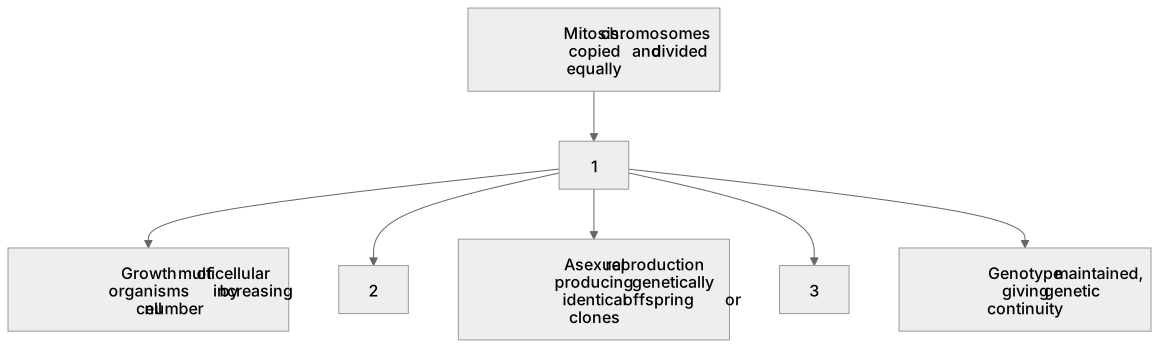
Some boxes have lost their names. Pick the right name for each number.
1Box 1
2Box 2
3Box 3
There is more to this lesson
The full lesson goes on to check your understanding and help you earn the marks. Create a free account to carry on, with your progress saved.
A week of Premium from your first lesson · Then the free plan continues · No card, no charge
Test your understanding of Cell division, cell diversity and cellular organisation: (e) the significance of mitosis in life cycles
Active recall beats re-reading. Take an instant quiz now to test what you’ve learned and lock it into long-term memory.
A week of Premium from your first lesson · Then the free plan continues · No card, no charge