OCR · A-Level · Biology
Course version: H420 · Version from Sept 2025
(m) the potential uses of stem cells in research and medicine.
Full specification wording
Cell division, cell diversity and cellular organisation: (m) the potential uses of stem cells in research and medicine.
Stem cells are undifferentiated cells able to divide and differentiate into specialised cell types.
Checked against the OCR H420 specification (opens in a new tab) on .
- Point 13 of 13
- 4 key terms
Study notes
From the checked teaching notes for this specification point.
The idea
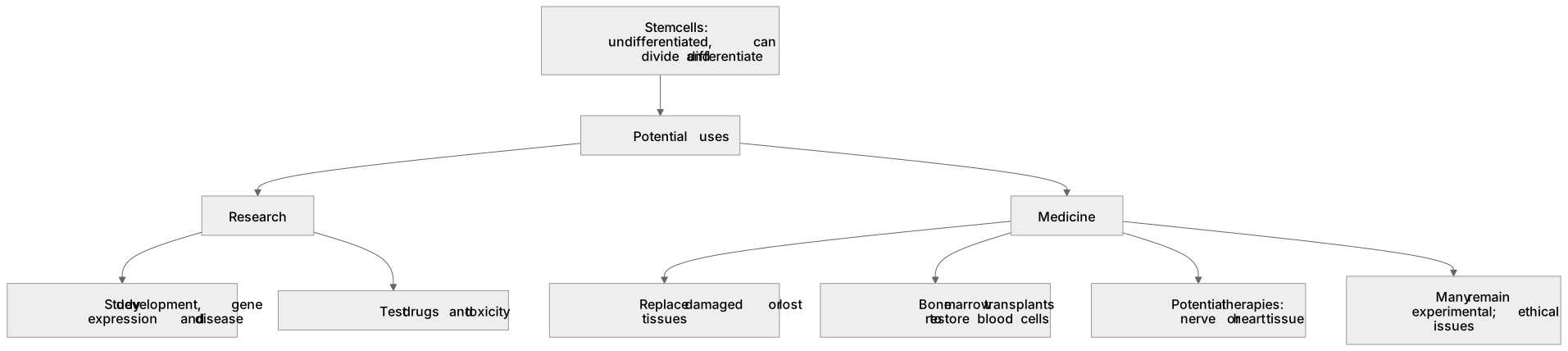
Stem cells are undifferentiated cells able to divide and differentiate into specialised cell types. Their potential uses fall into research and medicine. In research, pluripotent and multipotent stem cells provide models for studying development, gene expression and disease, and can be used to test drugs and toxicity. In medicine, stem cells may be used to replace damaged or lost tissues, for example bone marrow transplants to restore blood cells, or potential therapies for repairing tissue such as nerve or heart tissue. A useful method is to separate each use into research or medicine, then state the property of stem cells that makes it possible, such as self-renewal or potency. Recognise that many medical applications remain experimental and raise ethical issues, so the word potential matters.
What earns the marks
- Stem cells are undifferentiated cells that can divide and differentiate into specialised cell types.
- In research, stem cells can be used to study development, gene expression and disease, and to test drugs or toxicity.
- In medicine, stem cells have potential to replace damaged or lost tissues, such as in bone marrow transplants.
- Potential therapies include repairing tissues such as nerve or heart tissue, though many remain experimental.
- The use of stem cells raises ethical issues, which is why the statement refers to potential uses.
Common mistakes and how to put them right
Treating all stem cell therapies as established.
Put it right by noting many medical uses are still potential or experimental.
Confusing research uses with medical treatments.
Put it right by separating studying and testing from replacing damaged tissue.
Ignoring the ethical dimension.
Put it right by acknowledging ethical issues alongside the benefits.
Assuming stem cells are already specialised.
Put it right by stating they are undifferentiated and can differentiate.
Exam tips
- Classify each option as a research use or a medical use before deciding.
- Reject options that overstate certainty; the statement refers to potential uses.
- Link each use to a stem cell property such as self-renewal or potency.
- Consider ethical issues when an option presents stem cell use as entirely without controversy.
Try the lesson
The start of the Cell division, cell diversity and cellular organisation: (m) the potential uses of stem cells in research and medicine. lesson, made from checked teaching notes for this specification point.
Have a go first
Which is a potential medical use of stem cells?
Listen
Stem cells are undifferentiated cells able to divide and differentiate into specialised cell types. Their potential uses fall into research and medicine. In research, pluripotent and multipotent stem cells provide models for studying development, gene expression and disease, and can be used to test drugs and toxicity. In medicine, stem cells may be used to replace damaged or lost tissues, for example bone marrow transplants to restore blood cells, or potential therapies for repairing tissue such as nerve or heart tissue. A useful method is to separate each use into research or medicine, then state the property of stem cells that makes it possible, such as self-renewal or potency. Recognise that many medical applications remain experimental and raise ethical issues, so the word potential matters. A strong answer earns marks for these points. Stem cells are undifferentiated cells that can divide and differentiate into specialised cell types. In research, stem cells can be used to study development, gene expression and disease, and to test drugs or toxicity. In medicine, stem cells have potential to replace damaged or lost tissues, such as in bone marrow transplants. Potential therapies include repairing tissues such as nerve or heart tissue, though many remain experimental. A common slip: Treating all stem cell therapies as established. Instead, noting many medical uses are still potential or experimental. Exam tip: Classify each option as a research use or a medical use before deciding.
See it
Key words
Say what each word means before you turn the card.
Research applications
Try answering aloud or in your head before turning the card.
Medical and therapeutic applications
Try answering aloud or in your head before turning the card.
Ethical issues
Try answering aloud or in your head before turning the card.
Experimental versus established treatments
Try answering aloud or in your head before turning the card.
See every definition
- Research applications
- Pluripotent and multipotent stem cells provide models for studying development, gene expression and disease, and can be used to test drugs and toxicity.
- Medical and therapeutic applications
- Stem cells may be used to replace damaged or lost tissues, for example bone marrow transplants to restore blood cells, or potential therapies for repairing tissue such as nerve or heart tissue.
- Ethical issues
- The use of stem cells raises ethical issues, which is why the statement refers to potential uses.
- Experimental versus established treatments
- Many medical applications remain experimental, so the word potential matters.
Label the diagram
Some boxes have lost their names. Pick the right name for each number.
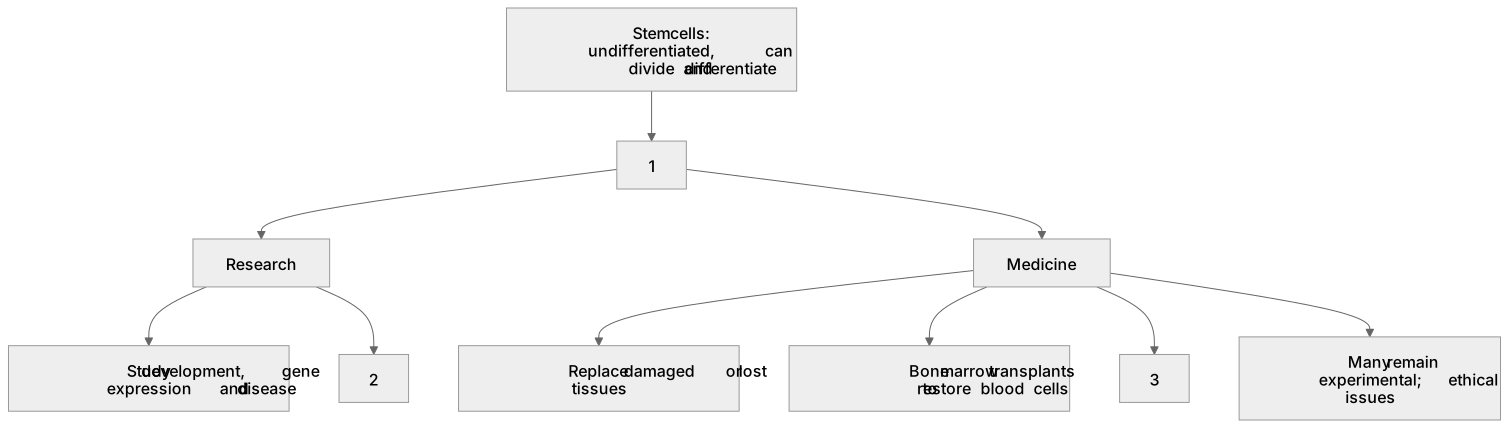
1Box 1
2Box 2
3Box 3
There is more to this lesson
The full lesson goes on to check your understanding and help you earn the marks. Create a free account to carry on, with your progress saved.
A week of Premium from your first lesson · Then the free plan continues · No card, no charge
Test your understanding of Cell division, cell diversity and cellular organisation: (m) the potential uses of stem cells in research and medicine.
Active recall beats re-reading. Take an instant quiz now to test what you’ve learned and lock it into long-term memory.
A week of Premium from your first lesson · Then the free plan continues · No card, no charge