OCR · A-Level · Biology
Course version: H420 · Version from Sept 2025
(g) the different types of adaptations of organisms to their environment
Full specification wording
Classification and evolution: (g) the different types of adaptations of organisms to their environment
Adaptations are inherited features that raise an organism's chance of surviving and reproducing in its habitat.
Checked against the OCR H420 specification (opens in a new tab) on .
- Point 8 of 10
- 3 key terms
Study notes
From the checked teaching notes for this specification point.
The idea
Adaptations are inherited features that raise an organism's chance of surviving and reproducing in its habitat. They fall into three linked types. Anatomical (structural) adaptations are body form and structure, such as a thick insulating coat, streamlined shape, or waxy cuticle reducing water loss. Physiological adaptations are biochemical or functional processes, such as the ability to concentrate urine, produce antifreeze proteins, or regulate salt balance. Behavioural adaptations are actions or patterns of activity, such as migration, nocturnal foraging, or basking to warm the body. The same challenge, for example cold, may be met by several types at once, so classify each feature by what it actually is rather than by the habitat. A thick coat is anatomical; shivering to generate heat is physiological; huddling together is behavioural.
What earns the marks
- Anatomical (structural) adaptations are physical features of body form or structure, e.g. streamlined shape, thick fur, waxy cuticle.
- Physiological adaptations are functional or biochemical processes within the body, e.g. concentrating urine, producing antifreeze proteins, regulating salt balance.
- Behavioural adaptations are actions or activity patterns, e.g. migration, nocturnal foraging, huddling, basking.
- Adaptations are inherited features that increase the chance of survival and reproduction in a particular environment.
- A single environmental challenge may be met by more than one type of adaptation, so each feature must be classified by what it is, not by the habitat.
Common mistakes and how to put them right
Calling any feature that helps survival 'behavioural'.
Put it right: Behaviour must be an action or activity pattern; a body structure is anatomical and a body process is physiological.
Treating the three types as alternatives that cannot co-occur.
Put it right: One organism often shows anatomical, physiological and behavioural adaptations together.
Classifying a feature by its habitat rather than its nature.
Put it right: Decide whether the feature is a structure, a process or an action, then assign the type.
Exam tips
- Read the feature described and ask: is it a structure, a process or an action? That decides anatomical, physiological or behavioural.
- Learn two clear examples of each type so you can match unfamiliar examples to the correct category.
- Watch for distractors that describe a habitat rather than the adaptation itself; classify the feature, not the environment.
Try the lesson
The start of the Classification and evolution: (g) the different types of adaptations of organisms to their environment lesson, made from checked teaching notes for this specification point.
Have a go first
A desert fox has large ears with a rich blood supply that help it lose heat. Which category of adaptation does this feature illustrate?
Listen
Adaptations are inherited features that raise an organism's chance of surviving and reproducing in its habitat. They fall into three linked types. Anatomical (structural) adaptations are body form and structure, such as a thick insulating coat, streamlined shape, or waxy cuticle reducing water loss. Physiological adaptations are biochemical or functional processes, such as the ability to concentrate urine, produce antifreeze proteins, or regulate salt balance. Behavioural adaptations are actions or patterns of activity, such as migration, nocturnal foraging, or basking to warm the body. The same challenge, for example cold, may be met by several types at once, so classify each feature by what it actually is rather than by the habitat. A thick coat is anatomical; shivering to generate heat is physiological; huddling together is behavioural. A strong answer earns marks for these points. Anatomical (structural) adaptations are physical features of body form or structure, e.g. streamlined shape, thick fur, waxy cuticle. Physiological adaptations are functional or biochemical processes within the body, e.g. concentrating urine, producing antifreeze proteins, regulating salt balance. Behavioural adaptations are actions or activity patterns, e.g. migration, nocturnal foraging, huddling, basking. Adaptations are inherited features that increase the chance of survival and reproduction in a particular environment. A common slip: Calling any feature that helps survival 'behavioural'. Instead, behaviour must be an action or activity pattern; a body structure is anatomical and a body process is physiological. Exam tip: Read the feature described and ask: is it a structure, a process or an action? That decides anatomical, physiological or behavioural.
See it
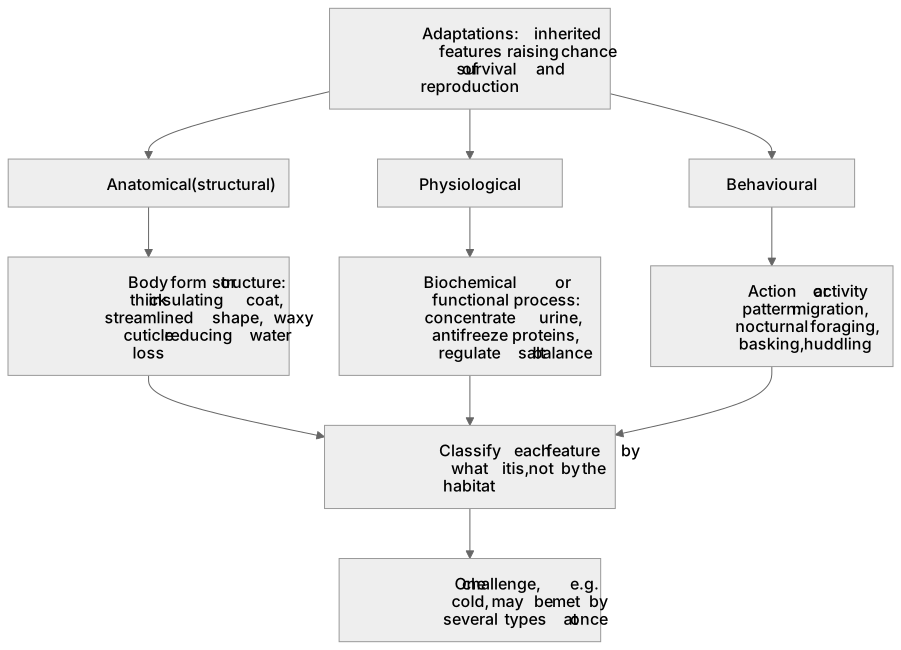
Key words
Say what each word means before you turn the card.
Anatomical adaptations
Try answering aloud or in your head before turning the card.
Physiological adaptations
Try answering aloud or in your head before turning the card.
Behavioural adaptations
Try answering aloud or in your head before turning the card.
See every definition
- Anatomical adaptations
- Physical features of body form or structure, such as a streamlined shape, thick fur or a waxy cuticle.
- Physiological adaptations
- Functional or biochemical processes within the body, such as concentrating urine, producing antifreeze proteins or regulating salt balance.
- Behavioural adaptations
- Actions or activity patterns, such as migration, nocturnal foraging, huddling or basking.
Label the diagram
Some boxes have lost their names. Pick the right name for each number.
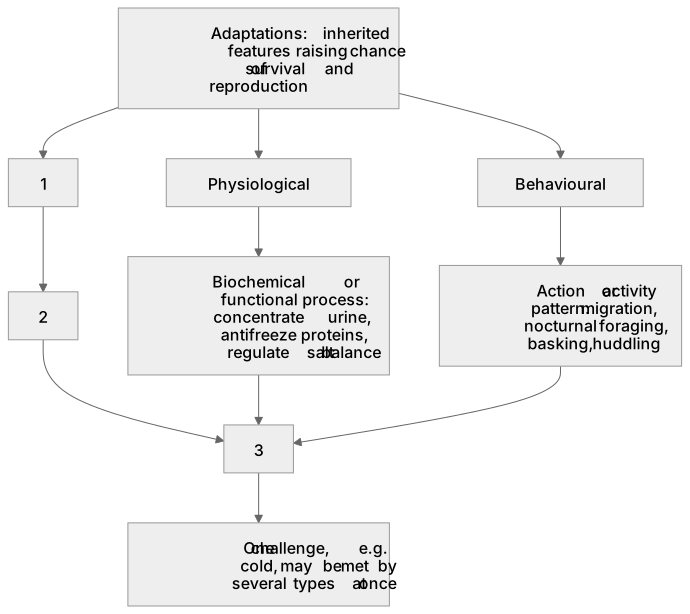
1Box 1
2Box 2
3Box 3
There is more to this lesson
The full lesson goes on to check your understanding and help you earn the marks. Create a free account to carry on, with your progress saved.
A week of Premium from your first lesson · Then the free plan continues · No card, no charge
Test your understanding of Classification and evolution: (g) the different types of adaptations of organisms to their environment
Active recall beats re-reading. Take an instant quiz now to test what you’ve learned and lock it into long-term memory.
A week of Premium from your first lesson · Then the free plan continues · No card, no charge