OCR · A-Level · Biology
Course version: H420 · Version from Sept 2025
(ii) the evidence that has led to new classification systems, such as the…
Full specification wording
Classification and evolution: (ii) the evidence that has led to new classification systems, such as the three domains of life, which clarifies relationships
Classification groups organisms by shared features, but the grouping must follow the evidence.
Checked against the OCR H420 specification (opens in a new tab) on .
- Point 4 of 10
- 4 key terms
Study notes
From the checked teaching notes for this specification point.
The idea
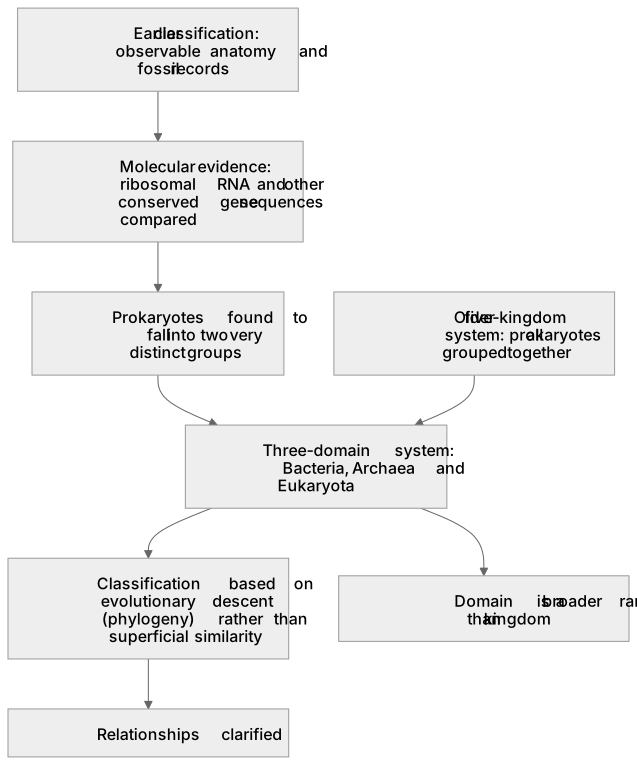
Classification groups organisms by shared features, but the grouping must follow the evidence. Early systems used observable anatomy and, later, fossil records. Molecular evidence changed the picture: comparing ribosomal RNA and other conserved gene sequences showed that some prokaryotes differ from each other as much as each differs from eukaryotes. This led to the three-domain system of Bacteria, Archaea and Eukaryota, replacing the older five-kingdom arrangement in which all prokaryotes sat together. The domains clarify relationships because they reflect evolutionary descent rather than superficial similarity. For an MCQ, link each piece of evidence to the classification change it caused, and remember that a domain is a broader rank than a kingdom.
What earns the marks
- Molecular evidence, especially comparisons of ribosomal RNA and other conserved gene sequences, revealed that prokaryotes fall into two very distinct groups.
- The three-domain system places organisms in Bacteria, Archaea and Eukaryota, separating the two prokaryotic domains.
- The older five-kingdom system grouped all prokaryotes together, so it did not reflect the depth of difference between the two prokaryotic groups.
- New classification systems clarify relationships because they are based on evolutionary descent (phylogeny) rather than only on observable or superficial similarity.
- Anatomical and fossil evidence contributed to earlier classification systems, but molecular data drove the move to the three-domain model.
- A domain is a higher (broader) taxonomic rank than a kingdom, so the three-domain system sits above the kingdom level.
Common mistakes and how to put them right
Assuming the three domains are Bacteria, Fungi and Eukaryota.
Put it right: The domains are Bacteria, Archaea and Eukaryota; Fungi is a kingdom within Eukaryota.
Believing the three-domain system was based mainly on visible anatomy.
Put it right: It arose chiefly from molecular evidence such as ribosomal RNA sequence comparisons.
Thinking Archaea are a type of bacterium within the same domain.
Put it right: Archaea form their own separate domain, distinct from Bacteria.
Treating a domain as a narrower rank than a kingdom.
Put it right: A domain is broader and sits above kingdom level.
Exam tips
- Read the question stem to see whether it asks for the evidence, the resulting system, or the reason relationships are clarified, then match the option to that specific demand.
- Eliminate options that name kingdoms where domains are required, or that swap the roles of molecular and anatomical evidence.
- Check any option claiming a domain is narrower than a kingdom, since that reverses the taxonomic hierarchy.
Try the lesson
The start of the Classification and evolution: (ii) the evidence that has led to new classification systems, such as the three domains of life, which clarifies relationships lesson, made from checked teaching notes for this specification point.
Have a go first
Which type of molecule is compared between organisms to build the three-domain system of classification?
Listen
Classification groups organisms by shared features, but the grouping must follow the evidence. Early systems used observable anatomy and, later, fossil records. Molecular evidence changed the picture: comparing ribosomal RNA and other conserved gene sequences showed that some prokaryotes differ from each other as much as each differs from eukaryotes. This led to the three-domain system of Bacteria, Archaea and Eukaryota, replacing the older five-kingdom arrangement in which all prokaryotes sat together. The domains clarify relationships because they reflect evolutionary descent rather than superficial similarity. For an MCQ, link each piece of evidence to the classification change it caused, and remember that a domain is a broader rank than a kingdom. A strong answer earns marks for these points. Molecular evidence, especially comparisons of ribosomal RNA and other conserved gene sequences, revealed that prokaryotes fall into two very distinct groups. The three-domain system places organisms in Bacteria, Archaea and Eukaryota, separating the two prokaryotic domains. The older five-kingdom system grouped all prokaryotes together, so it did not reflect the depth of difference between the two prokaryotic groups. New classification systems clarify relationships because they are based on evolutionary descent (phylogeny) rather than only on observable or superficial similarity. A common slip: Assuming the three domains are Bacteria, Fungi and Eukaryota. Instead, the domains are Bacteria, Archaea and Eukaryota; Fungi is a kingdom within Eukaryota. Exam tip: Read the question stem to see whether it asks for the evidence, the resulting system, or the reason relationships are clarified, then match the option to that specific demand.
See it
Key words
Say what each word means before you turn the card.
Molecular evidence
Try answering aloud or in your head before turning the card.
Three domains of life
Try answering aloud or in your head before turning the card.
Evolutionary descent
Try answering aloud or in your head before turning the card.
Domain
Try answering aloud or in your head before turning the card.
See every definition
- Molecular evidence
- Comparisons of ribosomal RNA and other conserved gene sequences revealed that prokaryotes fall into two very distinct groups.
- Three domains of life
- The system placing organisms in Bacteria, Archaea and Eukaryota, separating the two prokaryotic domains.
- Evolutionary descent
- The basis of new classification systems, which clarify relationships rather than relying only on observable or superficial similarity.
- Domain
- A higher, broader taxonomic rank than a kingdom, so the three-domain system sits above the kingdom level.
Label the diagram
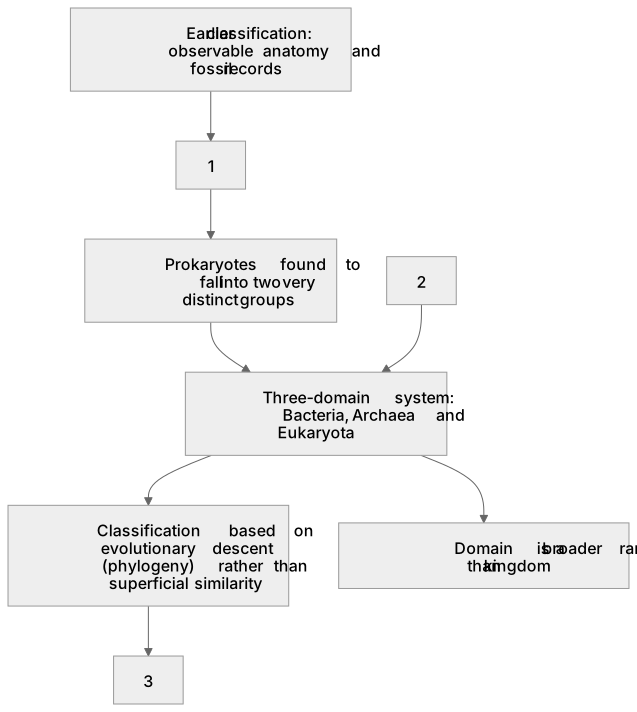
Some boxes have lost their names. Pick the right name for each number.
1Box 1
2Box 2
3Box 3
There is more to this lesson
The full lesson goes on to check your understanding and help you earn the marks. Create a free account to carry on, with your progress saved.
A week of Premium from your first lesson · Then the free plan continues · No card, no charge
Test your understanding of Classification and evolution: (ii) the evidence that has led to new classification systems, such as the three domains of life, which clarifies relationships
Active recall beats re-reading. Take an instant quiz now to test what you’ve learned and lock it into long-term memory.
A week of Premium from your first lesson · Then the free plan continues · No card, no charge