OCR · A-Level · Biology
Course version: H420 · Version from Sept 2025
(d) (i) how artificial clones in animals can be produced by artificial…
Full specification wording
Cloning and biotechnology: (d) (i) how artificial clones in animals can be produced by artificial embryo twinning or by enucleation and somatic cell nuclear transfer (SCNT)
Artificial cloning makes genetically identical animals without fertilisation of a new egg by a sperm.
Checked against the OCR H420 specification (opens in a new tab) on .
- Point 5 of 10
- 4 key terms
Study notes
From the checked teaching notes for this specification point.
The idea
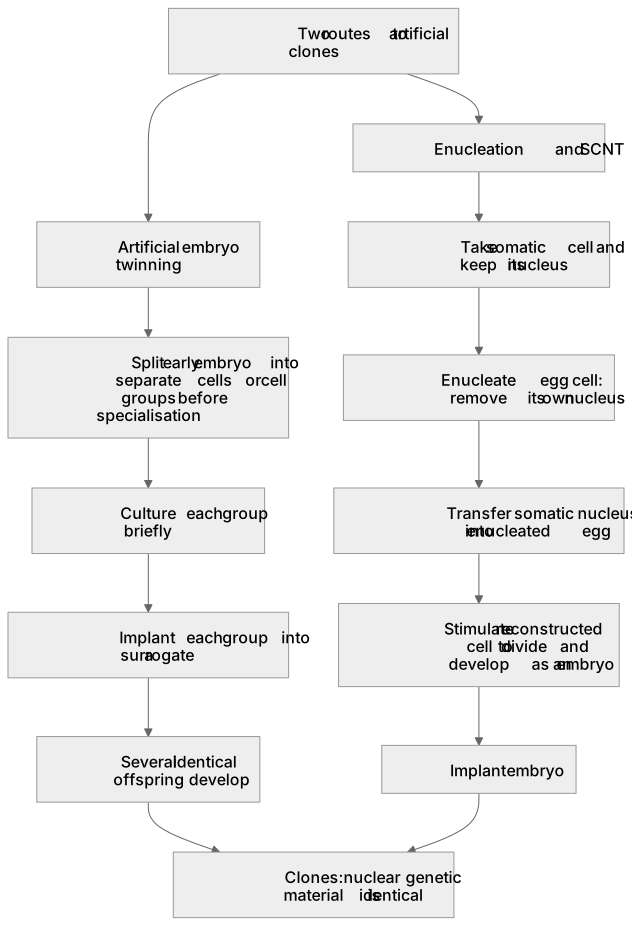
Artificial cloning makes genetically identical animals without fertilisation of a new egg by a sperm. In artificial embryo twinning, an early embryo is split before cells specialise: the embryo is divided into separate cells or groups, each is cultured briefly, and each group is implanted into a surrogate so several identical offspring develop. In SCNT, a somatic (body) cell is taken from the animal to be cloned and its nucleus is kept. An egg cell from a donor is enucleated, meaning its own nucleus is removed. The somatic nucleus is transferred into the enucleated egg, and the reconstructed cell is stimulated to divide and develop as an embryo, which is then implanted. Both routes give clones because the nuclear genetic material is identical; SCNT can clone an existing adult, whereas twinning clones an embryo that already exists.
What earns the marks
- Artificial embryo twinning splits an early embryo into separate cells or cell groups before specialisation.
- Each split group is cultured and implanted into a surrogate, producing genetically identical offspring.
- SCNT begins with a somatic cell whose nucleus is retained as the genetic source.
- An egg cell is enucleated, removing its own nucleus, before the somatic nucleus is transferred in.
- The reconstructed cell is stimulated to divide and develop into an embryo, then implanted.
Common mistakes and how to put them right
Thinking enucleation removes the somatic nucleus.
Put it right: , enucleation removes the egg cell's own nucleus so the somatic nucleus can direct development.
Confusing twinning with fertilisation of a new egg.
Put it right: , twinning splits an already-formed embryo, so no new genetic combination occurs.
Believing SCNT produces a clone of the egg donor.
Put it right: , the clone's nuclear DNA comes from the somatic cell donor.
Exam tips
- Learn the order of steps for each method so you can identify a described stage in a multiple-choice option.
- Distinguish the two routes by asking whether an embryo is split (twinning) or a nucleus is transferred into an enucleated egg (SCNT).
- Check each option for the correct direction of nucleus removal and transfer before selecting.
Try the lesson
The start of the Cloning and biotechnology: (d) (i) how artificial clones in animals can be produced by artificial embryo twinning or by enucleation and somatic cell nuclear transfer (SCNT) lesson, made from checked teaching notes for this specification point.
Have a go first
In artificial embryo twinning, what is done to the early embryo to produce several clones?
Listen
Artificial cloning makes genetically identical animals without fertilisation of a new egg by a sperm. In artificial embryo twinning, an early embryo is split before cells specialise: the embryo is divided into separate cells or groups, each is cultured briefly, and each group is implanted into a surrogate so several identical offspring develop. In SCNT, a somatic (body) cell is taken from the animal to be cloned and its nucleus is kept. An egg cell from a donor is enucleated, meaning its own nucleus is removed. The somatic nucleus is transferred into the enucleated egg, and the reconstructed cell is stimulated to divide and develop as an embryo, which is then implanted. Both routes give clones because the nuclear genetic material is identical; SCNT can clone an existing adult, whereas twinning clones an embryo that already exists. A strong answer earns marks for these points. Artificial embryo twinning splits an early embryo into separate cells or cell groups before specialisation. Each split group is cultured and implanted into a surrogate, producing genetically identical offspring. SCNT begins with a somatic cell whose nucleus is retained as the genetic source. An egg cell is enucleated, removing its own nucleus, before the somatic nucleus is transferred in. A common slip: Thinking enucleation removes the somatic nucleus. Instead, , enucleation removes the egg cell's own nucleus so the somatic nucleus can direct development. Exam tip: Learn the order of steps for each method so you can identify a described stage in a multiple-choice option.
See it
Key words
Say what each word means before you turn the card.
Artificial embryo twinning
Try answering aloud or in your head before turning the card.
Enucleation
Try answering aloud or in your head before turning the card.
Somatic cell nuclear transfer
Try answering aloud or in your head before turning the card.
Genetic identity of clones
Try answering aloud or in your head before turning the card.
See every definition
- Artificial embryo twinning
- An early embryo is split into separate cells or groups before cells specialise, each group is cultured briefly and implanted into a surrogate so several identical offspring develop.
- Enucleation
- The removal of an egg cell's own nucleus so that the somatic nucleus can be transferred in.
- Somatic cell nuclear transfer
- A somatic cell's nucleus is kept and transferred into an enucleated egg, and the reconstructed cell is stimulated to divide and develop as an embryo, which is then implanted.
- Genetic identity of clones
- Both routes give clones because the nuclear genetic material is identical, and SCNT can clone an existing adult whereas twinning clones an embryo that already exists.
Label the diagram
Some boxes have lost their names. Pick the right name for each number.
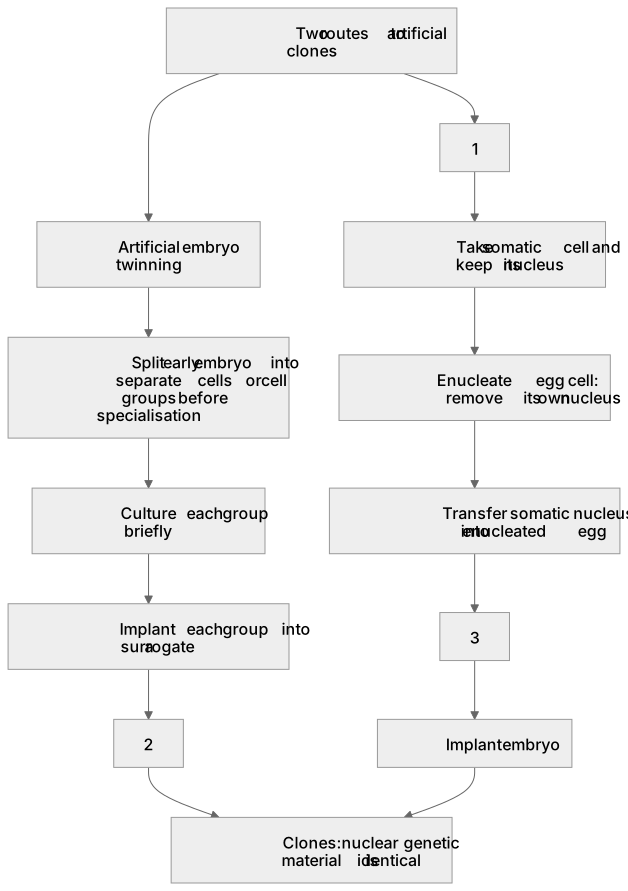
1Box 1
2Box 2
3Box 3
There is more to this lesson
The full lesson goes on to check your understanding and help you earn the marks. Create a free account to carry on, with your progress saved.
A week of Premium from your first lesson · Then the free plan continues · No card, no charge
Test your understanding of Cloning and biotechnology: (d) (i) how artificial clones in animals can be produced by artificial embryo twinning or by enucleation and somatic cell nuclear transfer (SCNT)
Active recall beats re-reading. Take an instant quiz now to test what you’ve learned and lock it into long-term memory.
A week of Premium from your first lesson · Then the free plan continues · No card, no charge