OCR · A-Level · Biology
Course version: H420 · Version from Sept 2025
(n) the benefits and risks of using antibiotics to manage bacterial…
Full specification wording
Communicable diseases, disease prevention and the immune system: (n) the benefits and risks of using antibiotics to manage bacterial infection.
Antibiotics treat bacterial infection by targeting bacterial structures or processes, such as cell-wall synthesis or protein synthesis, that human cells lack.
Checked against the OCR H420 specification (opens in a new tab) on .
- Point 14 of 14
- 4 key terms
Study notes
From the checked teaching notes for this specification point.
The idea
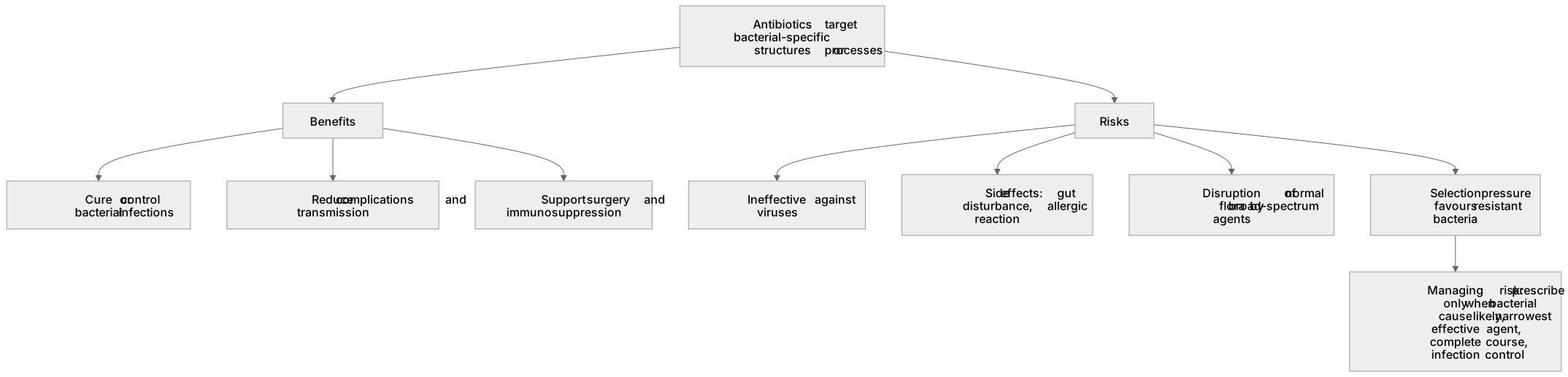
Antibiotics treat bacterial infection by targeting bacterial structures or processes, such as cell-wall synthesis or protein synthesis, that human cells lack. Benefits: they cure or control infections like tuberculosis and sepsis, reduce complications and transmission, and enable surgery and immunosuppression. Risks: they do not affect viruses, so misuse for viral illness is ineffective; side effects range from gut disturbance to allergic reaction; and selection pressure favours resistant bacteria. Overuse and incomplete courses increase resistant strains such as MRSA, and broad-spectrum drugs can disrupt normal flora. Managing risk means prescribing only when a bacterial cause is likely, choosing the narrowest effective agent, completing the course and applying infection-control measures.
What earns the marks
- Antibiotics target bacterial-specific structures or processes (for example cell-wall synthesis or protein synthesis) that human cells lack, giving selective action against bacteria.
- Benefits include curing or controlling bacterial infections, reducing complications and transmission, and supporting procedures such as surgery or immunosuppression.
- Antibiotics are ineffective against viruses, so prescribing them for viral illness gives no benefit and wastes the drug.
- Risks include side effects (for example gut disturbance or allergic reaction) and disruption of normal flora by broad-spectrum agents.
- Selection pressure from antibiotic use favours resistant bacteria, so overuse and incomplete courses increase resistance such as MRSA.
- Managing risk involves prescribing only when a bacterial cause is likely, using the narrowest effective agent, completing the course and applying infection control.
Common mistakes and how to put them right
Assuming antibiotics work against all infections including viral ones.
Put it right: They act only on bacteria, so viral illness is unaffected.
Believing that stopping a course early is harmless once symptoms ease.
Put it right: Surviving bacteria may be the more resistant ones, so completing the prescribed course reduces selection for resistance.
Treating resistance as a property the patient develops rather than the bacterial population.
Put it right: Resistance arises in bacteria through selection, not in human cells.
Exam tips
- When asked about benefits, link each to a specific bacterial target or clinical outcome rather than saying only that it 'kills germs'.
- For risks, distinguish side effects to the patient from the wider problem of resistance in bacterial populations.
- Use precise terms such as 'selection pressure' and 'broad-spectrum' to show understanding of how resistance develops.
Try the lesson
The start of the Communicable diseases, disease prevention and the immune system: (n) the benefits and risks of using antibiotics to manage bacterial infection. lesson, made from checked teaching notes for this specification point.
Have a go first
What is meant by antibiotic resistance in a population of bacteria?
Listen
Antibiotics treat bacterial infection by targeting bacterial structures or processes, such as cell-wall synthesis or protein synthesis, that human cells lack. Benefits: they cure or control infections like tuberculosis and sepsis, reduce complications and transmission, and enable surgery and immunosuppression. Risks: they do not affect viruses, so misuse for viral illness is ineffective; side effects range from gut disturbance to allergic reaction; and selection pressure favours resistant bacteria. Overuse and incomplete courses increase resistant strains such as MRSA, and broad-spectrum drugs can disrupt normal flora. Managing risk means prescribing only when a bacterial cause is likely, choosing the narrowest effective agent, completing the course and applying infection-control measures. A strong answer earns marks for these points. Antibiotics target bacterial-specific structures or processes (for example cell-wall synthesis or protein synthesis) that human cells lack, giving selective action against bacteria. Benefits include curing or controlling bacterial infections, reducing complications and transmission, and supporting procedures such as surgery or immunosuppression. Antibiotics are ineffective against viruses, so prescribing them for viral illness gives no benefit and wastes the drug. Risks include side effects (for example gut disturbance or allergic reaction) and disruption of normal flora by broad-spectrum agents. A common slip: Assuming antibiotics work against all infections including viral ones. Instead, they act only on bacteria, so viral illness is unaffected. Exam tip: When asked about benefits, link each to a specific bacterial target or clinical outcome rather than saying only that it 'kills germs'.
See it
Key words
Say what each word means before you turn the card.
Selective toxicity of antibiotics against bacterial targets
Try answering aloud or in your head before turning the card.
Clinical benefits of controlling bacterial infection
Try answering aloud or in your head before turning the card.
Ineffectiveness against viruses
Try answering aloud or in your head before turning the card.
Selection pressure and antibiotic resistance
Try answering aloud or in your head before turning the card.
See every definition
- Selective toxicity of antibiotics against bacterial targets
- Antibiotics target bacterial structures or processes, such as cell-wall synthesis or protein synthesis, that human cells lack.
- Clinical benefits of controlling bacterial infection
- Curing or controlling infections, reducing complications and transmission, and enabling surgery and immunosuppression.
- Ineffectiveness against viruses
- Antibiotics do not affect viruses, so misuse for viral illness is ineffective and wastes the drug.
- Selection pressure and antibiotic resistance
- Selection pressure favours resistant bacteria, so overuse and incomplete courses increase resistant strains such as MRSA.
Label the diagram
Some boxes have lost their names. Pick the right name for each number.
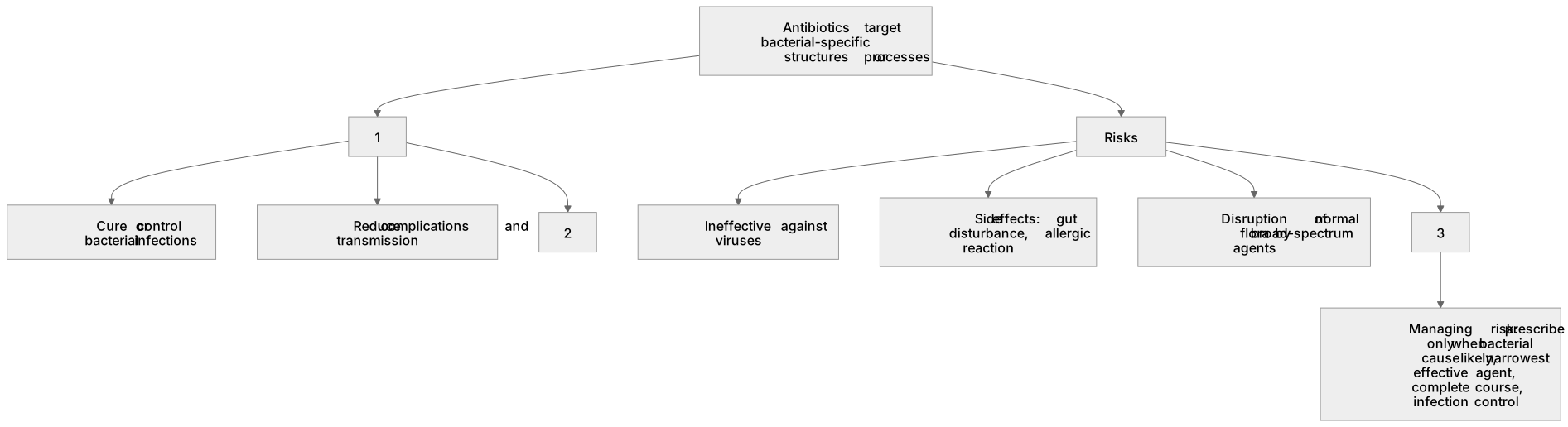
1Box 1
2Box 2
3Box 3
There is more to this lesson
The full lesson goes on to check your understanding and help you earn the marks. Create a free account to carry on, with your progress saved.
A week of Premium from your first lesson · Then the free plan continues · No card, no charge
Test your understanding of Communicable diseases, disease prevention and the immune system: (n) the benefits and risks of using antibiotics to manage bacterial infection.
Active recall beats re-reading. Take an instant quiz now to test what you’ve learned and lock it into long-term memory.
A week of Premium from your first lesson · Then the free plan continues · No card, no charge