OCR · A-Level · Biology
Course version: H420 · Version from Sept 2025
(b) the communication between cells by cell signalling
Full specification wording
Communication and homeostasis: (b) the communication between cells by cell signalling
Cell signalling is how one cell releases a chemical messenger that is detected by a target cell, changing the target cell's behaviour.
Checked against the OCR H420 specification (opens in a new tab) on .
- Point 2 of 4
- 4 key terms
Study notes
From the checked teaching notes for this specification point.
The idea
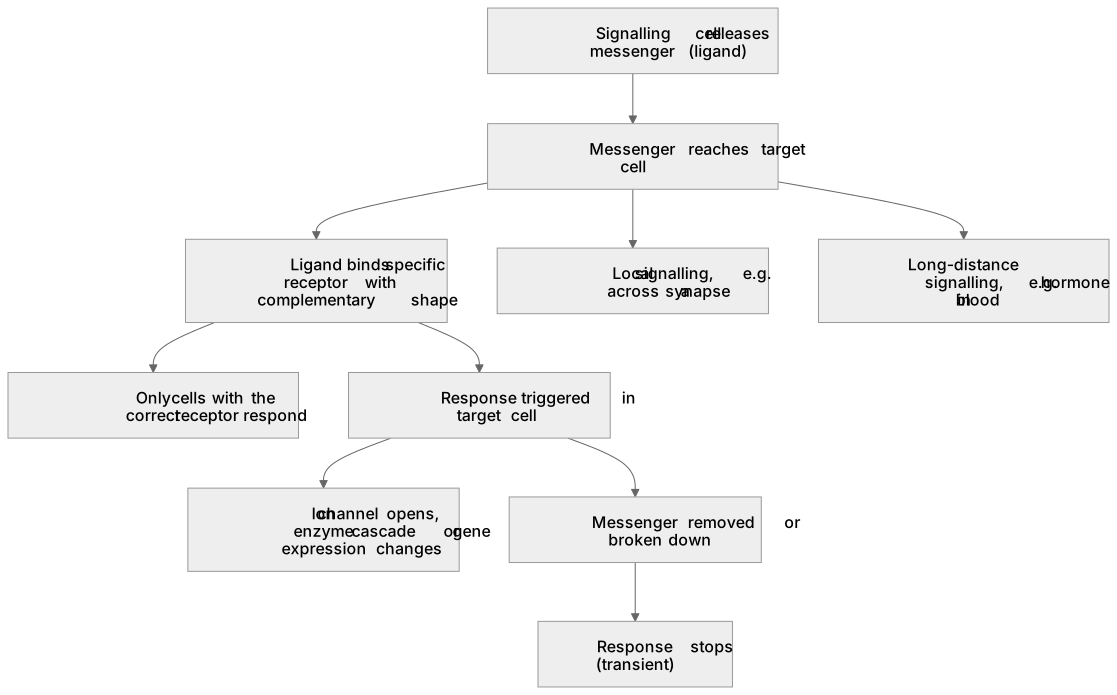
Cell signalling is how one cell releases a chemical messenger that is detected by a target cell, changing the target cell's behaviour. The messenger (a ligand) binds a specific receptor, often a membrane protein with a complementary binding site. Binding triggers a response inside the target, such as opening an ion channel, activating an enzyme cascade or altering gene expression. Because receptors are specific, only cells with the correct receptor respond, which is why a hormone can travel in blood yet affect only its target tissues. Signalling can be local (for example a neurotransmitter diffusing across a synapse) or long-distance (a hormone carried in the bloodstream). The signal is transient: the messenger is broken down or removed, so the response stops.
What earns the marks
- A signalling molecule (ligand) binds to a specific receptor with a complementary shape on or in the target cell.
- Receptor specificity means only target cells possessing that receptor respond to the messenger.
- Binding triggers a response in the target cell, such as an ion channel opening, an enzyme cascade or a change in gene expression.
- Signalling may be local (for example across a synapse) or long-distance (for example a hormone transported in the blood).
- Removal or breakdown of the messenger ends the response, making signalling transient.
Common mistakes and how to put them right
Assuming any cell can respond to any messenger.
Put it right: Only cells with the complementary receptor respond.
Confusing the messenger with the receptor.
Put it right: The messenger is the ligand; the receptor is the protein that binds it.
Thinking the signal continues indefinitely.
Put it right: The messenger is removed or broken down so the response is temporary.
Exam tips
- Identify the four components in each option: messenger, receptor, target cell and response.
- Reject options that imply a messenger acts without a receptor.
- Check whether the example given is local or long-distance before choosing.
Try the lesson
The start of the Communication and homeostasis: (b) the communication between cells by cell signalling lesson, made from checked teaching notes for this specification point.
Have a go first
A cell releases a signalling molecule that travels through the blood and binds to receptors on a distant target cell. Which type of signalling does this describe?
Listen
Cell signalling is how one cell releases a chemical messenger that is detected by a target cell, changing the target cell's behaviour. The messenger (a ligand) binds a specific receptor, often a membrane protein with a complementary binding site. Binding triggers a response inside the target, such as opening an ion channel, activating an enzyme cascade or altering gene expression. Because receptors are specific, only cells with the correct receptor respond, which is why a hormone can travel in blood yet affect only its target tissues. Signalling can be local (for example a neurotransmitter diffusing across a synapse) or long-distance (a hormone carried in the bloodstream). The signal is transient: the messenger is broken down or removed, so the response stops. A strong answer earns marks for these points. A signalling molecule (ligand) binds to a specific receptor with a complementary shape on or in the target cell. Receptor specificity means only target cells possessing that receptor respond to the messenger. Binding triggers a response in the target cell, such as an ion channel opening, an enzyme cascade or a change in gene expression. Signalling may be local (for example across a synapse) or long-distance (for example a hormone transported in the blood). A common slip: Assuming any cell can respond to any messenger. Instead, only cells with the complementary receptor respond. Exam tip: Identify the four components in each option: messenger, receptor, target cell and response.
See it
Key words
Say what each word means before you turn the card.
Specificity of receptor–ligand binding
Try answering aloud or in your head before turning the card.
Target cell response
Try answering aloud or in your head before turning the card.
Local versus long-distance signalling
Try answering aloud or in your head before turning the card.
Termination of the signal
Try answering aloud or in your head before turning the card.
See every definition
- Specificity of receptor–ligand binding
- A ligand binds a specific receptor with a complementary binding site, so only cells with the correct receptor respond.
- Target cell response
- Binding triggers a response inside the target, such as opening an ion channel, activating an enzyme cascade or altering gene expression.
- Local versus long-distance signalling
- Signalling can be local, for example a neurotransmitter diffusing across a synapse, or long-distance, a hormone carried in the bloodstream.
- Termination of the signal
- The signal is transient because the messenger is broken down or removed, so the response stops.
Label the diagram
Some boxes have lost their names. Pick the right name for each number.
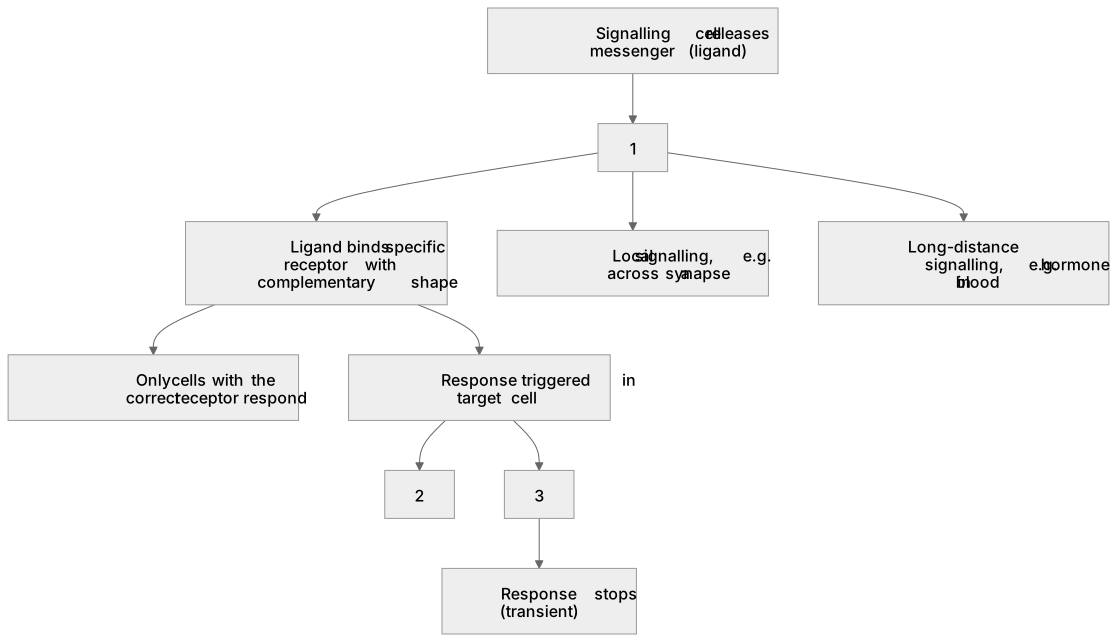
1Box 1
2Box 2
3Box 3
There is more to this lesson
The full lesson goes on to check your understanding and help you earn the marks. Create a free account to carry on, with your progress saved.
A week of Premium from your first lesson · Then the free plan continues · No card, no charge
Test your understanding of Communication and homeostasis: (b) the communication between cells by cell signalling
Active recall beats re-reading. Take an instant quiz now to test what you’ve learned and lock it into long-term memory.
A week of Premium from your first lesson · Then the free plan continues · No card, no charge