OCR · A-Level · Biology
Course version: H420 · Version from Sept 2025
Implementing: (b) appropriate units for measurements
In practical biology, every measured quantity needs a unit that matches the instrument and the scale used.
Checked against the OCR H420 specification (opens in a new tab) on .
- Point 2 of 3
- 4 key terms
Study notes
From the checked teaching notes for this specification point.
The idea
In practical biology, every measured quantity needs a unit that matches the instrument and the scale used. Length is recorded in millimetres (mm), centimetres (cm), metres (m) or micrometres (µm); mass in milligrams (mg), grams (g) or kilograms (kg); volume in cubic centimetres (cm³), cubic decimetres (dm³) or cubic metres (m³); time in seconds (s) or minutes (min); temperature in degrees Celsius (°C); and concentration in mol dm⁻³ or g dm⁻³. Rate units combine two quantities, for example cm³ s⁻¹ for gas volume per second or mm min⁻¹ for growth. When you choose an answer, check that the unit is dimensionally correct for the quantity, is at a sensible magnitude for the apparatus, and that any prefix (milli, micro, kilo) has been converted correctly.
For example: 250 mm equals 0.250 m, and 5 cm³ equals 5 × 10⁻⁶ m³.
What earns the marks
- Selects a unit whose dimension matches the measured quantity, such as cm³ for volume rather than cm².
- Chooses a prefix and magnitude appropriate to the apparatus, for example mm for a leaf length measured with a ruler.
- Converts correctly between prefixed units, for example 1 cm³ = 1 × 10⁻⁶ m³ and 1 mg = 1 × 10⁻³ g.
- Expresses a rate with the correct combined unit, such as cm³ s⁻¹ or mm min⁻¹, keeping the time element in the denominator.
- Rejects a unit that is dimensionally wrong for the stated quantity even when the numerical value looks plausible.
Common mistakes and how to put them right
Using an area unit such as cm² for a volume reading.
Put it right: Use a cubed unit such as cm³.
Writing a rate without the time component, for example giving only cm³ for gas produced.
Put it right: Divide by time and write cm³ s⁻¹.
Treating 1 cm³ as 1 × 10⁻³ m³.
Put it right: 1 cm³ = 1 × 10⁻⁶ m³ because each linear dimension is divided by 100.
Ignoring prefix conversion, for example recording 500 µm as 500 mm.
Put it right: 500 µm = 0.500 mm.
Exam tips
- Read the quantity named in the question first, then eliminate any option whose unit has the wrong dimension.
- Check the magnitude against the apparatus: a bench ruler is unlikely to justify a value in cubic metres.
- For rate questions, confirm the time unit appears in the denominator before selecting an option.
Try the lesson
The start of the Implementing: (b) appropriate units for measurements lesson, made from checked teaching notes for this specification point.
Have a go first
A student records a magnification calculation and obtains a value of 1500. Which unit should be attached to a magnification value?
Listen
In practical biology, every measured quantity needs a unit that matches the instrument and the scale used. Length is recorded in millimetres (mm), centimetres (cm), metres (m) or micrometres (µm); mass in milligrams (mg), grams (g) or kilograms (kg); volume in cubic centimetres (cm³), cubic decimetres (dm³) or cubic metres (m³); time in seconds (s) or minutes (min); temperature in degrees Celsius (°C); and concentration in mol dm⁻³ or g dm⁻³. Rate units combine two quantities, for example cm³ s⁻¹ for gas volume per second or mm min⁻¹ for growth. When you choose an answer, check that the unit is dimensionally correct for the quantity, is at a sensible magnitude for the apparatus, and that any prefix (milli, micro, kilo) has been converted correctly. For example, 250 mm equals 0.250 m, and 5 cm³ equals 5 × 10⁻⁶ m³. A strong answer earns marks for these points. Selects a unit whose dimension matches the measured quantity, such as cm³ for volume rather than cm². Chooses a prefix and magnitude appropriate to the apparatus, for example mm for a leaf length measured with a ruler. Converts correctly between prefixed units, for example 1 cm³ = 1 × 10⁻⁶ m³ and 1 mg = 1 × 10⁻³ g. Expresses a rate with the correct combined unit, such as cm³ s⁻¹ or mm min⁻¹, keeping the time element in the denominator. A common slip: Using an area unit such as cm² for a volume reading. Instead, use a cubed unit such as cm³. Exam tip: Read the quantity named in the question first, then eliminate any option whose unit has the wrong dimension.
See it

Key words
Say what each word means before you turn the card.
Dimensional consistency of units
Try answering aloud or in your head before turning the card.
Prefix conversion (milli, micro, kilo)
Try answering aloud or in your head before turning the card.
Units for rates
Try answering aloud or in your head before turning the card.
Matching units to apparatus and scale
Try answering aloud or in your head before turning the card.
See every definition
- Dimensional consistency of units
- A unit must match the measured quantity, such as a cubed unit for volume rather than an area unit.
- Prefix conversion (milli, micro, kilo)
- Changing between prefixed units by converting the prefix correctly, for example 250 mm equals 0.250 m.
- Units for rates
- A rate combines two quantities, for example cm³ s⁻¹ for gas volume per second, keeping the time element in the denominator.
- Matching units to apparatus and scale
- Choosing a prefix and magnitude appropriate to the apparatus, for example mm for a leaf length measured with a ruler.
Label the diagram
Some boxes have lost their names. Pick the right name for each number.
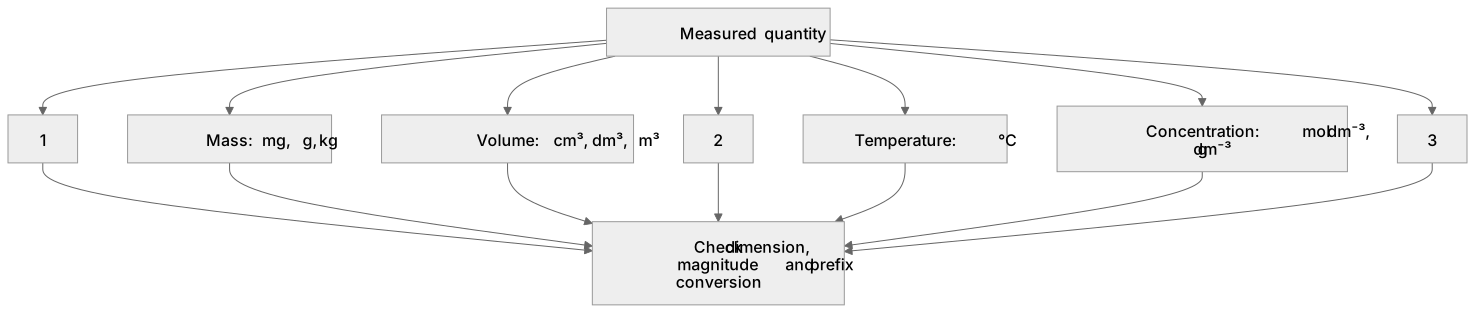
1Box 1
2Box 2
3Box 3
There is more to this lesson
The full lesson goes on to check your understanding and help you earn the marks. Create a free account to carry on, with your progress saved.
A week of Premium from your first lesson · Then the free plan continues · No card, no charge
Test your understanding of Implementing: (b) appropriate units for measurements
Active recall beats re-reading. Take an instant quiz now to test what you’ve learned and lock it into long-term memory.
A week of Premium from your first lesson · Then the free plan continues · No card, no charge