OCR · A-Level · Biology
Course version: H420 · Version from Sept 2025
(a) the principles of DNA sequencing and new DNA sequencing techniques
Full specification wording
Manipulating genomes: (a) the principles of DNA sequencing and new DNA sequencing techniques
DNA sequencing determines the order of nucleotides in a DNA molecule.
Checked against the OCR H420 specification (opens in a new tab) on .
- Point 1 of 10
- 4 key terms
Study notes
From the checked teaching notes for this specification point.
The idea
DNA sequencing determines the order of nucleotides in a DNA molecule. The classical chain-termination (Sanger) method relies on a template strand, a primer, DNA polymerase and a mixture of normal deoxynucleotides plus modified dideoxynucleotides that terminate chain extension. Because each terminating base carries a distinguishable label, fragments of different lengths are separated by electrophoresis and read in order of size, giving the sequence. Newer techniques, often called next-generation or high-throughput sequencing, avoid gel separation of individual fragments: DNA is fragmented, adaptors are ligated, and millions of clusters are sequenced in parallel, with fluorescent signals detected as each nucleotide is added. These methods generate very large volumes of short reads rapidly and cheaply per base, and the reads are assembled or aligned by computer.
What earns the marks
- Chain-termination sequencing uses dideoxynucleotides that lack a 3′ hydroxyl group, so chain extension by DNA polymerase stops when one is incorporated.
- Fragments terminated at different positions are separated by size (for example by capillary electrophoresis) and the sequence is read from shortest to longest.
- Fluorescent labels on the terminating nucleotides allow each base to be identified as fragments are detected.
- Next-generation sequencing fragments DNA, adds adaptors, and sequences many molecules in parallel, producing large numbers of short reads detected by fluorescence.
- High-throughput methods generate sequence data far faster and at lower cost per base than chain-termination methods, and reads are assembled or aligned using computer software.
- A primer and DNA polymerase are needed to initiate synthesis on a template strand in chain-termination sequencing.
Common mistakes and how to put them right
Thinking dideoxynucleotides stop synthesis because they cannot be added at all.
Put it right: They are incorporated but block further extension because they lack a 3′ hydroxyl group.
Assuming next-generation methods read one long continuous molecule.
Put it right: They typically produce many short reads that are assembled by computer.
Confusing the direction of reading a gel or electropherogram.
Put it right: The shortest fragments migrate furthest and correspond to the first nucleotides added after the primer.
Exam tips
- Link each technique to the molecular reason it works, such as chain termination by dideoxynucleotides, rather than just naming the method.
- When comparing methods, use explicit criteria such as speed, cost per base, read length and throughput.
- Practise reading a simple sequence from a set of labelled fragments ordered by size to check you understand how the sequence is deduced.
Try the lesson
The start of the Manipulating genomes: (a) the principles of DNA sequencing and new DNA sequencing techniques lesson, made from checked teaching notes for this specification point.
Have a go first
In Sanger sequencing, what is the role of the dideoxyribonucleotide (ddNTP) terminators?
Listen
DNA sequencing determines the order of nucleotides in a DNA molecule. The classical chain-termination (Sanger) method relies on a template strand, a primer, DNA polymerase and a mixture of normal deoxynucleotides plus modified dideoxynucleotides that terminate chain extension. Because each terminating base carries a distinguishable label, fragments of different lengths are separated by electrophoresis and read in order of size, giving the sequence. Newer techniques, often called next-generation or high-throughput sequencing, avoid gel separation of individual fragments: DNA is fragmented, adaptors are ligated, and millions of clusters are sequenced in parallel, with fluorescent signals detected as each nucleotide is added. These methods generate very large volumes of short reads rapidly and cheaply per base, and the reads are assembled or aligned by computer. A strong answer earns marks for these points. Chain-termination sequencing uses dideoxynucleotides that lack a 3′ hydroxyl group, so chain extension by DNA polymerase stops when one is incorporated. Fragments terminated at different positions are separated by size (for example by capillary electrophoresis) and the sequence is read from shortest to longest. Fluorescent labels on the terminating nucleotides allow each base to be identified as fragments are detected. Next-generation sequencing fragments DNA, adds adaptors, and sequences many molecules in parallel, producing large numbers of short reads detected by fluorescence. A common slip: Thinking dideoxynucleotides stop synthesis because they cannot be added at all. Instead, they are incorporated but block further extension because they lack a 3′ hydroxyl group. Exam tip: Link each technique to the molecular reason it works, such as chain termination by dideoxynucleotides, rather than just naming the method.
See it
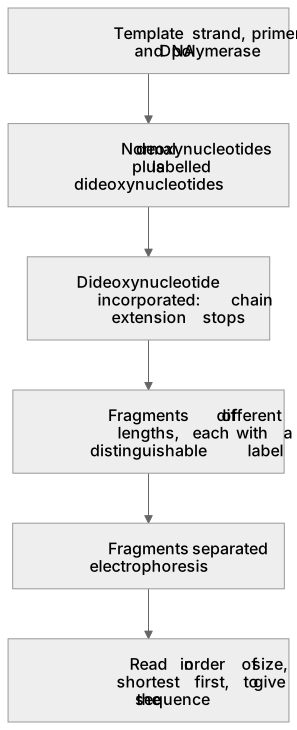
Put it in order
Put these steps in the order they happen.
- 1. Dideoxynucleotide incorporated: chain extension stops
- 2. Normal deoxynucleotides plus labelled dideoxynucleotides
- 3. Template strand, primer and DNA polymerase
- 4. Read in order of size, shortest first, to give the sequence
- 5. Fragments separated by electrophoresis
- 6. Fragments of different lengths, each with a distinguishable label
Key words
Say what each word means before you turn the card.
Chain-termination mechanism
Try answering aloud or in your head before turning the card.
Fluorescent detection and size separation
Try answering aloud or in your head before turning the card.
Parallel high-throughput sequencing
Try answering aloud or in your head before turning the card.
Comparison of scale, speed and cost
Try answering aloud or in your head before turning the card.
See every definition
- Chain-termination mechanism
- A method relying on a template strand, a primer, DNA polymerase and a mixture of normal deoxynucleotides plus modified dideoxynucleotides that terminate chain extension.
- Fluorescent detection and size separation
- Each terminating base carries a distinguishable label, so fragments of different lengths are separated by electrophoresis and read in order of size, giving the sequence.
- Parallel high-throughput sequencing
- DNA is fragmented, adaptors are ligated, and millions of clusters are sequenced in parallel, with fluorescent signals detected as each nucleotide is added.
- Comparison of scale, speed and cost
- These methods generate very large volumes of short reads rapidly and cheaply per base, and the reads are assembled or aligned by computer.
Label the diagram
Some boxes have lost their names. Pick the right name for each number.
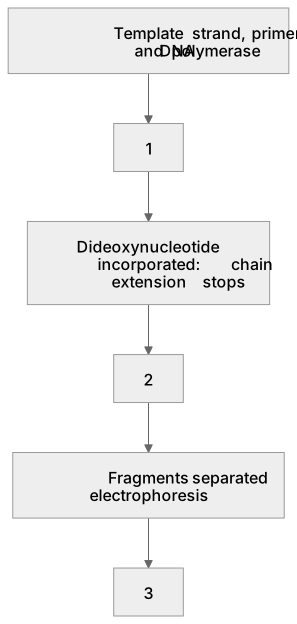
1Box 1
2Box 2
3Box 3
There is more to this lesson
The full lesson goes on to check your understanding and help you earn the marks. Create a free account to carry on, with your progress saved.
A week of Premium from your first lesson · Then the free plan continues · No card, no charge
Test your understanding of Manipulating genomes: (a) the principles of DNA sequencing and new DNA sequencing techniques
Active recall beats re-reading. Take an instant quiz now to test what you’ve learned and lock it into long-term memory.
A week of Premium from your first lesson · Then the free plan continues · No card, no charge