OCR · A-Level · Biology
Course version: H420 · Version from Sept 2025
(h) the principles of, and potential for, gene therapy in medicine.
Full specification wording
Manipulating genomes: (h) the principles of, and potential for, gene therapy in medicine.
Gene therapy treats disease by delivering genetic material into a patient's cells so a faulty gene is corrected, replaced or supplemented, or so a harmful gene product is suppressed.
Checked against the OCR H420 specification (opens in a new tab) on .
- Point 10 of 10
- 4 key terms
Study notes
From the checked teaching notes for this specification point.
The idea
Gene therapy treats disease by delivering genetic material into a patient's cells so a faulty gene is corrected, replaced or supplemented, or so a harmful gene product is suppressed. Somatic therapy targets body cells such as lung epithelium or bone marrow; changes are not inherited. Germ-line therapy would alter gametes or embryos and is not used clinically in humans. Delivery may be in vivo (vector introduced directly, e.g. an adenovirus carrying a functional allele to lung cells) or ex vivo (cells removed, modified, checked and returned). Vectors include modified viruses and liposomes. Success depends on efficient, targeted delivery, stable expression and immune tolerance. Potential is greatest for single-gene recessive disorders such as cystic fibrosis or severe combined immunodeficiency; complex polygenic disease is far harder.
What earns the marks
- States that gene therapy introduces functional genetic material into a patient's cells to treat disease.
- Distinguishes somatic therapy (body cells, not inherited) from germ-line therapy (gametes or embryos, heritable, not used clinically in humans).
- Identifies delivery methods: viral vectors or liposomes, and in vivo versus ex vivo routes.
- Explains that potential is greatest for single-gene recessive disorders, while polygenic or multifactorial disease is much harder to treat.
- Recognises limitations: immune response to vector, insertional mutagenesis, and transient or unstable expression.
Common mistakes and how to put them right
Confusing gene therapy with gene editing of embryos.
Put it right: Clinical gene therapy is somatic and non-heritable; germ-line alteration is not standard practice.
Assuming any disease can be cured.
Put it right: Single-gene recessive conditions are the realistic targets; polygenic disease is far more complex.
Thinking the vector itself is the medicine.
Put it right: The vector is a delivery vehicle; the therapeutic agent is the genetic material.
Believing one treatment gives permanent cure.
Put it right: Expression may be transient, so repeat dosing may be needed.
Exam tips
- Always separate somatic from germ-line when asked about principles.
- Name a specific delivery route (viral vector, liposome) and say why targeting matters.
- Link potential to a named single-gene disorder and state one limitation to show balance.
Try the lesson
The start of the Manipulating genomes: (h) the principles of, and potential for, gene therapy in medicine. lesson, made from checked teaching notes for this specification point.
Have a go first
Which of the following best describes the primary aim of gene therapy?
Listen
Gene therapy treats disease by delivering genetic material into a patient's cells so a faulty gene is corrected, replaced or supplemented, or so a harmful gene product is suppressed. Somatic therapy targets body cells such as lung epithelium or bone marrow; changes are not inherited. Germ-line therapy would alter gametes or embryos and is not used clinically in humans. Delivery may be in vivo (vector introduced directly, e.g. an adenovirus carrying a functional allele to lung cells) or ex vivo (cells removed, modified, checked and returned). Vectors include modified viruses and liposomes. Success depends on efficient, targeted delivery, stable expression and immune tolerance. Potential is greatest for single-gene recessive disorders such as cystic fibrosis or severe combined immunodeficiency; complex polygenic disease is far harder. A strong answer earns marks for these points. States that gene therapy introduces functional genetic material into a patient's cells to treat disease. Distinguishes somatic therapy (body cells, not inherited) from germ-line therapy (gametes or embryos, heritable, not used clinically in humans). Identifies delivery methods: viral vectors or liposomes, and in vivo versus ex vivo routes. Explains that potential is greatest for single-gene recessive disorders, while polygenic or multifactorial disease is much harder to treat. A common slip: Confusing gene therapy with gene editing of embryos. Instead, clinical gene therapy is somatic and non-heritable; germ-line alteration is not standard practice. Exam tip: Always separate somatic from germ-line when asked about principles.
See it
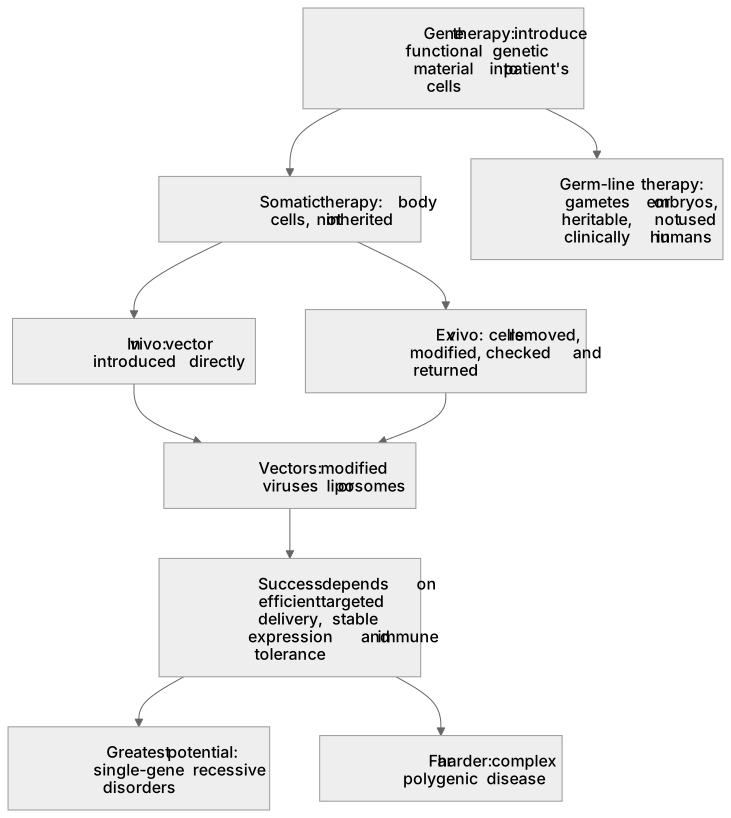
Key words
Say what each word means before you turn the card.
Somatic therapy
Try answering aloud or in your head before turning the card.
Germ-line therapy
Try answering aloud or in your head before turning the card.
In vivo
Try answering aloud or in your head before turning the card.
Ex vivo
Try answering aloud or in your head before turning the card.
See every definition
- Somatic therapy
- Targets body cells such as lung epithelium or bone marrow, and the changes are not inherited.
- Germ-line therapy
- Would alter gametes or embryos and is not used clinically in humans.
- In vivo
- A delivery strategy in which the vector is introduced directly, for example an adenovirus carrying a functional allele to lung cells.
- Ex vivo
- A delivery strategy in which cells are removed, modified, checked and returned.
Label the diagram
Some boxes have lost their names. Pick the right name for each number.
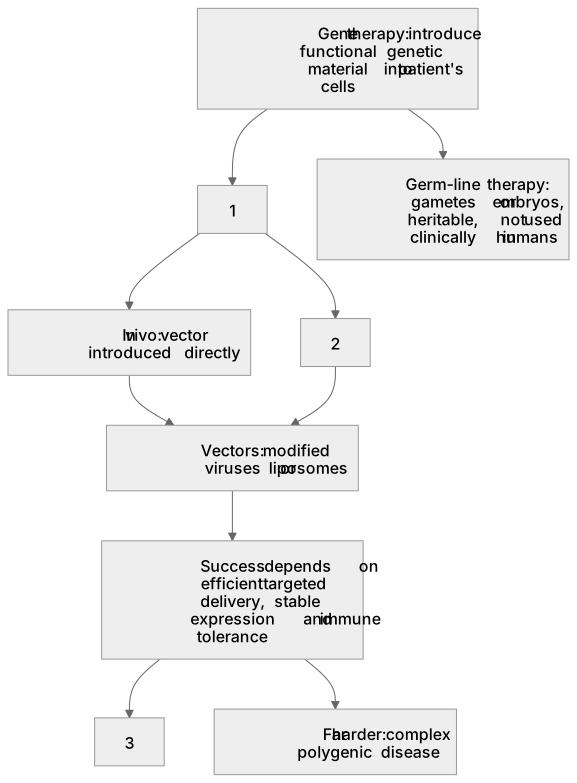
1Box 1
2Box 2
3Box 3
There is more to this lesson
The full lesson goes on to check your understanding and help you earn the marks. Create a free account to carry on, with your progress saved.
A week of Premium from your first lesson · Then the free plan continues · No card, no charge
Test your understanding of Manipulating genomes: (h) the principles of, and potential for, gene therapy in medicine.
Active recall beats re-reading. Take an instant quiz now to test what you’ve learned and lock it into long-term memory.
A week of Premium from your first lesson · Then the free plan continues · No card, no charge