OCR · A-Level · Biology
Course version: H420 · Version from Sept 2025
(e) the fixation of carbon dioxide and the light-independent stage of…
Full specification wording
Photosynthesis: (e) the fixation of carbon dioxide and the light-independent stage of photosynthesis
The light-independent stage occurs in the stroma and does not need light directly, but depends on ATP and reduced NADP from the light-dependent stage.
Checked against the OCR H420 specification (opens in a new tab) on .
- Point 6 of 9
- 4 key terms
Study notes
From the checked teaching notes for this specification point.
The idea
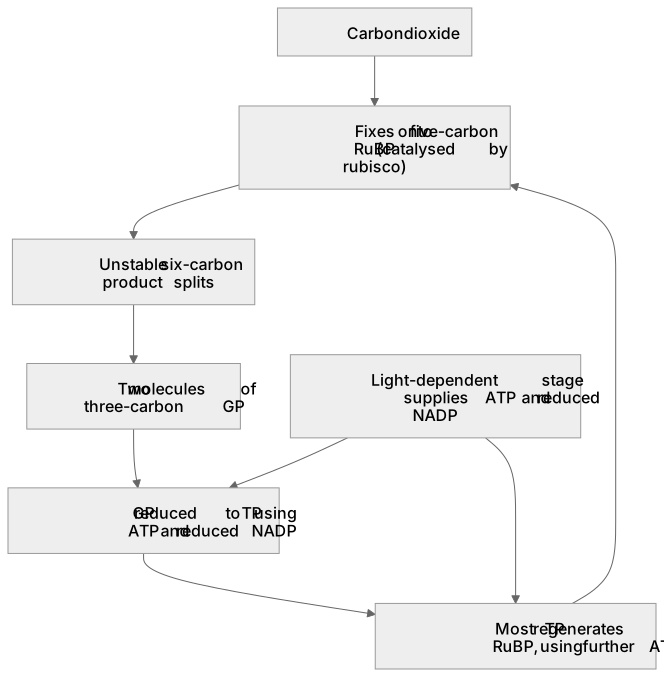
The light-independent stage occurs in the stroma and does not need light directly, but depends on ATP and reduced NADP from the light-dependent stage. Carbon dioxide is fixed when it joins the five-carbon acceptor ribulose bisphosphate (RuBP), catalysed by rubisco, forming two molecules of the three-carbon glycerate 3-phosphate (GP). GP is reduced to triose phosphate (TP) using ATP and reduced NADP. Most TP regenerates RuBP, consuming further ATP, so the cycle continues. A useful check: for each CO₂ fixed, one carbon enters the cycle, and the cycle must turn six times to build one hexose. Track the carbon atoms and the ATP and reduced NADP consumed at each step.
What earns the marks
- Carbon dioxide is fixed by combining with the five-carbon compound ribulose bisphosphate (RuBP), a reaction catalysed by the enzyme rubisco.
- The unstable six-carbon product immediately splits into two molecules of the three-carbon glycerate 3-phosphate (GP).
- GP is reduced to triose phosphate (TP) using ATP and reduced NADP supplied by the light-dependent stage.
- Most TP is used to regenerate RuBP, which requires further ATP, so the cycle is self-sustaining.
- The stage occurs in the stroma and does not require light directly, but stops without the products of the light-dependent reactions.
Common mistakes and how to put them right
Saying the light-independent stage needs light directly.
Put it right by explaining it depends on ATP and reduced NADP from the light-dependent stage, not on light itself.
Naming the CO₂ acceptor as a three-carbon compound.
Put it right by stating the acceptor is the five-carbon RuBP.
Forgetting that ATP is used both in reducing GP and in regenerating RuBP.
Put it right by listing both ATP-consuming steps.
Exam tips
- Learn the carbon-atom count at each step (5-carbon RuBP, 3-carbon GP and TP) so you can trace the cycle accurately.
- Link each step to the enzyme or coenzyme involved, such as rubisco for fixation and reduced NADP for reduction.
- Practise explaining why the cycle stops in darkness even though it does not use light directly.
Try the lesson
The start of the Photosynthesis: (e) the fixation of carbon dioxide and the light-independent stage of photosynthesis lesson, made from checked teaching notes for this specification point.
Have a go first
In the light-independent stage of photosynthesis, which enzyme catalyses the fixation of carbon dioxide onto ribulose bisphosphate (RuBP)?
Listen
The light-independent stage occurs in the stroma and does not need light directly, but depends on ATP and reduced NADP from the light-dependent stage. Carbon dioxide is fixed when it joins the five-carbon acceptor ribulose bisphosphate (RuBP), catalysed by rubisco, forming two molecules of the three-carbon glycerate 3-phosphate (GP). GP is reduced to triose phosphate (TP) using ATP and reduced NADP. Most TP regenerates RuBP, consuming further ATP, so the cycle continues. A useful check: for each CO₂ fixed, one carbon enters the cycle, and the cycle must turn six times to build one hexose. Track the carbon atoms and the ATP and reduced NADP consumed at each step. A strong answer earns marks for these points. Carbon dioxide is fixed by combining with the five-carbon compound ribulose bisphosphate (RuBP), a reaction catalysed by the enzyme rubisco. The unstable six-carbon product immediately splits into two molecules of the three-carbon glycerate 3-phosphate (GP). GP is reduced to triose phosphate (TP) using ATP and reduced NADP supplied by the light-dependent stage. Most TP is used to regenerate RuBP, which requires further ATP, so the cycle is self-sustaining. A common slip: Saying the light-independent stage needs light directly. Instead, explaining it depends on ATP and reduced NADP from the light-dependent stage, not on light itself. Exam tip: Learn the carbon-atom count at each step (5-carbon RuBP, 3-carbon GP and TP) so you can trace the cycle accurately.
See it
Key words
Say what each word means before you turn the card.
Carbon fixation by rubisco
Try answering aloud or in your head before turning the card.
Reduction of GP to TP
Try answering aloud or in your head before turning the card.
Regeneration of RuBP
Try answering aloud or in your head before turning the card.
Dependence on the light-dependent stage
Try answering aloud or in your head before turning the card.
See every definition
- Carbon fixation by rubisco
- Carbon dioxide joins the five-carbon acceptor ribulose bisphosphate (RuBP), a reaction catalysed by the enzyme rubisco.
- Reduction of GP to TP
- Glycerate 3-phosphate (GP) is reduced to triose phosphate (TP) using ATP and reduced NADP supplied by the light-dependent stage.
- Regeneration of RuBP
- Most TP is used to regenerate RuBP, which requires further ATP, so the cycle is self-sustaining.
- Dependence on the light-dependent stage
- The stage occurs in the stroma and does not require light directly, but stops without the products of the light-dependent reactions.
Label the diagram
Some boxes have lost their names. Pick the right name for each number.
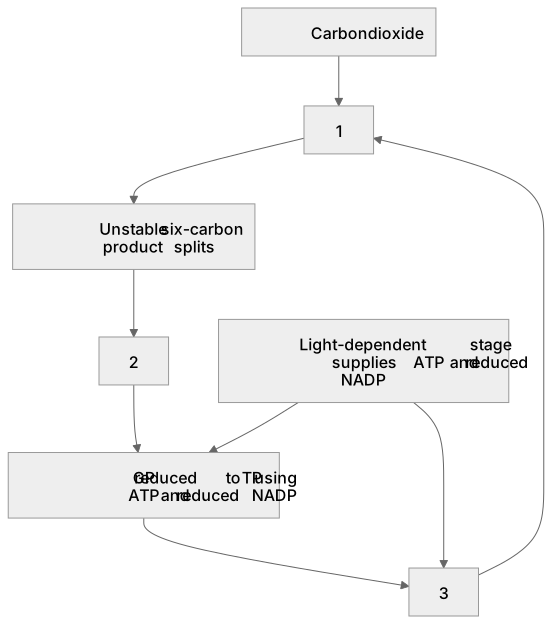
1Box 1
2Box 2
3Box 3
There is more to this lesson
The full lesson goes on to check your understanding and help you earn the marks. Create a free account to carry on, with your progress saved.
A week of Premium from your first lesson · Then the free plan continues · No card, no charge
Test your understanding of Photosynthesis: (e) the fixation of carbon dioxide and the light-independent stage of photosynthesis
Active recall beats re-reading. Take an instant quiz now to test what you’ve learned and lock it into long-term memory.
A week of Premium from your first lesson · Then the free plan continues · No card, no charge