OCR · A-Level · Biology
Course version: H420 · Version from Sept 2025
(ii) practical investigations into factors affecting the rate of…
Full specification wording
Photosynthesis: (ii) practical investigations into factors affecting the rate of photosynthesis.
Practical work measures the rate of photosynthesis by a dependent variable such as oxygen evolved or carbon dioxide taken up.
Checked against the OCR H420 specification (opens in a new tab) on .
- Point 9 of 9
- 4 key terms
Study notes
From the checked teaching notes for this specification point.
The idea
Practical work measures the rate of photosynthesis by a dependent variable such as oxygen evolved or carbon dioxide taken up. A common method uses pondweed: the number of oxygen bubbles released per minute, or the volume of gas collected, is recorded while one independent variable (for example light intensity, set by distance from a lamp, or carbon dioxide concentration using hydrogencarbonate solution, or temperature using a water bath) is changed and the others are controlled. Rate is calculated from the dependent variable, and results are plotted to show the limiting-factor pattern. Control variables include temperature, carbon dioxide supply and light distance, and repeats improve reliability.
What earns the marks
- Rate is measured via a dependent variable such as oxygen bubbles per minute or volume of gas collected.
- The independent variable (light intensity, carbon dioxide concentration or temperature) is changed while others are controlled.
- Control variables include temperature, carbon dioxide supply and distance from the light source.
- Light intensity can be varied by changing lamp distance; carbon dioxide by hydrogencarbonate concentration; temperature by a water bath.
- Repeats and averaging improve reliability; results are plotted to reveal limiting-factor patterns.
Common mistakes and how to put them right
Confusing the independent and dependent variables.
Put it right: The factor changed is independent, the measured gas release is dependent.
Failing to control other factors such as temperature when varying light.
Put it right: Uncontrolled variables invalidate the limiting-factor conclusion.
Recording a single reading as the rate.
Put it right: Repeat and average, and express rate per unit time.
Exam tips
- Name the dependent variable and how it is measured, not just 'measure photosynthesis'.
- State how each control variable is kept constant.
- Express rate per unit time (for example bubbles per minute).
Try the lesson
The start of the Photosynthesis: (ii) practical investigations into factors affecting the rate of photosynthesis. lesson, made from checked teaching notes for this specification point.
Have a go first
In a practical using pondweed, bubbles of gas are counted as they are released. Which gas is being collected, and why is it used to measure the rate?
Listen
Practical work measures the rate of photosynthesis by a dependent variable such as oxygen evolved or carbon dioxide taken up. A common method uses pondweed: the number of oxygen bubbles released per minute, or the volume of gas collected, is recorded while one independent variable (for example light intensity, set by distance from a lamp, or carbon dioxide concentration using hydrogencarbonate solution, or temperature using a water bath) is changed and the others are controlled. Rate is calculated from the dependent variable, and results are plotted to show the limiting-factor pattern. Control variables include temperature, carbon dioxide supply and light distance, and repeats improve reliability. A strong answer earns marks for these points. Rate is measured via a dependent variable such as oxygen bubbles per minute or volume of gas collected. The independent variable (light intensity, carbon dioxide concentration or temperature) is changed while others are controlled. Control variables include temperature, carbon dioxide supply and distance from the light source. Light intensity can be varied by changing lamp distance; carbon dioxide by hydrogencarbonate concentration; temperature by a water bath. A common slip: Confusing the independent and dependent variables. Instead, the factor changed is independent, the measured gas release is dependent. Exam tip: Name the dependent variable and how it is measured, not just 'measure photosynthesis'.
See it
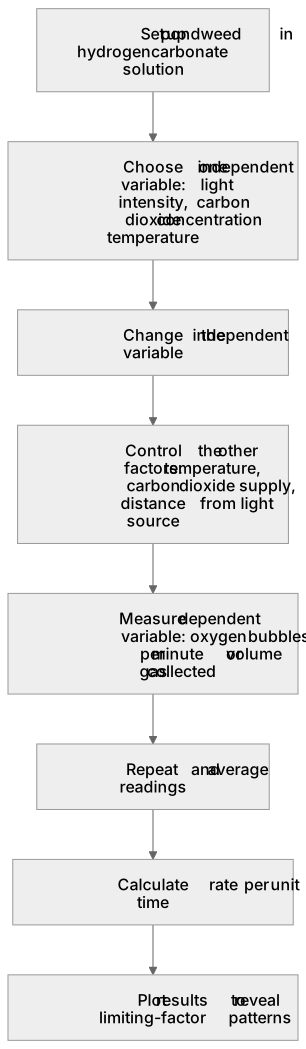
Put it in order
Put these steps in the order they happen.
- 1. Measure dependent variable: oxygen bubbles per minute or volume of gas collected
- 2. Plot results to reveal limiting-factor patterns
- 3. Repeat and average readings
- 4. Set up pondweed in hydrogencarbonate solution
- 5. Choose one independent variable: light intensity, carbon dioxide concentration or temperature
- 6. Calculate rate per unit time
- 7. Change the independent variable
- 8. Control the other factors: temperature, carbon dioxide supply, distance from light source
Key words
Say what each word means before you turn the card.
Independent variable
Try answering aloud or in your head before turning the card.
Dependent variable
Try answering aloud or in your head before turning the card.
Control variables
Try answering aloud or in your head before turning the card.
Reliability
Try answering aloud or in your head before turning the card.
See every definition
- Independent variable
- The factor that is changed, such as light intensity, carbon dioxide concentration or temperature, while the others are controlled.
- Dependent variable
- The factor measured, such as oxygen bubbles per minute or volume of gas collected, from which rate is calculated.
- Control variables
- Factors kept constant, including temperature, carbon dioxide supply and distance from the light source.
- Reliability
- Improved by repeats and averaging, with rate expressed per unit time.
Label the diagram
Some boxes have lost their names. Pick the right name for each number.
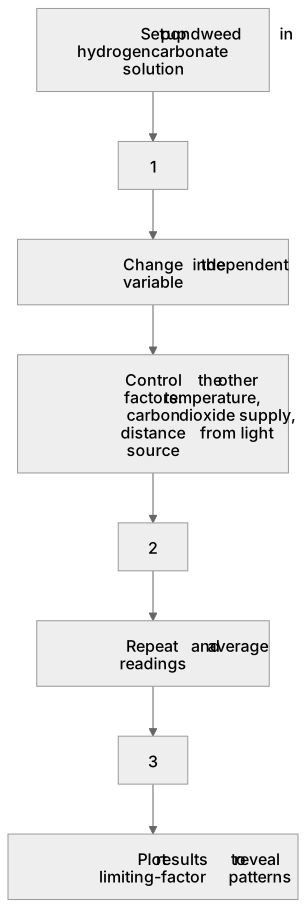
1Box 1
2Box 2
3Box 3
There is more to this lesson
The full lesson goes on to check your understanding and help you earn the marks. Create a free account to carry on, with your progress saved.
A week of Premium from your first lesson · Then the free plan continues · No card, no charge
Test your understanding of Photosynthesis: (ii) practical investigations into factors affecting the rate of photosynthesis.
Active recall beats re-reading. Take an instant quiz now to test what you’ve learned and lock it into long-term memory.
A week of Premium from your first lesson · Then the free plan continues · No card, no charge