OCR · A-Level · Biology
Course version: H420 · Version from Sept 2025
(b) identification of variables that must be controlled, where appropriate
Full specification wording
Planning: (b) identification of variables that must be controlled, where appropriate
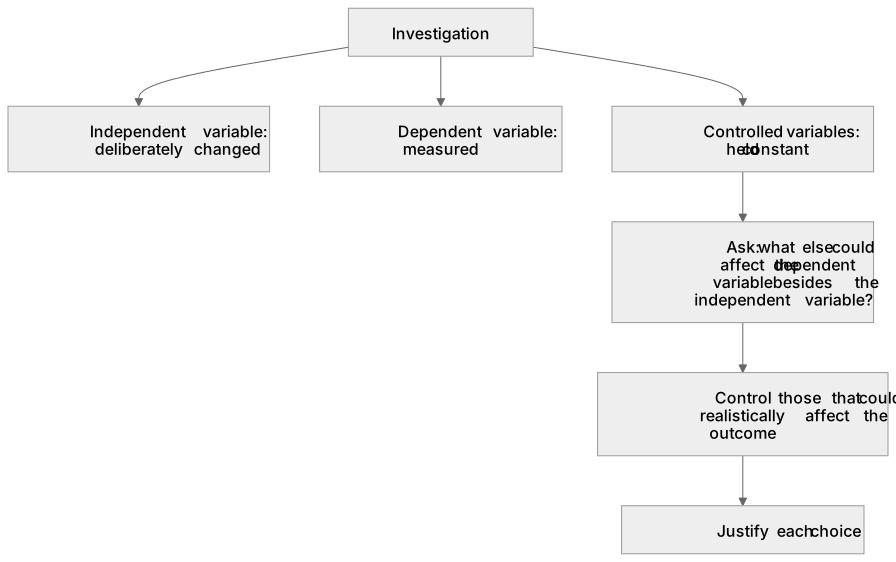
In any investigation, some variables are deliberately changed (independent), some are measured (dependent) and the rest must be held constant so they do not distort the result.
Checked against the OCR H420 specification (opens in a new tab) on .
- 4 key terms
Study notes
From the checked teaching notes for this specification point.
The idea
In any investigation, some variables are deliberately changed (independent), some are measured (dependent) and the rest must be held constant so they do not distort the result. These controlled variables are the confounding factors. To identify them, ask what else could affect the dependent variable besides the independent variable. For example, in an investigation of enzyme activity against temperature, pH, substrate concentration and enzyme concentration must be controlled because each affects rate. In a plant photosynthesis experiment, light intensity, carbon dioxide concentration and temperature are potential confounders. The phrase 'where appropriate' matters: you control variables that could realistically affect the outcome, and you justify each choice.
What earns the marks
- Distinguishes independent, dependent and controlled variables in a given scenario.
- Identifies a confounding variable that could affect the dependent variable.
- Explains why a named variable must be held constant.
- Selects the option that correctly names a variable requiring control, rejecting distractors that are the independent or dependent variable.
Common mistakes and how to put them right
Naming the independent variable as the one to control.
Put it right: Recognise that the independent variable is deliberately changed, not held constant.
Assuming every conceivable variable must be controlled.
Put it right: Control those that could realistically affect the dependent variable and justify the choice.
Ignoring a confounder that clearly affects the outcome.
Put it right: Check each option against what could influence the measured result.
Exam tips
- Label each variable in the scenario as independent, dependent or controlled before choosing an option.
- Ask whether each option could affect the dependent variable; if it could and is not being changed, it needs controlling.
- Reject distractors that are the variable being measured or deliberately changed.
Try the lesson
The start of the Planning: (b) identification of variables that must be controlled, where appropriate lesson, made from checked teaching notes for this specification point.
Have a go first
A student investigates the effect of light intensity on the rate of photosynthesis in pondweed. Which variable must be controlled so that the comparison is fair?
Listen
In any investigation, some variables are deliberately changed (independent), some are measured (dependent) and the rest must be held constant so they do not distort the result. These controlled variables are the confounding factors. To identify them, ask what else could affect the dependent variable besides the independent variable. For example, in an investigation of enzyme activity against temperature, pH, substrate concentration and enzyme concentration must be controlled because each affects rate. In a plant photosynthesis experiment, light intensity, carbon dioxide concentration and temperature are potential confounders. The phrase 'where appropriate' matters: you control variables that could realistically affect the outcome, and you justify each choice. A strong answer earns marks for these points. Distinguishes independent, dependent and controlled variables in a given scenario. Identifies a confounding variable that could affect the dependent variable. Explains why a named variable must be held constant. Selects the option that correctly names a variable requiring control, rejecting distractors that are the independent or dependent variable. A common slip: Naming the independent variable as the one to control. Instead, recognise that the independent variable is deliberately changed, not held constant. Exam tip: Label each variable in the scenario as independent, dependent or controlled before choosing an option.
See it
Watch it explained
What is the one idea the video explains? Say it in a sentence.
Read the described scene instead
In any investigation, you deliberately change one variable and measure another. The variable you change is the independent variable. The variable you measure is the dependent variable. Everything else that could distort the result should be held constant. Those held-constant variables are controlled variables, and they include confounding factors. A confounding factor is something other than the independent variable that could affect the dependent variable. To identify controlled variables, ask what else could affect the dependent variable besides the independent variable. Those possible influences are the confounders. You control variables that could realistically affect the outcome, not every conceivable variable. The phrase 'where appropriate' means the control must be justified. For each one, explain how it could change the dependent variable if it were not held constant. Consider an investigation of enzyme activity against temperature. Temperature is the independent variable because it is deliberately changed. The rate of reaction is the dependent variable because it is measured. What else could affect rate? pH, substrate concentration and enzyme concentration are controlled variables because each can affect enzyme activity. If any of these changed between trials, the result could not be attributed to temperature alone. Now apply the same reasoning to a plant photosynthesis experiment. Suppose light intensity is deliberately changed, and the rate of oxygen production is measured. Carbon dioxide concentration and temperature are potential confounders because both can affect photosynthesis. They should be held constant so that any change in oxygen production can be attributed to light intensity. Notice that the independent and dependent variables are not the variables to control. A common mistake is naming the independent variable as the one to control. Remember, the independent variable is deliberately changed, not held constant. Another mistake is assuming every conceivable variable must be controlled. Control those that could realistically affect the dependent variable and justify the choice. Finally, do not ignore a confounder that clearly affects the outcome. Check each option against what could influence the measured result. Before choosing an answer, label each variable in the scenario as independent, dependent or controlled. Ask whether each option could affect the dependent variable; if it could, and it is not being changed, it needs controlling. Reject distractors that are the variable being measured or deliberately changed. Then briefly pause and try this: for a named control, explain how it could distort the dependent variable if it were not held constant.
Key words
Say what each word means before you turn the card.
Independent variable
Try answering aloud or in your head before turning the card.
Dependent variable
Try answering aloud or in your head before turning the card.
Controlled variables
Try answering aloud or in your head before turning the card.
Confounding factors
Try answering aloud or in your head before turning the card.
See every definition
- Independent variable
- The variable that is deliberately changed in an investigation.
- Dependent variable
- The variable that is measured in an investigation.
- Controlled variables
- Variables that must be held constant so they do not distort the result; these are the confounding factors.
- Confounding factors
- Variables that must be held constant so they do not distort the result, identified by asking what else could affect the dependent variable besides the independent variable.
Label the diagram
Some boxes have lost their names. Pick the right name for each number.
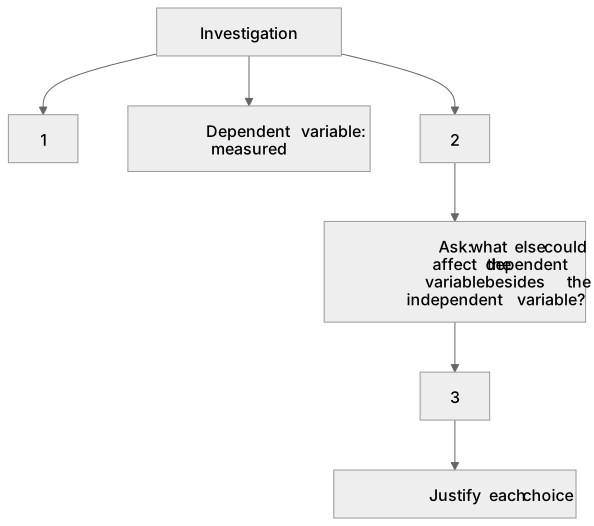
1Box 1
2Box 2
3Box 3
There is more to this lesson
The full lesson goes on to check your understanding and help you earn the marks. Create a free account to carry on, with your progress saved.
A week of Premium from your first lesson · Then the free plan continues · No card, no charge
Test your understanding of Planning: (b) identification of variables that must be controlled, where appropriate
Active recall beats re-reading. Take an instant quiz now to test what you’ve learned and lock it into long-term memory.
A week of Premium from your first lesson · Then the free plan continues · No card, no charge