OCR · A-Level · Biology
Course version: H420 · Version from Sept 2025
Plant and animal responses: (a) (i) the types of plant responses
Plant responses are the ways plants adjust growth or movement to stimuli, and OCR expects you to recognise the main types.
Checked against the OCR H420 specification (opens in a new tab) on .
- Point 1 of 12
- 4 key terms
Study notes
From the checked teaching notes for this specification point.
The idea
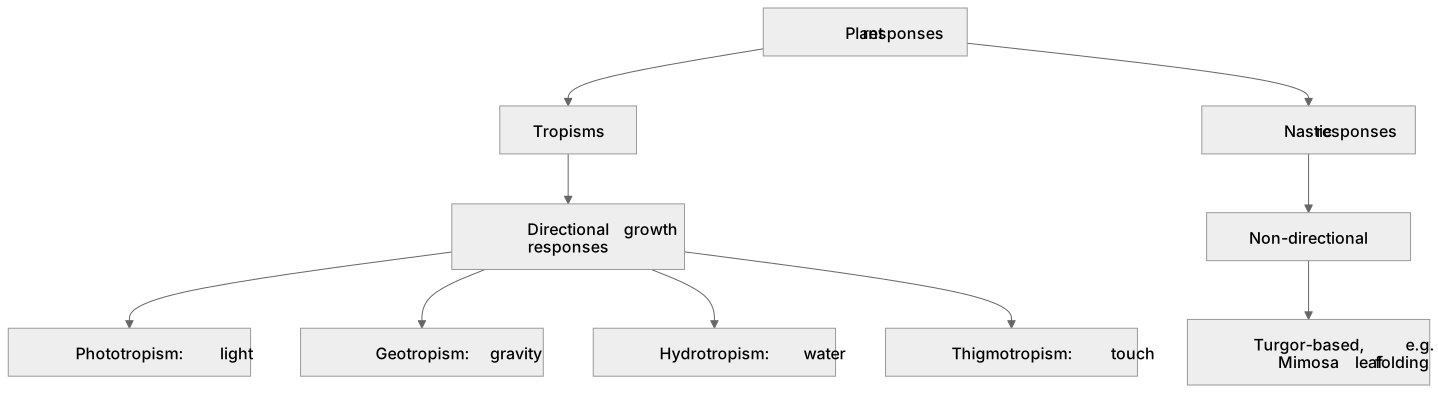
Plant responses are the ways plants adjust growth or movement to stimuli, and OCR expects you to recognise the main types. Tropisms are directional growth responses: phototropism to light, geotropism (gravitropism) to gravity, hydrotropism to water and thigmotropism to touch. Shoots are positively phototropic and negatively geotropic; roots are the reverse. Nastic responses are non-directional movements, such as the folding of Mimosa leaves when touched, and are driven by turgor changes rather than growth direction. Taxis responses involve whole-organism movement, but these are not typical of rooted plants. Learn to classify an unfamiliar example by asking whether the response is directional and whether it is growth-based or turgor-based.
What earns the marks
- Tropisms are directional growth responses to a unilateral stimulus.
- Phototropism is a response to light; geotropism is a response to gravity; hydrotropism is a response to water; thigmotropism is a response to touch.
- Shoots show positive phototropism and negative geotropism; roots show positive geotropism.
- Nastic responses are non-directional and often involve reversible turgor changes, for example leaf folding in Mimosa.
- Classifying an example requires identifying the stimulus, whether the response is directional, and whether it is growth-based or turgor-based.
Common mistakes and how to put them right
Confusing nastic responses with tropisms.
Put it right: Nastic movements are non-directional, whereas tropisms are directional growth responses.
Assuming roots are positively phototropic.
Put it right: Roots are positively geotropic and generally grow away from light.
Treating all plant responses as growth responses.
Put it right: Some, such as Mimosa leaf folding, are rapid turgor-driven movements.
Exam tips
- For each example, name the stimulus first, then state whether the response is directional.
- Use the correct prefix (photo-, geo-, hydro-, thigmo-) to show the stimulus involved.
- Distinguish growth-based tropisms from turgor-based nastic movements when justifying a classification.
Try the lesson
The start of the Plant and animal responses: (a) (i) the types of plant responses lesson, made from checked teaching notes for this specification point.
Have a go first
A plant's roots grow towards a region of moist soil. Which type of response is this?
Listen
Plant responses are the ways plants adjust growth or movement to stimuli, and OCR expects you to recognise the main types. Tropisms are directional growth responses: phototropism to light, geotropism (gravitropism) to gravity, hydrotropism to water and thigmotropism to touch. Shoots are positively phototropic and negatively geotropic; roots are the reverse. Nastic responses are non-directional movements, such as the folding of Mimosa leaves when touched, and are driven by turgor changes rather than growth direction. Taxis responses involve whole-organism movement, but these are not typical of rooted plants. Learn to classify an unfamiliar example by asking whether the response is directional and whether it is growth-based or turgor-based. A strong answer earns marks for these points. Tropisms are directional growth responses to a unilateral stimulus. Phototropism is a response to light; geotropism is a response to gravity; hydrotropism is a response to water; thigmotropism is a response to touch. Shoots show positive phototropism and negative geotropism; roots show positive geotropism. Nastic responses are non-directional and often involve reversible turgor changes, for example leaf folding in Mimosa. Exam tip: For each example, name the stimulus first, then state whether the response is directional.
See it
Key words
Say what each word means before you turn the card.
Tropisms
Try answering aloud or in your head before turning the card.
Nastic responses
Try answering aloud or in your head before turning the card.
Positive and negative responses
Try answering aloud or in your head before turning the card.
Stimulus-specific prefixes
Try answering aloud or in your head before turning the card.
See every definition
- Tropisms
- Directional growth responses to a unilateral stimulus, such as phototropism to light or geotropism to gravity.
- Nastic responses
- Non-directional movements, often involving reversible turgor changes, for example leaf folding in Mimosa.
- Positive and negative responses
- Shoots show positive phototropism and negative geotropism, while roots show positive geotropism.
- Stimulus-specific prefixes
- Photo- indicates light, geo- indicates gravity, hydro- indicates water and thigmo- indicates touch.
Label the diagram
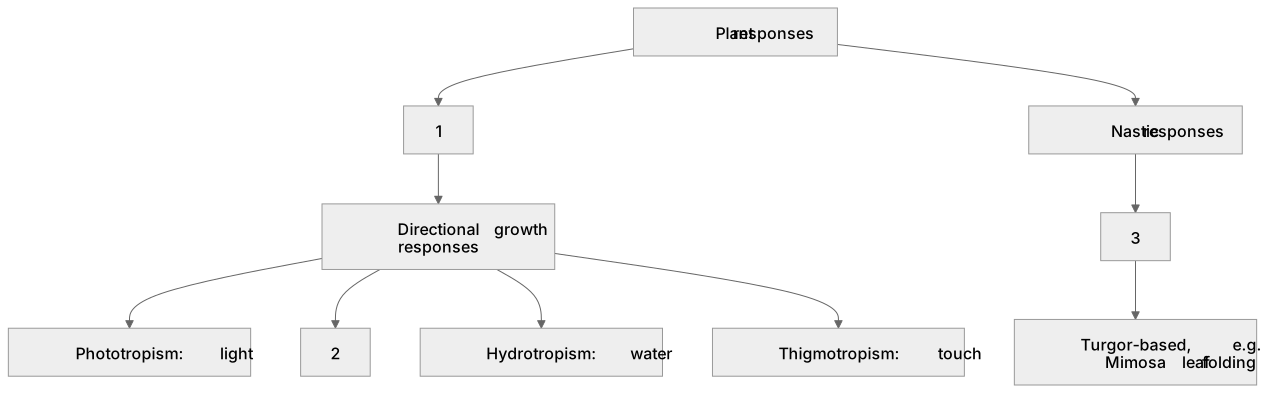
Some boxes have lost their names. Pick the right name for each number.
1Box 1
2Box 2
3Box 3
There is more to this lesson
The full lesson goes on to check your understanding and help you earn the marks. Create a free account to carry on, with your progress saved.
A week of Premium from your first lesson · Then the free plan continues · No card, no charge
Test your understanding of Plant and animal responses: (a) (i) the types of plant responses
Active recall beats re-reading. Take an instant quiz now to test what you’ve learned and lock it into long-term memory.
A week of Premium from your first lesson · Then the free plan continues · No card, no charge