OCR · A-Level · Biology
Course version: H420 · Version from Sept 2025
(d) the experimental evidence for the role of gibberellin in the control…
Full specification wording
Plant and animal responses: (d) the experimental evidence for the role of gibberellin in the control of stem elongation and seed germination
Gibberellins promote stem elongation and seed germination, and the evidence comes from mutants and application experiments.
Checked against the OCR H420 specification (opens in a new tab) on .
- Point 4 of 12
- 4 key terms
Study notes
From the checked teaching notes for this specification point.
The idea
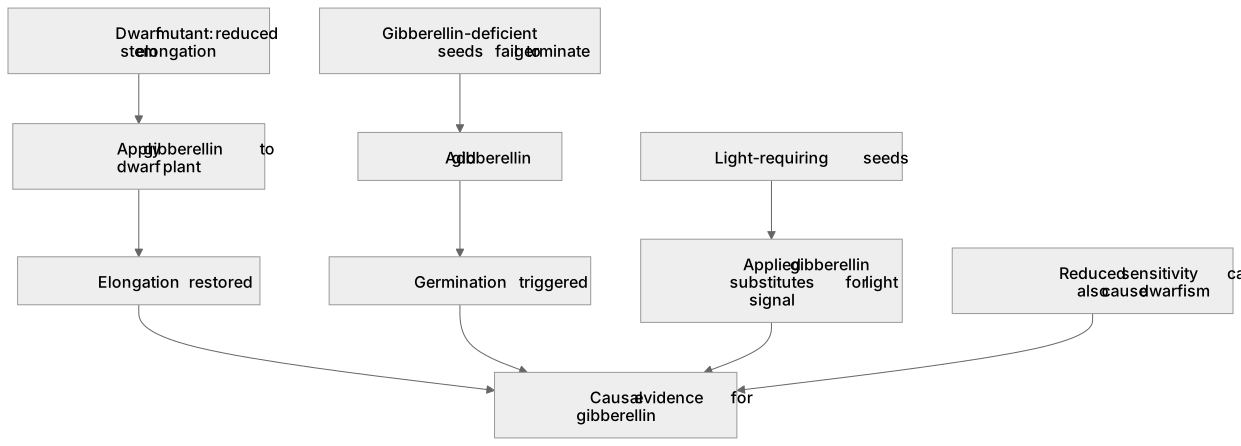
Gibberellins promote stem elongation and seed germination, and the evidence comes from mutants and application experiments. Dwarf varieties (for example short-stemmed mutants) have low gibberellin or reduced sensitivity; applying gibberellin to dwarf plants restores normal elongation, showing the hormone drives stem growth. For germination, gibberellin-deficient seeds fail to germinate, and adding gibberellin triggers germination, including in some light-requiring seeds where it substitutes for the light signal. The evidence combines naturally occurring mutants (loss of function) with replacement by applied hormone, so a strong answer separates the observation from the causal test and notes that sensitivity, not only hormone level, can matter.
What earns the marks
- Dwarf (short-stemmed) mutant plants show reduced stem elongation, linking gibberellin to stem growth.
- Applying gibberellin to dwarf plants restores elongation, showing the hormone causes the growth rather than merely correlating with it.
- Gibberellin-deficient seeds fail to germinate, and adding gibberellin triggers germination, showing its role in seed germination.
- In some light-requiring seeds, applied gibberellin can substitute for the light signal that normally promotes germination.
- Mutant and replacement experiments together provide causal evidence, but reduced sensitivity (not only low hormone) can also produce dwarfism.
- Conclusions are limited to the species and conditions tested and do not by themselves reveal the full molecular mechanism.
Common mistakes and how to put them right
Claiming dwarf plants always lack gibberellin.
Put it right: Dwarfism can also result from reduced sensitivity to gibberellin, so level alone is not the whole story.
Treating correlation as proof.
Put it right: The causal evidence comes from applying gibberellin and seeing elongation or germination restored.
Confusing gibberellin with auxin roles.
Put it right: Gibberellin promotes stem elongation and germination, whereas auxin is central to apical dominance.
Exam tips
- Pair each observation with its manipulation: dwarf mutant → apply gibberellin → elongation restored.
- For germination, state that deficient seeds fail and applied gibberellin triggers germination.
- Mention that sensitivity as well as hormone concentration can explain mutant phenotypes.
Try the lesson
The start of the Plant and animal responses: (d) the experimental evidence for the role of gibberellin in the control of stem elongation and seed germination lesson, made from checked teaching notes for this specification point.
Have a go first
Which observation would provide evidence that gibberellin is involved in seed germination?
Listen
Gibberellins promote stem elongation and seed germination, and the evidence comes from mutants and application experiments. Dwarf varieties (for example short-stemmed mutants) have low gibberellin or reduced sensitivity; applying gibberellin to dwarf plants restores normal elongation, showing the hormone drives stem growth. For germination, gibberellin-deficient seeds fail to germinate, and adding gibberellin triggers germination, including in some light-requiring seeds where it substitutes for the light signal. The evidence combines naturally occurring mutants (loss of function) with replacement by applied hormone, so a strong answer separates the observation from the causal test and notes that sensitivity, not only hormone level, can matter. A strong answer earns marks for these points. Dwarf (short-stemmed) mutant plants show reduced stem elongation, linking gibberellin to stem growth. Applying gibberellin to dwarf plants restores elongation, showing the hormone causes the growth rather than merely correlating with it. Gibberellin-deficient seeds fail to germinate, and adding gibberellin triggers germination, showing its role in seed germination. In some light-requiring seeds, applied gibberellin can substitute for the light signal that normally promotes germination. A common slip: Claiming dwarf plants always lack gibberellin. Instead, dwarfism can also result from reduced sensitivity to gibberellin, so level alone is not the whole story. Exam tip: Pair each observation with its manipulation: dwarf mutant → apply gibberellin → elongation restored.
See it
Key words
Say what each word means before you turn the card.
Gibberellin and stem elongation
Try answering aloud or in your head before turning the card.
Gibberellin and seed germination
Try answering aloud or in your head before turning the card.
Dwarf mutants and hormone-replacement experiments
Try answering aloud or in your head before turning the card.
Hormone sensitivity versus hormone concentration
Try answering aloud or in your head before turning the card.
See every definition
- Gibberellin and stem elongation
- Dwarf short-stemmed mutants show reduced stem elongation, and applying gibberellin to dwarf plants restores elongation, showing the hormone causes the growth.
- Gibberellin and seed germination
- Gibberellin-deficient seeds fail to germinate, and adding gibberellin triggers germination, including in some light-requiring seeds where it substitutes for the light signal.
- Dwarf mutants and hormone-replacement experiments
- Naturally occurring loss-of-function mutants combined with replacement by applied hormone provide causal evidence, separating the observation from the causal test.
- Hormone sensitivity versus hormone concentration
- Dwarfism can result from reduced sensitivity to gibberellin as well as low hormone, so level alone is not the whole story.
Label the diagram
Some boxes have lost their names. Pick the right name for each number.
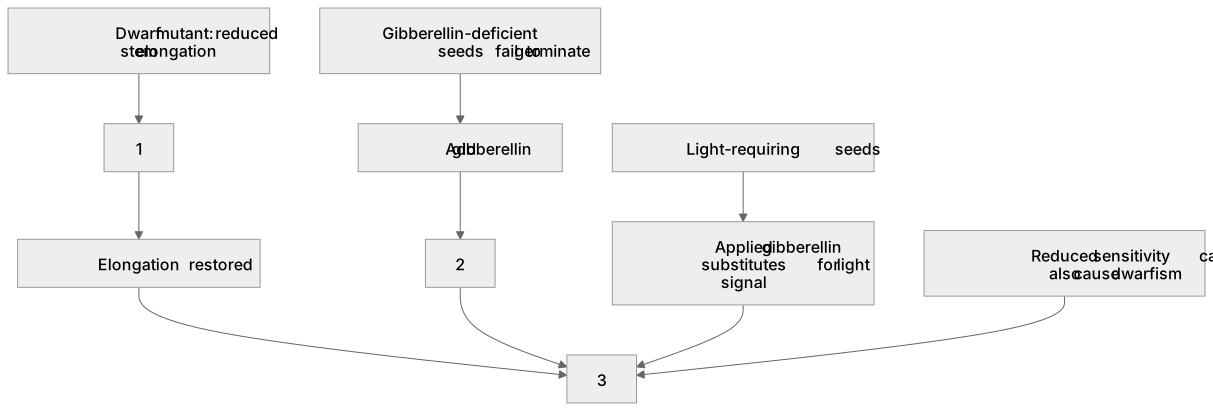
1Box 1
2Box 2
3Box 3
There is more to this lesson
The full lesson goes on to check your understanding and help you earn the marks. Create a free account to carry on, with your progress saved.
A week of Premium from your first lesson · Then the free plan continues · No card, no charge
Test your understanding of Plant and animal responses: (d) the experimental evidence for the role of gibberellin in the control of stem elongation and seed germination
Active recall beats re-reading. Take an instant quiz now to test what you’ve learned and lock it into long-term memory.
A week of Premium from your first lesson · Then the free plan continues · No card, no charge