OCR · A-Level · Biology
Course version: H420 · Version from Sept 2025
(a) the need for transport systems in multicellular plants
Full specification wording
Transport in plants: (a) the need for transport systems in multicellular plants
Multicellular plants are large, so their surface area to volume ratio is small.
Checked against the OCR H420 specification (opens in a new tab) on .
- Point 1 of 8
- 4 key terms
Study notes
From the checked teaching notes for this specification point.
The idea
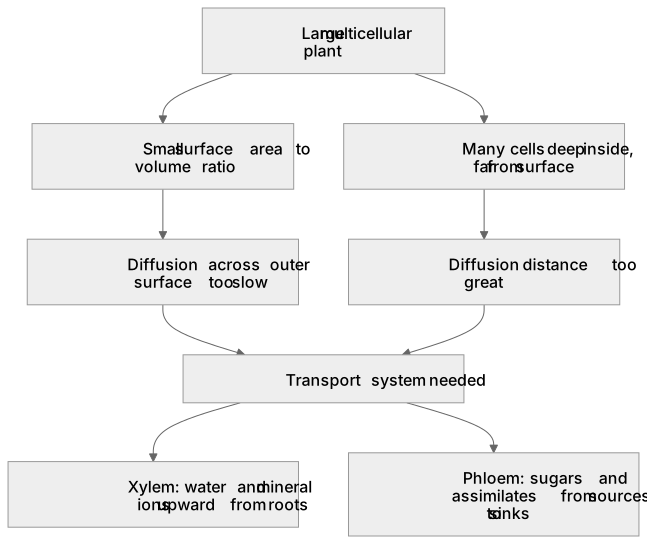
Multicellular plants are large, so their surface area to volume ratio is small. Diffusion alone across the outer surface would be too slow to supply every cell with water, mineral ions and sugars, and to remove waste. Many plant cells are also deep inside the plant, far from the surface, and have low metabolic rates but still need a steady supply. Plants therefore need transport systems: the xylem carries water and mineral ions upward from the roots, and the phloem translocates sugars and other assimilates. These systems rely on the plant's own energy and on transpiration pull and pressure flow. The need arises from size, distance and the demand for efficient distribution.
What earns the marks
- Multicellular plants have a small surface area to volume ratio, so diffusion across the surface is too slow to meet the needs of all cells.
- Many cells are deep within the plant, far from the external surface, so diffusion distance is too great.
- Plants need to transport water and mineral ions from roots to the rest of the plant.
- Plants need to transport sugars and other assimilates from sources (e.g. leaves) to sinks.
- Xylem transports water and mineral ions upward; phloem translocates sugars.
- Transport systems allow efficient distribution and removal of substances despite the plant's size.
Common mistakes and how to put them right
Thinking plants do not need transport because they are simple.
Put it right: Large multicellular plants have a small surface area to volume ratio and need transport.
Confusing xylem and phloem functions.
Put it right: Xylem carries water and mineral ions, phloem carries sugars.
Assuming diffusion is always sufficient.
Put it right: Diffusion is too slow over the distances involved in large plants.
Ignoring that many cells are deep inside the plant, increasing diffusion distance.
Exam tips
- Link the need for transport to surface area to volume ratio and diffusion distance.
- Name the substances transported and the vessels involved (xylem, phloem).
- Use the terms 'source' and 'sink' when discussing sugar transport.
- Explain why diffusion alone is insufficient rather than just stating it.
Try the lesson
The start of the Transport in plants: (a) the need for transport systems in multicellular plants lesson, made from checked teaching notes for this specification point.
Have a go first
Which feature of a large multicellular plant makes diffusion alone insufficient to supply its cells with minerals?
Listen
Multicellular plants are large, so their surface area to volume ratio is small. Diffusion alone across the outer surface would be too slow to supply every cell with water, mineral ions and sugars, and to remove waste. Many plant cells are also deep inside the plant, far from the surface, and have low metabolic rates but still need a steady supply. Plants therefore need transport systems: the xylem carries water and mineral ions upward from the roots, and the phloem translocates sugars and other assimilates. These systems rely on the plant's own energy and on transpiration pull and pressure flow. The need arises from size, distance and the demand for efficient distribution. A strong answer earns marks for these points. Multicellular plants have a small surface area to volume ratio, so diffusion across the surface is too slow to meet the needs of all cells. Many cells are deep within the plant, far from the external surface, so diffusion distance is too great. Plants need to transport water and mineral ions from roots to the rest of the plant. Plants need to transport sugars and other assimilates from sources (e.g. leaves) to sinks. Exam tip: Link the need for transport to surface area to volume ratio and diffusion distance.
See it
Key words
Say what each word means before you turn the card.
Surface area to volume ratio in plants
Try answering aloud or in your head before turning the card.
Diffusion distance and cell position
Try answering aloud or in your head before turning the card.
Xylem and phloem functions
Try answering aloud or in your head before turning the card.
Source-to-sink transport of assimilates
Try answering aloud or in your head before turning the card.
See every definition
- Surface area to volume ratio in plants
- Multicellular plants are large, so this ratio is small, meaning diffusion across the outer surface would be too slow to supply every cell.
- Diffusion distance and cell position
- Many plant cells are deep inside the plant, far from the surface, so the diffusion distance is too great.
- Xylem and phloem functions
- The xylem carries water and mineral ions upward from the roots, and the phloem translocates sugars and other assimilates.
- Source-to-sink transport of assimilates
- Sugars and other assimilates are transported from sources to sinks, allowing efficient distribution despite the plant's size.
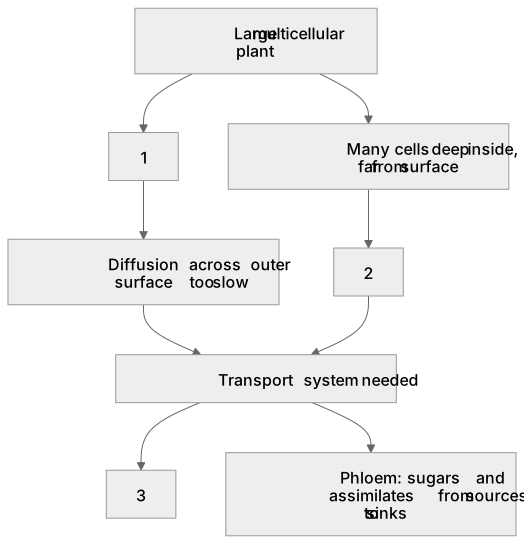
Label the diagram
Some boxes have lost their names. Pick the right name for each number.
1Box 1
2Box 2
3Box 3
There is more to this lesson
The full lesson goes on to check your understanding and help you earn the marks. Create a free account to carry on, with your progress saved.
A week of Premium from your first lesson · Then the free plan continues · No card, no charge
Test your understanding of Transport in plants: (a) the need for transport systems in multicellular plants
Active recall beats re-reading. Take an instant quiz now to test what you’ve learned and lock it into long-term memory.
A week of Premium from your first lesson · Then the free plan continues · No card, no charge