OCR · A-Level · Biology
Course version: H420 · Version from Sept 2025
Transport in plants: (f) the mechanism of translocation.
Translocation is the movement of assimilates, mainly sucrose and amino acids, through the phloem from sources to sinks.
Checked against the OCR H420 specification (opens in a new tab) on .
- Point 8 of 8
- 4 key terms
Study notes
From the checked teaching notes for this specification point.
The idea
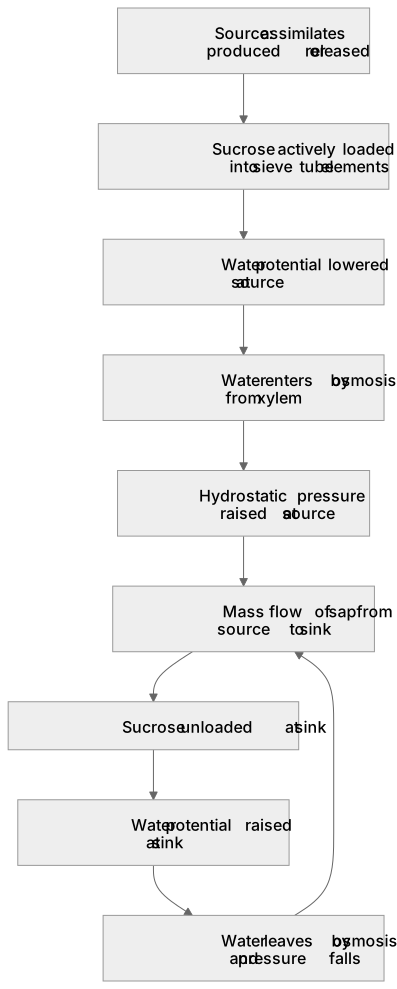
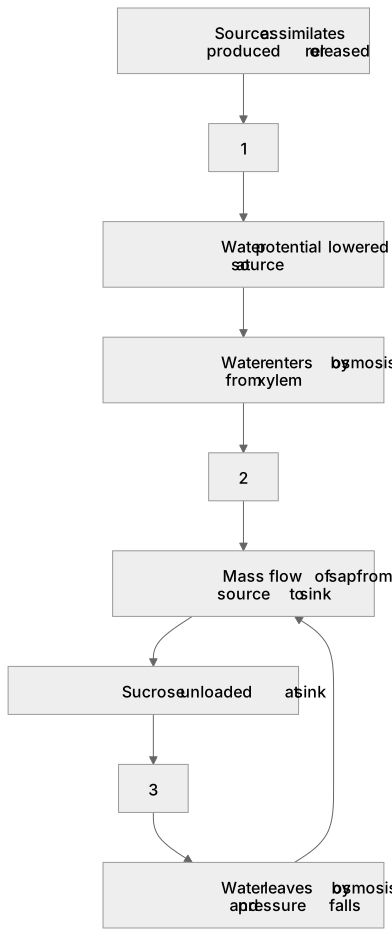
Translocation is the movement of assimilates, mainly sucrose and amino acids, through the phloem from sources to sinks. Sources are regions where assimilates are produced or released, such as photosynthesising leaves; sinks are regions where they are used or stored, such as growing roots, fruits or storage organs. The accepted mechanism is mass flow driven by a pressure gradient. At the source, sucrose is actively loaded into sieve tube elements, lowering water potential so water enters by osmosis from the xylem, raising hydrostatic pressure. At the sink, sucrose is unloaded, water leaves by osmosis and pressure falls. Sieve plates and companion cells support the flow.
What earns the marks
- Translocation moves assimilates such as sucrose and amino acids through the phloem.
- Sources are regions producing or releasing assimilates; sinks are regions using or storing them.
- Active loading of sucrose into sieve tubes at the source lowers water potential.
- Water enters sieve tubes by osmosis from the xylem, raising hydrostatic pressure at the source.
- Unloading of sucrose at the sink raises water potential, so water leaves by osmosis and pressure falls.
- The pressure gradient drives mass flow of sap from source to sink.
- Companion cells provide ATP for active loading; sieve plates allow flow between sieve tube elements.
Common mistakes and how to put them right
Confusing translocation with transpiration.
Put it right: Translocation moves assimilates in phloem, transpiration moves water in xylem.
Reversing the pressure gradient.
Put it right: Pressure is higher at the source and lower at the sink, so flow goes source to sink.
Saying sucrose moves by diffusion alone.
Put it right: The mechanism is mass flow driven by active loading and a pressure gradient.
Treating a source and sink as fixed.
Put it right: The same organ can be a source or sink depending on season and stage of growth.
Exam tips
- Identify the source and sink in the scenario before reasoning about direction of flow.
- Link each step to water potential and pressure changes rather than describing events vaguely.
- Check that any option about the phloem names assimilates, not water or mineral ions.
Try the lesson
The start of the Transport in plants: (f) the mechanism of translocation. lesson, made from checked teaching notes for this specification point.
Have a go first
In the context of translocation, what is meant by a sink?
Listen
Translocation is the movement of assimilates, mainly sucrose and amino acids, through the phloem from sources to sinks. Sources are regions where assimilates are produced or released, such as photosynthesising leaves; sinks are regions where they are used or stored, such as growing roots, fruits or storage organs. The accepted mechanism is mass flow driven by a pressure gradient. At the source, sucrose is actively loaded into sieve tube elements, lowering water potential so water enters by osmosis from the xylem, raising hydrostatic pressure. At the sink, sucrose is unloaded, water leaves by osmosis and pressure falls. Sieve plates and companion cells support the flow. A strong answer earns marks for these points. Translocation moves assimilates such as sucrose and amino acids through the phloem. Sources are regions producing or releasing assimilates; sinks are regions using or storing them. Active loading of sucrose into sieve tubes at the source lowers water potential. Water enters sieve tubes by osmosis from the xylem, raising hydrostatic pressure at the source. Exam tip: Identify the source and sink in the scenario before reasoning about direction of flow.
See it
Key words
Say what each word means before you turn the card.
Translocation
Try answering aloud or in your head before turning the card.
Sources and sinks
Try answering aloud or in your head before turning the card.
Mass flow
Try answering aloud or in your head before turning the card.
Active loading
Try answering aloud or in your head before turning the card.
See every definition
- Translocation
- The movement of assimilates, mainly sucrose and amino acids, through the phloem from sources to sinks.
- Sources and sinks
- Regions where assimilates are produced or released, and regions where they are used or stored, respectively.
- Mass flow
- The accepted mechanism of translocation, driven by a pressure gradient, moving sap from source to sink.
- Active loading
- The process at the source in which sucrose is actively loaded into sieve tube elements, lowering water potential.
Label the diagram
Some boxes have lost their names. Pick the right name for each number.
1Box 1
2Box 2
3Box 3
There is more to this lesson
The full lesson goes on to check your understanding and help you earn the marks. Create a free account to carry on, with your progress saved.
A week of Premium from your first lesson · Then the free plan continues · No card, no charge
Test your understanding of Transport in plants: (f) the mechanism of translocation.
Active recall beats re-reading. Take an instant quiz now to test what you’ve learned and lock it into long-term memory.
A week of Premium from your first lesson · Then the free plan continues · No card, no charge