OCR · A-Level · Biology
Course version: H420 · Version from Sept 2025
(iii) the dissection of stems, both longitudinally and transversely, and…
Full specification wording
Transport in plants: (iii) the dissection of stems, both longitudinally and transversely, and their examination to demonstrate the position and structure of xylem vessels
This practical requires you to cut a plant stem in two planes and use the sections to show where xylem vessels lie and how they are built.
Checked against the OCR H420 specification (opens in a new tab) on .
- Point 3 of 8
- 4 key terms
Study notes
From the checked teaching notes for this specification point.
The idea
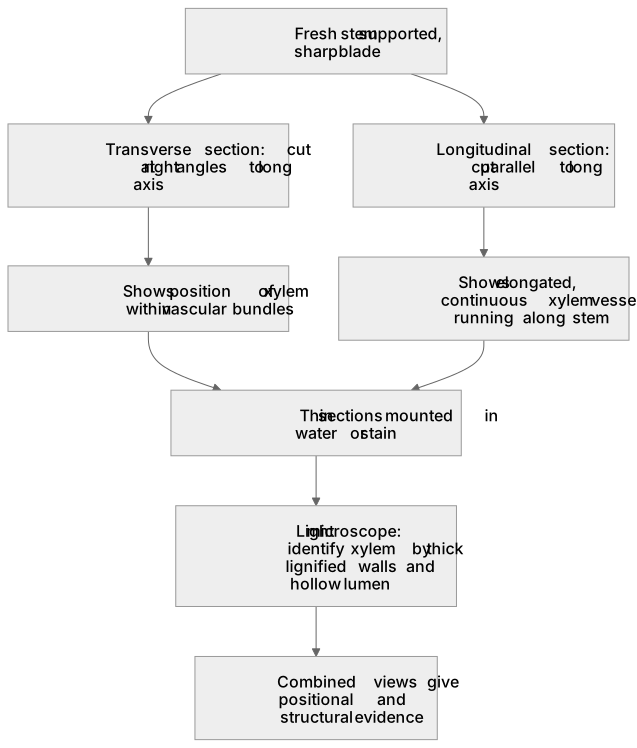
This practical requires you to cut a plant stem in two planes and use the sections to show where xylem vessels lie and how they are built. A transverse section is a cross-section cut at right angles to the stem's long axis; it reveals the ring or scattered arrangement of vascular bundles and the position of xylem within each bundle. A longitudinal section is cut parallel to the long axis, exposing elongated vessel elements running up the stem. Use a sharp blade and a fresh, supported stem, cut thin sections, and mount them in water or stain such as toluidine blue to make lignified walls visible under a light microscope. Identify xylem by thick walls, hollow lumen and position toward the inner side of each bundle. Compare the two views: the transverse section shows position and grouping, the longitudinal section shows the continuous tube-like structure.
What earns the marks
- States that a transverse section is cut at right angles to the stem's long axis and shows the position of xylem within vascular bundles.
- States that a longitudinal section is cut parallel to the stem's long axis and shows elongated, continuous xylem vessels running along the stem.
- Identifies xylem vessels by thick lignified walls and a hollow lumen, distinguishing them from phloem in the same bundle.
- Explains that thin sections mounted in water or a suitable stain are needed for clear light-microscope examination.
- Recognises that combining both planes of section gives positional and structural evidence that neither view alone provides.
Common mistakes and how to put them right
Confusing the two planes.
Put it right by linking each plane to what it reveals.
Assuming xylem lies on the outer edge of the bundle.
Put it right: Xylem is typically toward the inner side, with phloem outward; correct the position using the section image.
Treating a thick hand-cut slice as adequate.
Put it right: Thin sections are needed for transmitted light, so correct by cutting thin sections and mounting them suitably.
Exam tips
- Link each plane of section explicitly to the feature it demonstrates: position (transverse) versus continuous tube structure (longitudinal).
- Use structural identifiers for xylem — thick lignified walls and hollow lumen — rather than colour alone.
- When a question shows a section image, first orient it (which plane?) before naming tissues.
Try the lesson
The start of the Transport in plants: (iii) the dissection of stems, both longitudinally and transversely, and their examination to demonstrate the position and structure of xylem vessels lesson, made from checked teaching notes for this specification point.
Have a go first
When a herbaceous stem is cut transversely and viewed with a hand lens, which observation would help locate the xylem vessels?
Listen
This practical requires you to cut a plant stem in two planes and use the sections to show where xylem vessels lie and how they are built. A transverse section is a cross-section cut at right angles to the stem's long axis; it reveals the ring or scattered arrangement of vascular bundles and the position of xylem within each bundle. A longitudinal section is cut parallel to the long axis, exposing elongated vessel elements running up the stem. Use a sharp blade and a fresh, supported stem, cut thin sections, and mount them in water or stain such as toluidine blue to make lignified walls visible under a light microscope. Identify xylem by thick walls, hollow lumen and position toward the inner side of each bundle. Compare the two views: the transverse section shows position and grouping, the longitudinal section shows the continuous tube-like structure. A strong answer earns marks for these points. States that a transverse section is cut at right angles to the stem's long axis and shows the position of xylem within vascular bundles. States that a longitudinal section is cut parallel to the stem's long axis and shows elongated, continuous xylem vessels running along the stem. Identifies xylem vessels by thick lignified walls and a hollow lumen, distinguishing them from phloem in the same bundle. Explains that thin sections mounted in water or a suitable stain are needed for clear light-microscope examination. A common slip: Confusing the two planes: a transverse section is a cross-section at right angles to the stem axis, not a lengthwise cut. Instead, linking each plane to what it reveals. Exam tip: Link each plane of section explicitly to the feature it demonstrates: position (transverse) versus continuous tube structure (longitudinal).
See it
Key words
Say what each word means before you turn the card.
Transverse section
Try answering aloud or in your head before turning the card.
Longitudinal section
Try answering aloud or in your head before turning the card.
Xylem vessels
Try answering aloud or in your head before turning the card.
Thin sections
Try answering aloud or in your head before turning the card.
See every definition
- Transverse section
- A cross-section cut at right angles to the stem's long axis, revealing the ring or scattered arrangement of vascular bundles and the position of xylem within each bundle.
- Longitudinal section
- A cut made parallel to the long axis of the stem, exposing elongated vessel elements running up the stem.
- Xylem vessels
- Structures identified by thick lignified walls and a hollow lumen, lying toward the inner side of each bundle and distinguished from phloem in the same bundle.
- Thin sections
- Sections mounted in water or a stain such as toluidine blue so that lignified walls are visible under a light microscope.
Label the diagram
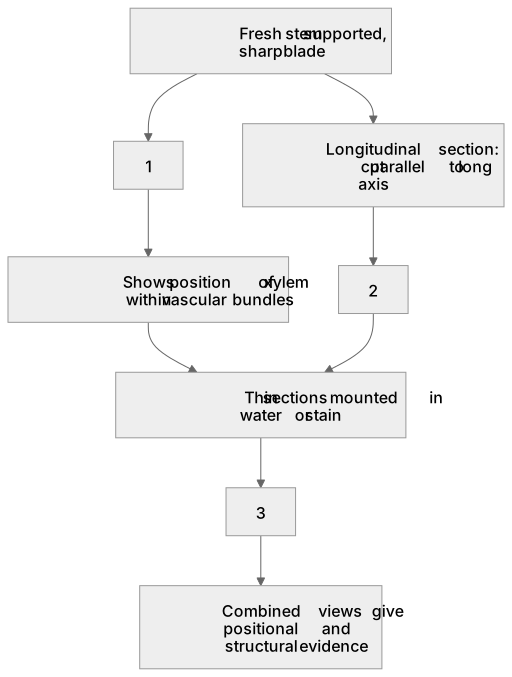
Some boxes have lost their names. Pick the right name for each number.
1Box 1
2Box 2
3Box 3
There is more to this lesson
The full lesson goes on to check your understanding and help you earn the marks. Create a free account to carry on, with your progress saved.
A week of Premium from your first lesson · Then the free plan continues · No card, no charge
Test your understanding of Transport in plants: (iii) the dissection of stems, both longitudinally and transversely, and their examination to demonstrate the position and structure of xylem vessels
Active recall beats re-reading. Take an instant quiz now to test what you’ve learned and lock it into long-term memory.
A week of Premium from your first lesson · Then the free plan continues · No card, no charge