OCR · A-Level · Biology
Course version: H420 · Version from Sept 2025
Use of apparatus and techniques: (i) plant or animal responses
This technique requires you to measure a plant or animal response using appropriate apparatus and a controlled method.
Checked against the OCR H420 specification (opens in a new tab) on .
- Point 9 of 14
- 4 key terms
Study notes
From the checked teaching notes for this specification point.
The idea
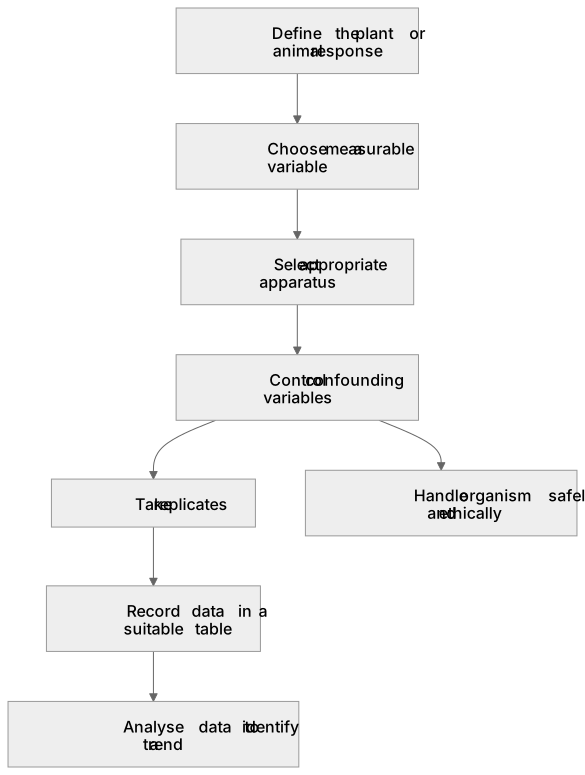
This technique requires you to measure a plant or animal response using appropriate apparatus and a controlled method. For a plant response you might measure phototropism or geotropism by recording the direction and angle of shoot or root growth over time, using a clinometer or protractor and ruler, with light or gravity as the controlled stimulus. For an animal response you might measure a reflex such as the response to a stimulus, recording reaction time with a ruler-drop or timing device, or measuring movement with a choice chamber. In both cases you must define the response, choose a measurable variable, control confounding variables such as temperature and light, take replicates, and record data in a suitable table. You should also consider the safety and ethical handling of the organism, and analyse the data to identify a trend.
What earns the marks
- Defines the plant or animal response being measured and selects a measurable variable, such as growth angle, direction of growth or reaction time.
- Selects appropriate apparatus, for example a protractor or clinometer for plant growth, or a ruler-drop or timing device for animal reaction time.
- Controls confounding variables such as temperature, light intensity or handling so the response can be attributed to the stimulus.
- Takes replicates and records data in a suitable table to allow a trend to be identified.
- Handles the organism safely and ethically during measurement.
Common mistakes and how to put them right
Measuring an unrelated variable that does not represent the response.
Put it right: Choose a variable directly linked to the response, such as growth angle for tropism.
Failing to control the stimulus or confounding variables.
Put it right: Keep light, temperature and handling constant so the response is valid.
Recording a single measurement without replicates.
Put it right: Repeat measurements to establish reliability and identify a trend.
Exam tips
- Name the specific apparatus and the variable it measures rather than saying 'use equipment'.
- State the stimulus and the controlled variables explicitly so the method is reproducible.
- Describe how data will be recorded and analysed, for example a table of angle against time.
Try the lesson
The start of the Use of apparatus and techniques: (i) plant or animal responses lesson, made from checked teaching notes for this specification point.
Have a go first
A student investigates phototropism by placing a shoot so that light comes from one side. What response is expected from the shoot?
Listen
This technique requires you to measure a plant or animal response using appropriate apparatus and a controlled method. For a plant response you might measure phototropism or geotropism by recording the direction and angle of shoot or root growth over time, using a clinometer or protractor and ruler, with light or gravity as the controlled stimulus. For an animal response you might measure a reflex such as the response to a stimulus, recording reaction time with a ruler-drop or timing device, or measuring movement with a choice chamber. In both cases you must define the response, choose a measurable variable, control confounding variables such as temperature and light, take replicates, and record data in a suitable table. You should also consider the safety and ethical handling of the organism, and analyse the data to identify a trend. A strong answer earns marks for these points. Defines the plant or animal response being measured and selects a measurable variable, such as growth angle, direction of growth or reaction time. Selects appropriate apparatus, for example a protractor or clinometer for plant growth, or a ruler-drop or timing device for animal reaction time. Controls confounding variables such as temperature, light intensity or handling so the response can be attributed to the stimulus. Takes replicates and records data in a suitable table to allow a trend to be identified. A common slip: Measuring an unrelated variable that does not represent the response. Instead, choose a variable directly linked to the response, such as growth angle for tropism. Exam tip: Name the specific apparatus and the variable it measures rather than saying 'use equipment'.
See it
Key words
Say what each word means before you turn the card.
Defining and measuring a response
Try answering aloud or in your head before turning the card.
Apparatus selection
Try answering aloud or in your head before turning the card.
Control of variables
Try answering aloud or in your head before turning the card.
Data recording and analysis
Try answering aloud or in your head before turning the card.
See every definition
- Defining and measuring a response
- Requires you to define the plant or animal response being measured and choose a measurable variable, such as growth angle, direction of growth or reaction time.
- Apparatus selection
- Selecting appropriate apparatus, for example a protractor or clinometer for plant growth, or a ruler-drop or timing device for animal reaction time.
- Control of variables
- Controlling confounding variables such as temperature, light intensity or handling so the response can be attributed to the stimulus.
- Data recording and analysis
- Taking replicates and recording data in a suitable table to allow a trend to be identified.
Label the diagram
Some boxes have lost their names. Pick the right name for each number.
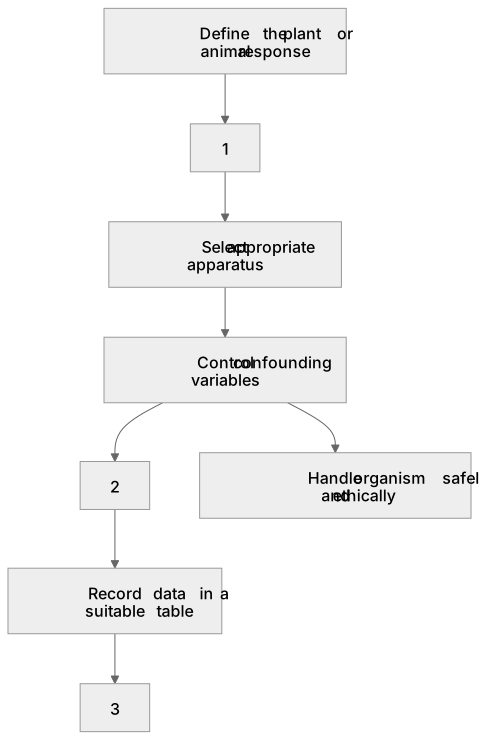
1Box 1
2Box 2
3Box 3
There is more to this lesson
The full lesson goes on to check your understanding and help you earn the marks. Create a free account to carry on, with your progress saved.
A week of Premium from your first lesson · Then the free plan continues · No card, no charge
Test your understanding of Use of apparatus and techniques: (i) plant or animal responses
Active recall beats re-reading. Take an instant quiz now to test what you’ve learned and lock it into long-term memory.
A week of Premium from your first lesson · Then the free plan continues · No card, no charge