OCR · A-Level · Biology
Course version: H420 · Version from Sept 2025
(j) safe use of instruments for dissection of an animal or plant organ
Full specification wording
Use of apparatus and techniques: (j) safe use of instruments for dissection of an animal or plant organ
This practical technique requires you to dissect an animal or plant organ while controlling biological and physical hazards.
Checked against the OCR H420 specification (opens in a new tab) on .
- Point 12 of 14
- 4 key terms
Study notes
From the checked teaching notes for this specification point.
The idea
This practical technique requires you to dissect an animal or plant organ while controlling biological and physical hazards. Before cutting, confirm the organ's identity and orientation, read the dissection instructions, and set out a clean board, the correct scalpel, scissors, forceps and mounted needle, plus eye protection where risk assessment requires it. Carry the scalpel with the blade covered and pointing down, cut away from your body and away from your fingers, and never cut towards a hand holding the specimen. Use forceps to steady tissue rather than fingers, make shallow controlled incisions, and pass instruments handle-first. Keep the workspace clear, dispose of sharps in the designated container and biological waste as your centre directs, and clean and store instruments afterwards. Safety is assessed by observing your conduct throughout, not by a written account alone.
What earns the marks
- Selects and lays out appropriate dissection instruments and personal protective equipment before starting, following the centre risk assessment.
- Handles and carries the scalpel safely, keeping the blade covered and directed away from the body and hands.
- Cuts away from fingers and the body, using forceps or a mounted needle to steady tissue rather than unprotected fingers.
- Maintains a clear, organised workspace and disposes of sharps and biological waste correctly, then cleans and stores instruments.
Common mistakes and how to put them right
Believing a written description of safe dissection is equivalent to performing it.
Put it right: The criterion is assessed by observed practical conduct, so practise the physical handling.
Cutting towards the hand that holds the specimen.
Put it right: Correct practice steadies tissue with forceps and directs the blade away from fingers and body.
Leaving a scalpel uncovered on the bench or passing it blade-first.
Put it right: Correct practice covers the blade when not in use and passes instruments handle-first.
Exam tips
- Rehearse the full sequence of setting out, cutting, clearing away and cleaning so safe habits become automatic under observation.
- State the hazard and the control together, for example a sharp blade controlled by cutting away from the body and covering the blade in transit.
- Ask your teacher to observe a practice dissection and give feedback on hand position and instrument handling before assessment.
Try the lesson
The start of the Use of apparatus and techniques: (j) safe use of instruments for dissection of an animal or plant organ lesson, made from checked teaching notes for this specification point.
Have a go first
After finishing a dissection of a fish, what is the safest way for a student to deal with the used scalpel?
Listen
This practical technique requires you to dissect an animal or plant organ while controlling biological and physical hazards. Before cutting, confirm the organ's identity and orientation, read the dissection instructions, and set out a clean board, the correct scalpel, scissors, forceps and mounted needle, plus eye protection where risk assessment requires it. Carry the scalpel with the blade covered and pointing down, cut away from your body and away from your fingers, and never cut towards a hand holding the specimen. Use forceps to steady tissue rather than fingers, make shallow controlled incisions, and pass instruments handle-first. Keep the workspace clear, dispose of sharps in the designated container and biological waste as your centre directs, and clean and store instruments afterwards. Safety is assessed by observing your conduct throughout, not by a written account alone. A strong answer earns marks for these points. Selects and lays out appropriate dissection instruments and personal protective equipment before starting, following the centre risk assessment. Handles and carries the scalpel safely, keeping the blade covered and directed away from the body and hands. Cuts away from fingers and the body, using forceps or a mounted needle to steady tissue rather than unprotected fingers. Maintains a clear, organised workspace and disposes of sharps and biological waste correctly, then cleans and stores instruments. Exam tip: Rehearse the full sequence of setting out, cutting, clearing away and cleaning so safe habits become automatic under observation.
See it
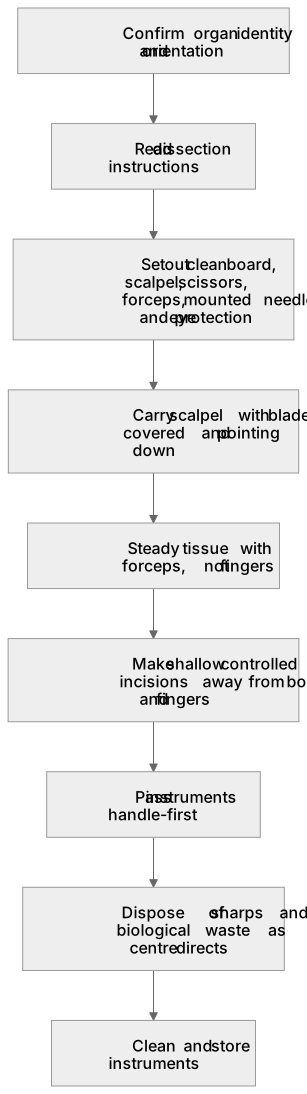
Key words
Say what each word means before you turn the card.
Risk assessment and hazard control
Try answering aloud or in your head before turning the card.
Correct selection and use of dissection instruments
Try answering aloud or in your head before turning the card.
Safe cutting technique and hand position
Try answering aloud or in your head before turning the card.
Waste disposal, cleaning and instrument storage
Try answering aloud or in your head before turning the card.
See every definition
- Risk assessment and hazard control
- Before cutting, confirm the organ's identity and orientation, read the dissection instructions, and set out a clean board, the correct instruments, plus eye protection where risk assessment requires it.
- Correct selection and use of dissection instruments
- Set out the correct scalpel, scissors, forceps and mounted needle, use forceps to steady tissue rather than fingers, and pass instruments handle-first.
- Safe cutting technique and hand position
- Carry the scalpel with the blade covered and pointing down, cut away from your body and away from your fingers, and never cut towards a hand holding the specimen.
- Waste disposal, cleaning and instrument storage
- Keep the workspace clear, dispose of sharps in the designated container and biological waste as your centre directs, and clean and store instruments afterwards.
Label the diagram
Some boxes have lost their names. Pick the right name for each number.
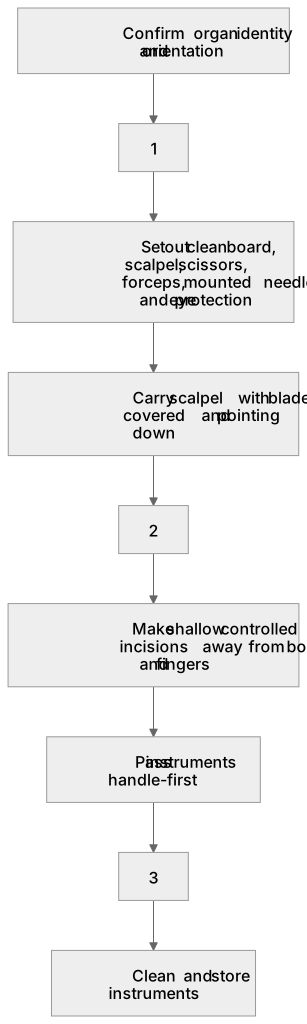
1Box 1
2Box 2
3Box 3
There is more to this lesson
The full lesson goes on to check your understanding and help you earn the marks. Create a free account to carry on, with your progress saved.
A week of Premium from your first lesson · Then the free plan continues · No card, no charge
Test your understanding of Use of apparatus and techniques: (j) safe use of instruments for dissection of an animal or plant organ
Active recall beats re-reading. Take an instant quiz now to test what you’ve learned and lock it into long-term memory.
A week of Premium from your first lesson · Then the free plan continues · No card, no charge