OCR · A-Level · Biology
Course version: H420 · Version from Sept 2025
(l) use of ICT such as computer modelling, or a data logger to collect…
Full specification wording
Use of apparatus and techniques: (l) use of ICT such as computer modelling, or a data logger to collect data, or use of software to process data.
This practical technique covers three distinct ICT uses in biology.
Checked against the OCR H420 specification (opens in a new tab) on .
- Point 14 of 14
- 3 key terms
Study notes
From the checked teaching notes for this specification point.
The idea
This practical technique covers three distinct ICT uses in biology. First, computer modelling: building a simulation of a biological system, such as a predator–prey model or a diffusion model, then changing variables to predict outcomes that would be slow or unsafe to test directly. Second, data logging: connecting sensors, for example a temperature probe or a pH electrode, to a logger that records readings at set intervals, giving continuous, objective data with fewer human reading errors. Third, software processing: entering raw readings into a spreadsheet or statistics package to calculate means, plot graphs and run tests. For each use, identify the purpose, the variable controlled or measured, and one limitation, such as a model's assumptions or a sensor's calibration drift.
What earns the marks
- Computer modelling simulates a biological system so variables can be changed and predictions made without carrying out the real experiment.
- A model is only as reliable as its assumptions, so predictions must be checked against real data.
- A data logger uses sensors to record readings automatically at set time intervals, giving continuous data and reducing human error.
- Software processing covers calculating means, drawing graphs and running statistical tests on raw data.
- Choosing the correct ICT tool depends on whether the aim is prediction (modelling), continuous measurement (logging) or analysis (software).
Common mistakes and how to put them right
Thinking a computer model proves what will happen in a real organism.
Put it right: A model predicts, and its output must be validated against real measurements.
Believing a data logger removes the need for careful sensor placement or calibration.
Put it right: Logging reduces reading error but poor setup still gives invalid data.
Assuming software processing means the software decides the conclusion.
Put it right: The student must interpret the processed output biologically.
Exam tips
- Match the ICT tool to the purpose stated in the question: prediction, continuous measurement or data analysis.
- When describing a data logger, name the sensor and the interval of recording.
- State one limitation of the chosen ICT use, such as model assumptions or sensor drift, to gain credit.
Try the lesson
The start of the Use of apparatus and techniques: (l) use of ICT such as computer modelling, or a data logger to collect data, or use of software to process data. lesson, made from checked teaching notes for this specification point.
Have a go first
A student wants a continuous electronic record of how the temperature of a water bath changes over two hours. Which use of ICT is most suitable for this purpose?
Listen
This practical technique covers three distinct ICT uses in biology. First, computer modelling: building a simulation of a biological system, such as a predator–prey model or a diffusion model, then changing variables to predict outcomes that would be slow or unsafe to test directly. Second, data logging: connecting sensors, for example a temperature probe or a pH electrode, to a logger that records readings at set intervals, giving continuous, objective data with fewer human reading errors. Third, software processing: entering raw readings into a spreadsheet or statistics package to calculate means, plot graphs and run tests. For each use, identify the purpose, the variable controlled or measured, and one limitation, such as a model's assumptions or a sensor's calibration drift. A strong answer earns marks for these points. Computer modelling simulates a biological system so variables can be changed and predictions made without carrying out the real experiment. A model is only as reliable as its assumptions, so predictions must be checked against real data. A data logger uses sensors to record readings automatically at set time intervals, giving continuous data and reducing human error. Software processing covers calculating means, drawing graphs and running statistical tests on raw data. A common slip: Thinking a computer model proves what will happen in a real organism. Instead, a model predicts, and its output must be validated against real measurements. Exam tip: Match the ICT tool to the purpose stated in the question: prediction, continuous measurement or data analysis.
See it
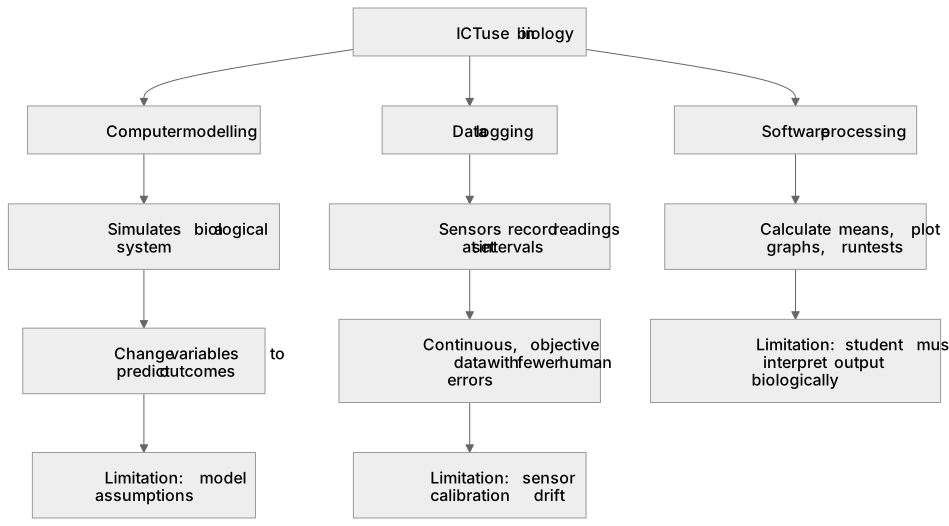
Key words
Say what each word means before you turn the card.
Computer modelling
Try answering aloud or in your head before turning the card.
Data logger
Try answering aloud or in your head before turning the card.
Software processing
Try answering aloud or in your head before turning the card.
See every definition
- Computer modelling
- Building a simulation of a biological system, then changing variables to predict outcomes that would be slow or unsafe to test directly.
- Data logger
- Uses sensors to record readings automatically at set time intervals, giving continuous data and reducing human error.
- Software processing
- Entering raw readings into a spreadsheet or statistics package to calculate means, plot graphs and run tests.
Label the diagram
Some boxes have lost their names. Pick the right name for each number.
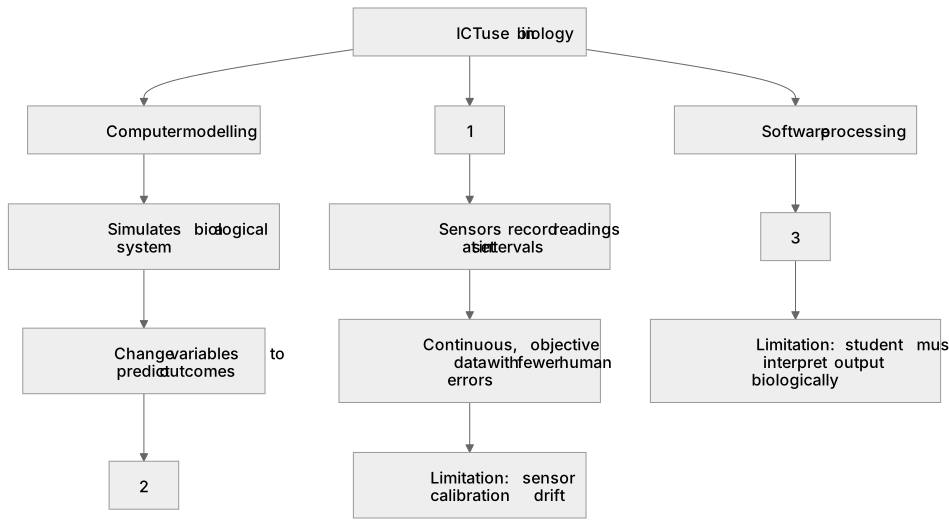
1Box 1
2Box 2
3Box 3
There is more to this lesson
The full lesson goes on to check your understanding and help you earn the marks. Create a free account to carry on, with your progress saved.
A week of Premium from your first lesson · Then the free plan continues · No card, no charge
Test your understanding of Use of apparatus and techniques: (l) use of ICT such as computer modelling, or a data logger to collect data, or use of software to process data.
Active recall beats re-reading. Take an instant quiz now to test what you’ve learned and lock it into long-term memory.
A week of Premium from your first lesson · Then the free plan continues · No card, no charge