
Study Notes
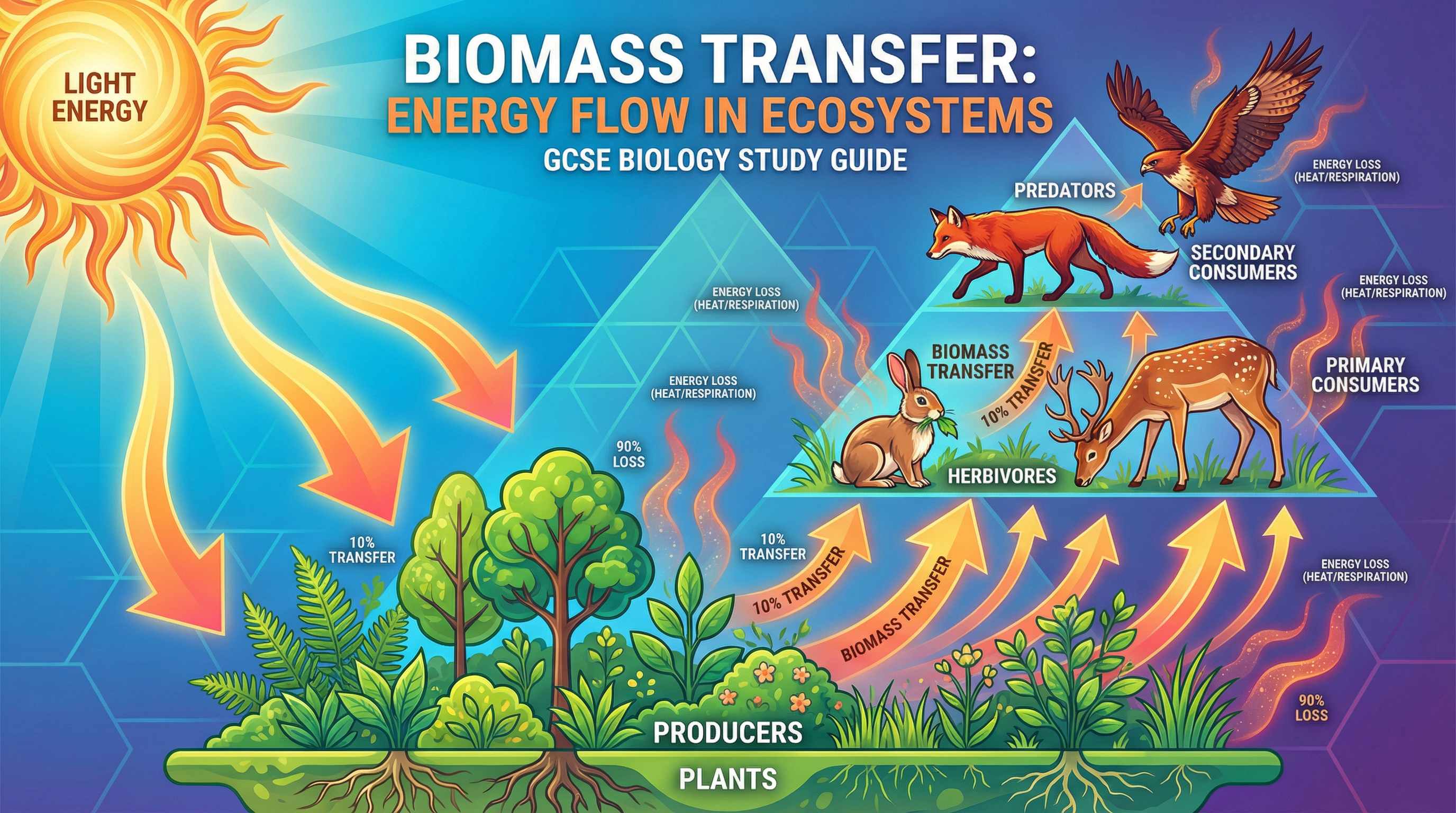
Overview
Welcome to your comprehensive guide to Biomass Transfer, a fundamental topic in OCR GCSE Biology (specification point 7.7). This topic explores the flow of energy and biological material through ecosystems, a concept that underpins much of our understanding of the natural world. In your exam, you'll be expected to not only explain why biomass is lost at each stage of a food chain but also to calculate the efficiency of this transfer. Mastering this topic is key to unlocking higher-tier marks, as it frequently appears in structured questions that combine data analysis (AO2) with application of knowledge (AO3). This guide will equip you with the precise language, calculation skills, and exam techniques needed to confidently tackle any question an examiner throws at you.
Key Concepts
Concept 1: What is Biomass?
In the context of your GCSE, biomass is defined as the total dry mass of all the living organisms in a specific area or at a specific trophic level. The term 'dry mass' is critical and is worth a mark on its own. It refers to the mass of an organism after all its water has been removed, typically by heating it in an oven at a low temperature until a constant mass is reached.
**Why is 'dry mass' so important?**The water content of an organism is highly variable. For example, a jellyfish is about 95% water, while a human is about 60% water. Even in a single organism, water content can fluctuate throughout the day. By using dry mass, scientists can make fair and accurate comparisons of the amount of biological material at different trophic levels, as it represents the stored chemical energy.
Example:
Imagine you have 100g of fresh lettuce and 100g of fresh steak. The lettuce has a much higher water content. If you were to dry both out, the steak would have a significantly higher dry mass because it contains more proteins and fats (stored energy). This is why we use dry mass to measure biomass.
Concept 2: Trophic Levels and Energy Flow
A trophic level is the position an organism occupies in a food chain.
- Trophic Level 1: Producers - These are organisms that produce their own food, usually through photosynthesis (e.g., plants, algae). They convert light energy into chemical energy stored in organic molecules.
- Trophic Level 2: Primary Consumers - Herbivores that feed on producers (e.g., rabbits, caterpillars).
- Trophic Level 3: Secondary Consumers - Carnivores that feed on primary consumers (e.g., foxes, birds).
- Trophic Level 4: Tertiary Consumers - Carnivores that feed on secondary consumers (e.g., eagles, sharks).
Energy flows from one trophic level to the next when an organism is eaten. However, this transfer is very inefficient.
Concept 3: The Inefficiency of Biomass Transfer
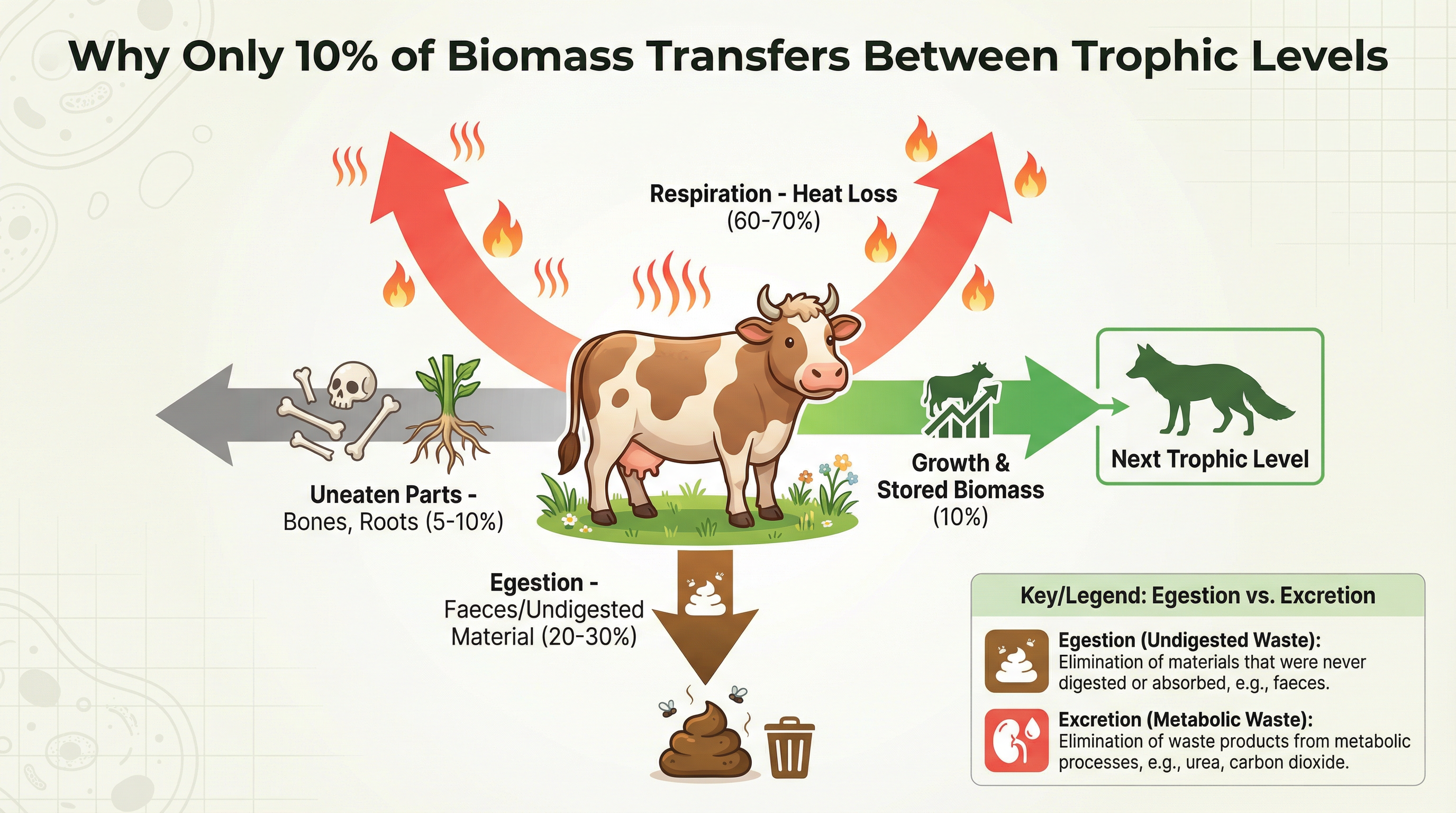
Only about 10% of the biomass from one trophic level is converted into biomass at the next level. The remaining 90% is lost. This is a crucial figure to remember and understand. The reasons for this loss can be split into three main categories that you must be able to explain in an exam.
-
Respiration (Heat Loss): Organisms use a large proportion of the energy they consume for metabolic processes like respiration. This energy is used for movement, keeping warm (in mammals and birds), and other life processes. A significant amount of this energy is lost to the surroundings as heat. This is the largest source of energy loss, often accounting for 60-70% of the energy consumed.
-
Egestion (Undigested Waste): Not all parts of an organism are digestible. For example, herbivores cannot digest cellulose in plant cell walls, and carnivores may not digest bones or fur. This undigested material is passed out as faeces (egestion). It is vital not to confuse this with excretion. Egestion is the removal of undigested waste, whereas excretion is the removal of metabolic waste products like urea and carbon dioxide.
-
Incomplete Consumption (Uneaten Parts): Not all of an organism is eaten by the next trophic level. For instance, the roots of a plant or the skeleton of an animal are often left behind. This uneaten biomass is then available to decomposers.
This massive loss of biomass at each trophic level explains why food chains are rarely longer than 4 or 5 levels. There is simply not enough biomass remaining to support a higher trophic level.
Mathematical/Scientific Relationships
Calculating the Efficiency of Biomass Transfer
This is a common exam question and a skill you must master. The formula is:
Efficiency = (Biomass at the higher trophic level / Biomass at the lower trophic level) x 100
- This formula is not given on the formula sheet, so you must memorise it.
- The answer is usually given as a percentage.
- Crucial Tip: The efficiency will always be less than 100%. If you get a value greater than 100, you have divided the numbers the wrong way around!
Example Calculation:
In a woodland ecosystem, the total biomass of producers is 25,000 kg. The biomass of the primary consumers is 2,000 kg. Calculate the efficiency of biomass transfer between the producers and primary consumers.
- Step 1: Identify the biomass at the higher and lower trophic levels.
- Higher level (Primary Consumers) = 2,000 kg
- Lower level (Producers) = 25,000 kg
- Step 2: Substitute the values into the formula.
- Efficiency = (2,000 / 25,000) x 100
- Step 3: Calculate the result.
- Efficiency = 0.08 x 100 = 8%
Pyramids of Biomass
Pyramids of biomass are a way of representing the amount of biomass at each trophic level in an ecosystem. They are drawn to scale, with the producers at the bottom. Each successive bar is narrower to represent the loss of biomass.
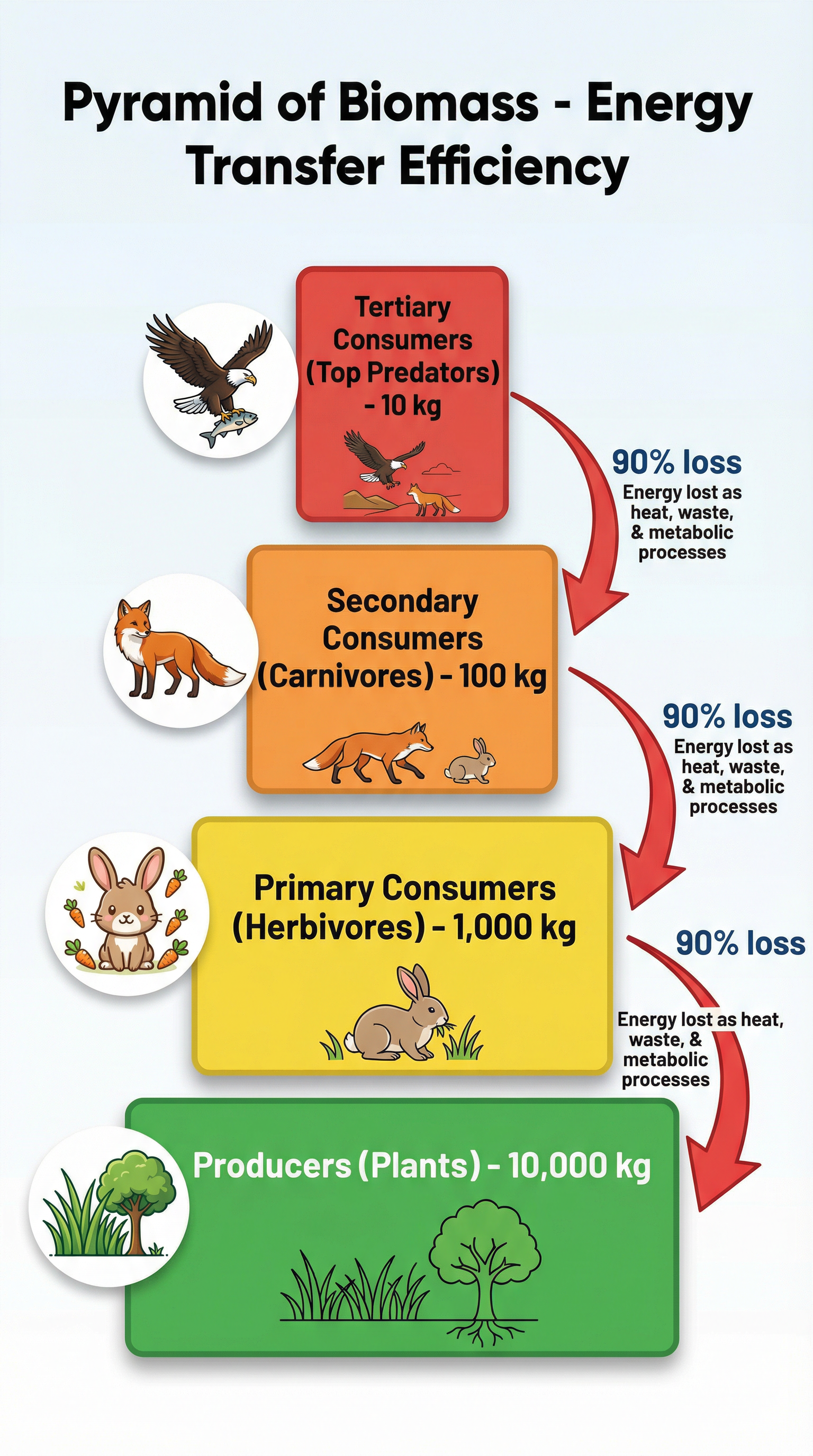
How to draw a pyramid of biomass:
- Use a ruler and draw a horizontal bar for the producers.
- The length or area of the bar should be proportional to the biomass.
- Draw the bar for the primary consumers on top, centred, and proportionally smaller.
- Continue for each trophic level.
- Label each level clearly with the name of the trophic level and the amount of biomass.
Practical Applications
Understanding biomass transfer is crucial for managing food production and ecosystems sustainably. For example, it explains why it is more efficient for humans to eat plants than to eat animals that have eaten plants. The food chain is shorter, so less energy and biomass are lost.
Required Practical: Measuring BiomassAlthough there isn't a specific required practical on biomass transfer, the principles are tested through data analysis. To measure the biomass of a plant sample in the lab, you would:
- Apparatus: Sample of plant material (e.g., grass), drying oven, balance.
- Method:
a. Gently wash the soil from the roots of the plant sample.
b. Pat the sample dry and measure its mass.
c. Place the sample in a drying oven at a low temperature (e.g., 60°C) to evaporate the water without burning the sample.
d. After a set time (e.g., 24 hours), remove the sample, allow it to cool, and measure its mass.
e. Repeat step d until the mass no longer changes. This is the dry mass or biomass. - Common Errors: Heating the oven to too high a temperature, causing the sample to burn and lose mass as carbon dioxide, leading to an inaccurate result.