Eduqas · GCSE · Biology
Biodiversity
Biodiversity is the variety of all living things, and it's essential for stable ecosystems. This topic covers how we measure it, the human activities that threaten it, and how we can protect it for the future.
- 5 min read
- 3 worked examples
- 5 practice questions
- 6 key terms
Study Notes
Overview
Welcome to Topic 6.3: Biodiversity. This topic is fundamental to Biology because it explores the intricate web of life on Earth and our place within it. Biodiversity is not just a buzzword; it is a measurable, scientific indicator of ecosystem health. You will learn how to quantify the abundance and distribution of species using practical techniques like quadrats and transects. You will also examine the profound impacts—both positive and negative—that human activities have on global ecosystems.
This topic connects synoptically with food webs, the carbon cycle, and evolution. Examiners frequently test your ability to evaluate data on human impact and to apply sampling methodologies to novel contexts. Mastering this topic requires precision in definitions and a clear understanding of the 'why' behind conservation efforts.
Listen to our deep-dive podcast episode below to reinforce your understanding:
Key Concepts
Concept 1: Defining and Measuring Biodiversity
Biodiversity is strictly defined as the variety and number of different species in an area. It is a measure of the biological richness of an ecosystem. High biodiversity ensures ecosystem stability because it reduces the dependence of one species on another for food and shelter.
To measure biodiversity, ecologists use specific sampling techniques. Because it is usually impossible to count every single organism in a habitat, we take representative samples.
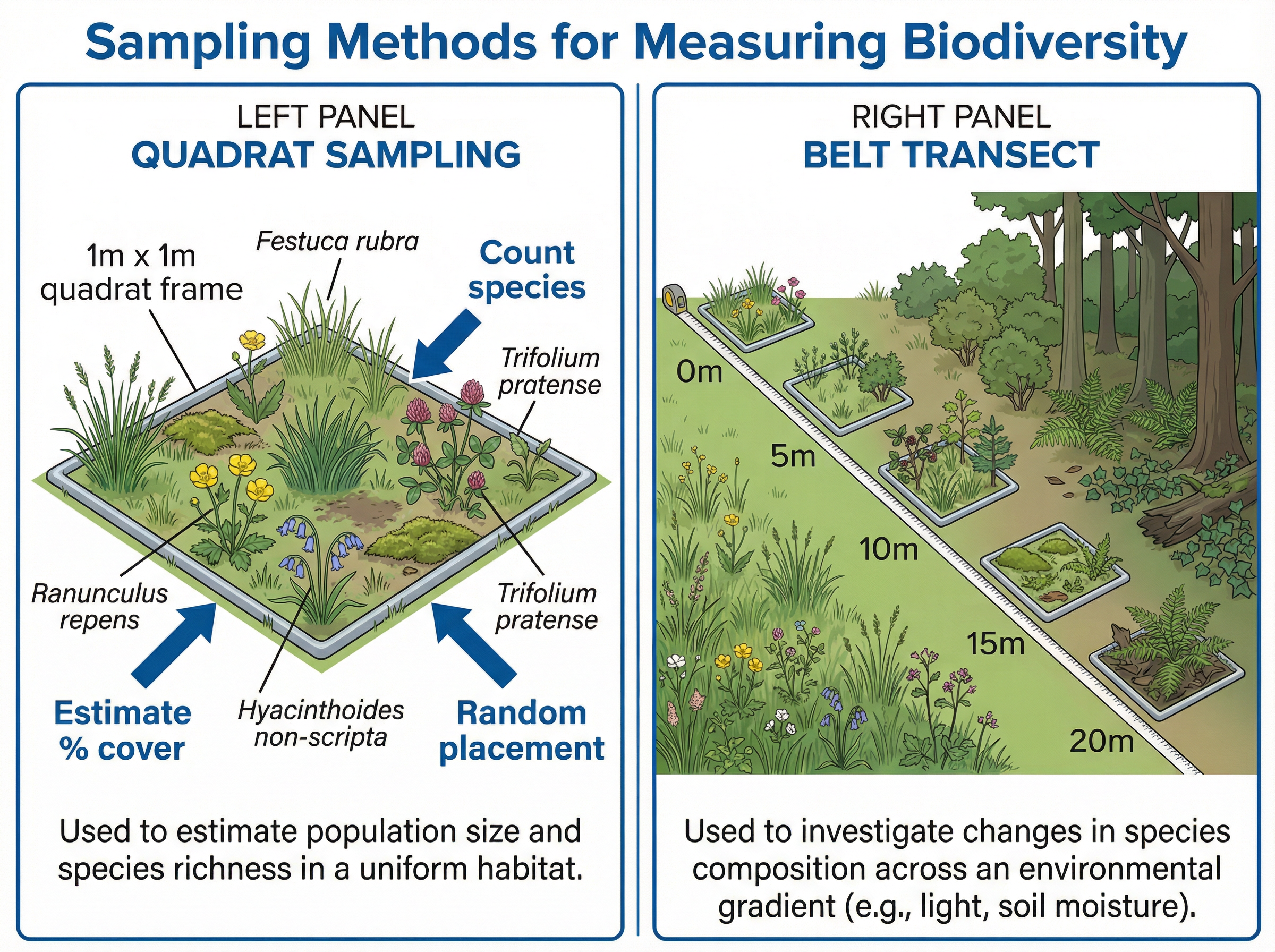
Quadrats are used to measure the abundance (number) of species in a relatively uniform area. A quadrat is typically a 1m x 1m square frame. It must be placed randomly (e.g., using a random number generator for coordinates) to avoid bias. You count the number of species or estimate percentage cover within the quadrat.
Transects are used to measure how the distribution of species changes across an environmental gradient (like moving from a shaded woodland into an open field). A tape measure is laid out, and quadrats are placed at regular intervals along the line.
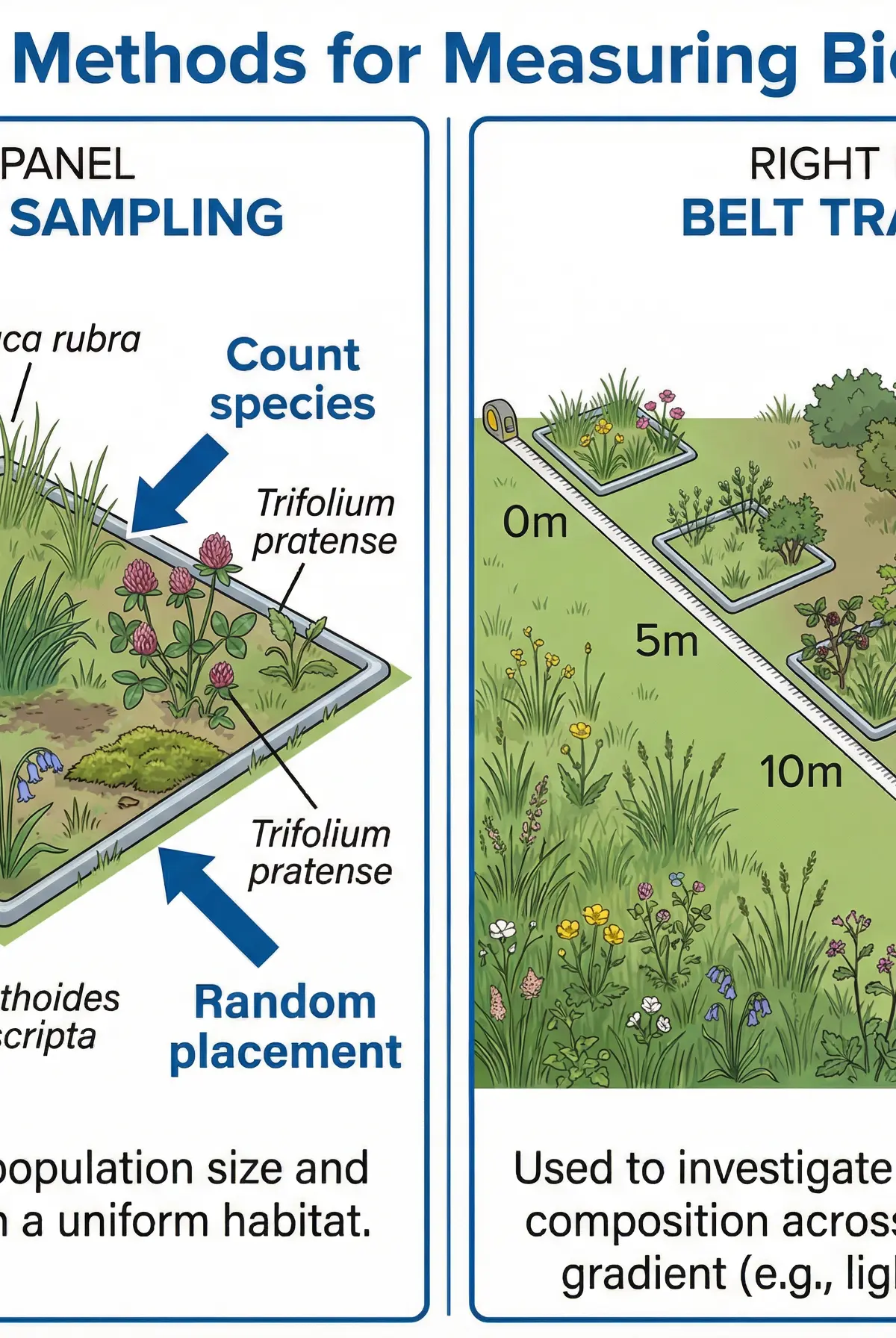
Example: If a student wants to know how many daisies are in a field, they use quadrats. If they want to know how daisy numbers change as you move away from a tree, they use a transect.
Concept 2: Estimating Animal Populations (Capture-Recapture)
While quadrats work well for plants and slow-moving animals, fast-moving animals require a different approach. The capture-recapture method is used to estimate population sizes of mobile species.
A sample of the population is captured, marked in a harmless way, and released. After giving them time to mix back into the population, a second sample is captured. By counting how many marked individuals are in the second sample, we can estimate the total population size.
Concept 3: Indicator Species
Indicator species are organisms whose presence, absence, or abundance provides information about the environmental conditions of an area, particularly regarding pollution.
- Air Pollution: Lichens are highly sensitive to sulfur dioxide. A high diversity of lichen species indicates clean air.
- Water Pollution: Invertebrates like stonefly larvae and freshwater shrimps require high oxygen levels, indicating clean water. Conversely, rat-tailed maggots and sludge worms tolerate low oxygen and indicate polluted water.
Concept 4: Human Impacts on Biodiversity
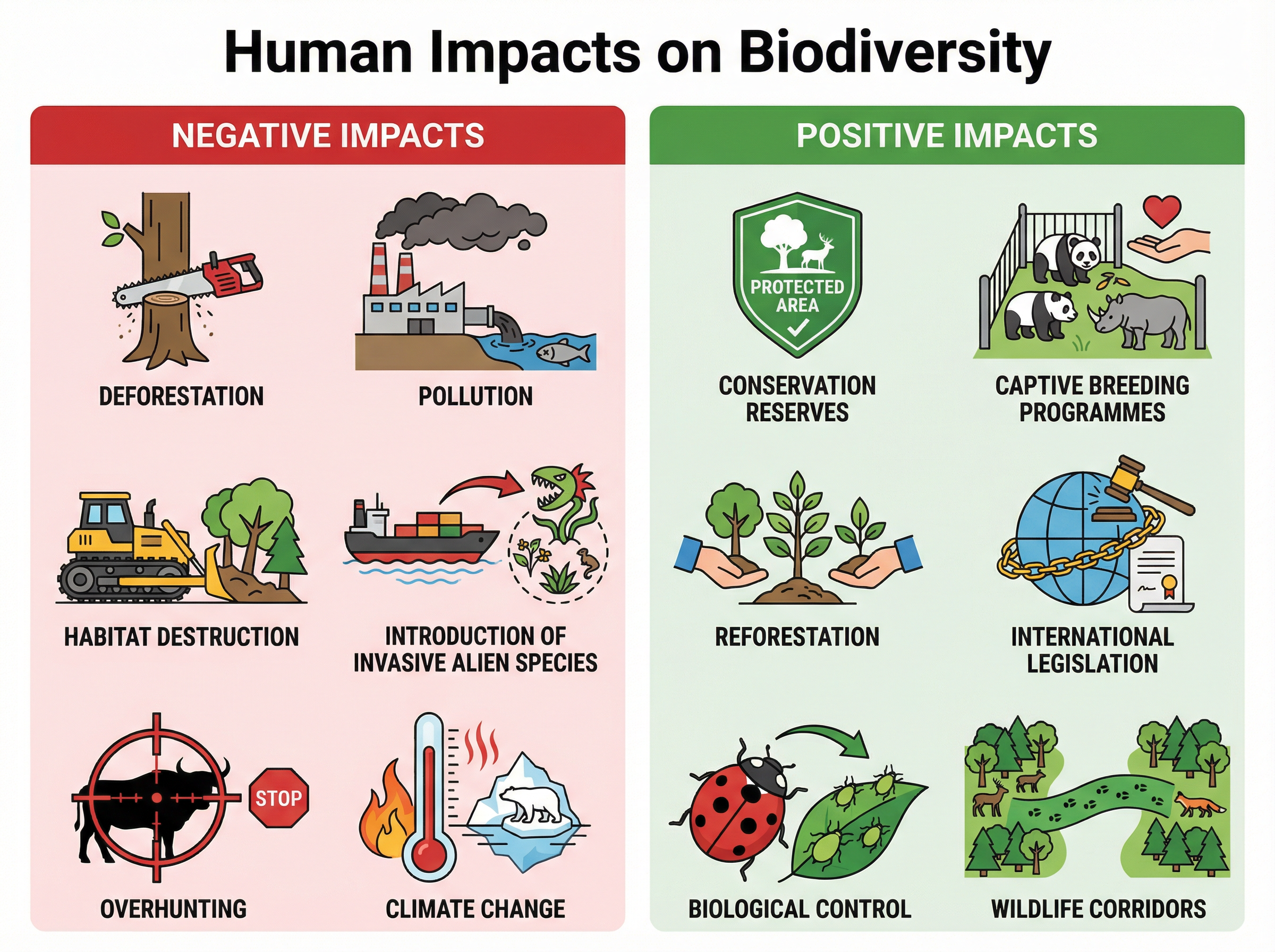
Human activities have significantly altered the global environment. Examiners expect you to evaluate both negative and positive impacts.
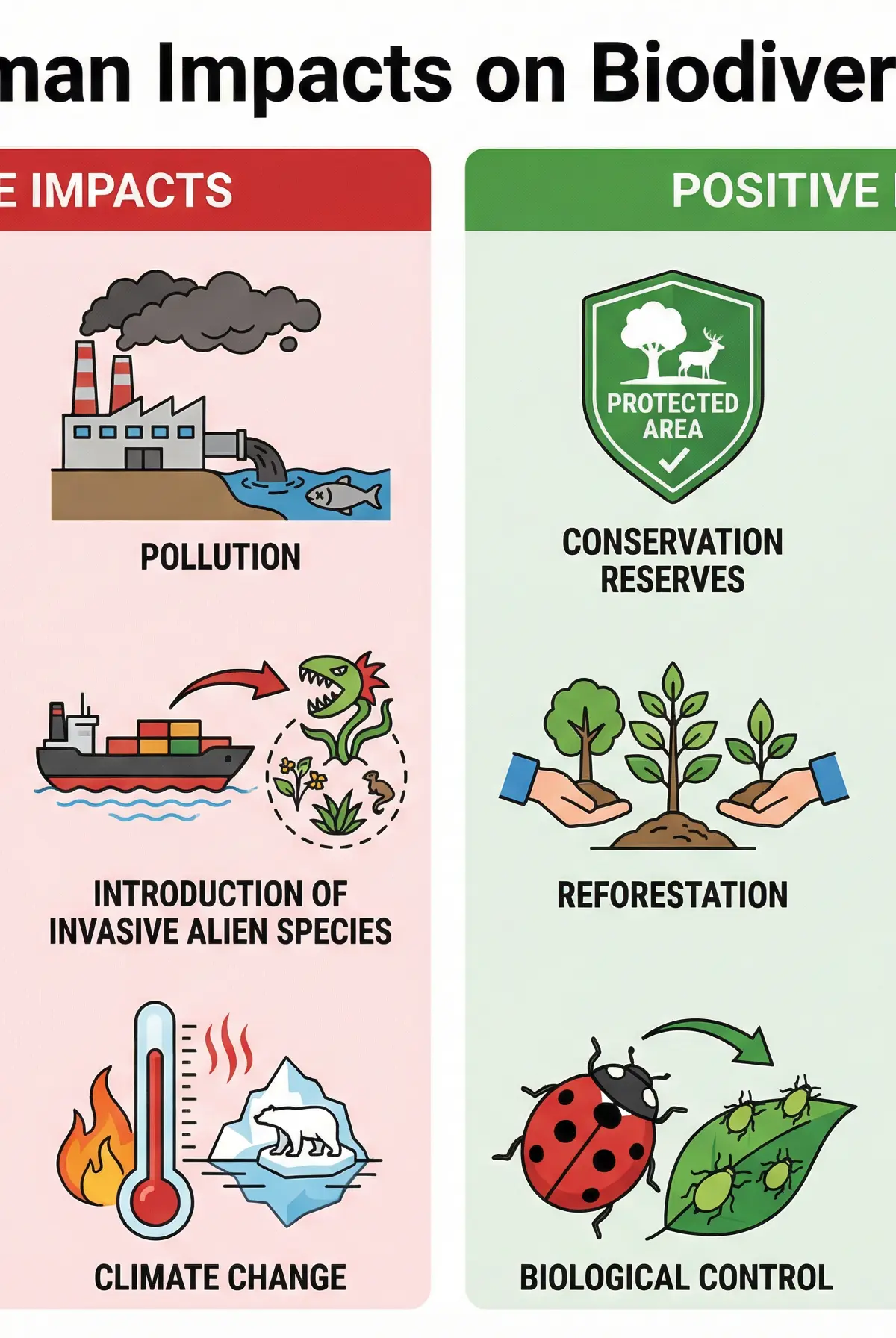
Negative Impacts:
- Deforestation: Clearing forests destroys habitats, leading to a loss of species and contributing to climate change.
- Pollution: Pesticides and industrial waste poison food webs. Eutrophication from agricultural runoff depletes oxygen in aquatic ecosystems.
- Invasive Species: Introducing non-native species can devastate local populations through competition or predation (e.g., the grey squirrel displacing the red squirrel in the UK).
Positive Impacts:
- Conservation: Establishing protected nature reserves prevents habitat destruction.
- Captive Breeding: Zoos and wildlife parks breed endangered species to prevent extinction and reintroduce them to the wild.
- Legislation: International treaties (like CITES) restrict the trade of endangered species and their products.
Mathematical/Scientific Relationships
Capture-Recapture FormulaTo estimate population size:
Estimated Population = (First Sample Size × Second Sample Size) / Number of Marked Individuals in Second Sample
Note: This formula is usually NOT given on the formula sheet. You must memorise it.
Practical Applications
Required Practical: Investigating Population SizeYou must be able to describe how to use quadrats to estimate the population size of a plant species in a habitat.
- Lay out two tape measures at right angles to form a grid.
- Use a random number generator to obtain coordinates.
- Place the quadrat at the coordinates and count the number of target plants.
- Repeat this at least 10 times for a representative sample.
- Calculate the mean number of plants per quadrat.
- Multiply the mean by the total area of the habitat to estimate the total population.
Visual Resources
2 diagrams and illustrations
Interactive Diagrams
2 interactive diagrams to visualise key concepts
Conceptual Flow Outline
The process of Eutrophication
Conceptual Flow Outline
The Capture-Recapture Method
Worked Examples
3 worked examples — open one to explore the question and available guidance.
Practice Questions
Test your understanding — click to reveal model answers
A scientist wants to estimate the number of buttercups in a large, flat field. Describe the method they should use. [4 marks]
Hint: Think about which sampling tool is best for a uniform area, and how to avoid bias.
Explain why high biodiversity is important for the stability of an ecosystem. [3 marks]
Hint: Think about food webs and what happens if one species is removed.
A river is tested for pollution. Scientists find rat-tailed maggots but no stonefly larvae. What does this indicate about the water quality? Explain your answer. [3 marks]
Hint: Recall what conditions these specific indicator species require.
Calculate the estimated population of a species of snail if 30 were caught and marked in the first sample, and 40 were caught in the second sample, of which 5 were marked. [2 marks]
Hint: Use the formula: (First × Second) / Marked.
Give two reasons why a large sample size is needed when using quadrats. [2 marks]
Hint: Think about reliability and the nature of biological environments.